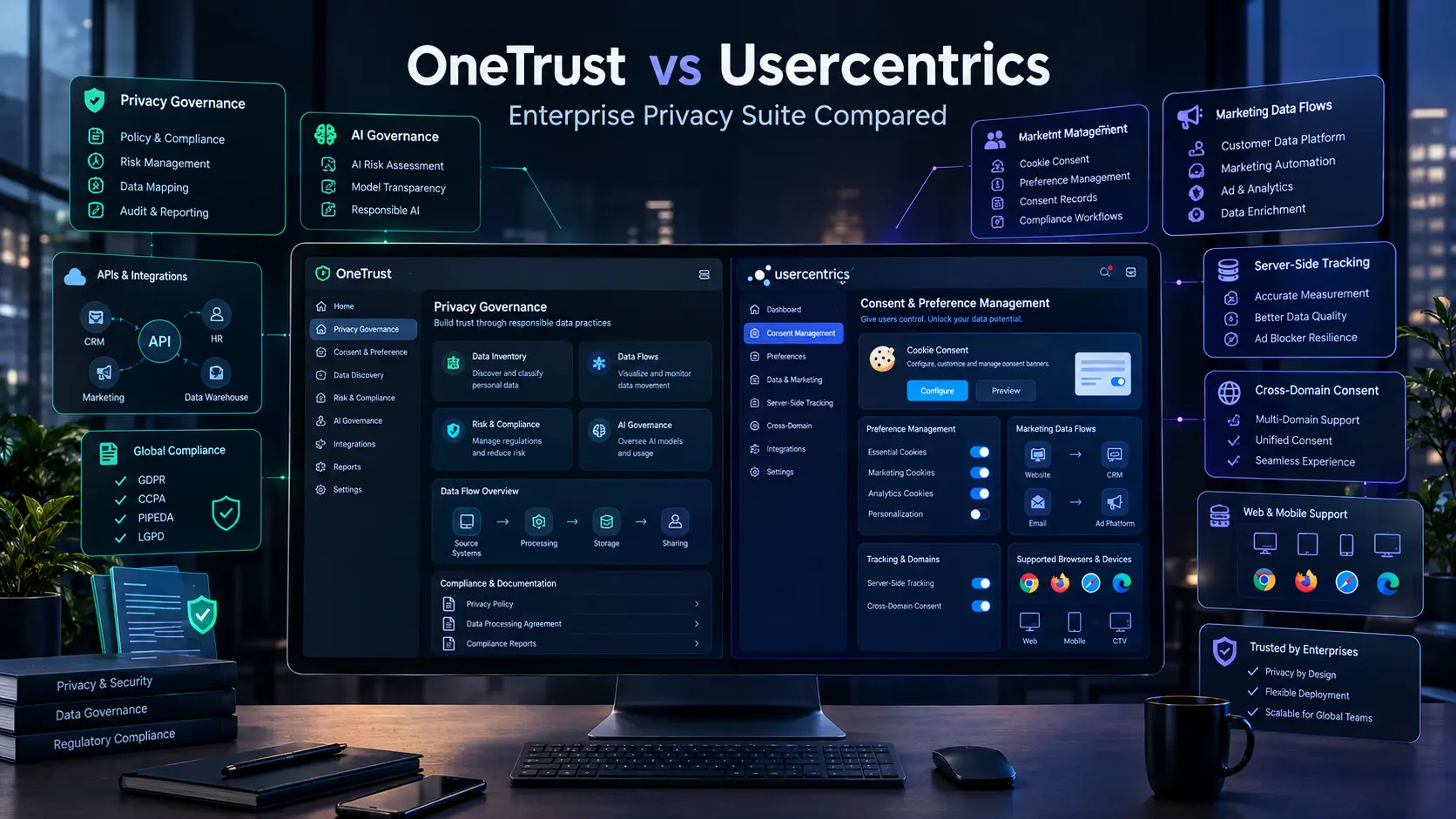
The key difference in OneTrust vs Usercentrics is no longer the cookie banner. Both support large, multi-site consent programs. The harder question is what happens after consent. OneTrust connects consent to a wider privacy, preference, and governance system, while Usercentrics focuses strongly on consent, preference management, marketing data flows, and emerging AI workflows. That makes the broader operating model important when choosing an enterprise CMP in 2026.
The overlooked question: where does consent go next?
A consent record has limited value if it stays inside a banner tool. Under GDPR, organizations must be able to demonstrate consent when they rely on it as a legal basis, and people must be able to withdraw consent as easily as they gave it. This makes the path from a visitor’s choice to tags, analytics, apps, marketing platforms, and internal records a practical test of a privacy compliance platform.
OneTrust’s current CMP supports consent experiences across websites, mobile apps, and connected TV. Its current platform also uses a database of more than 45 million categorized cookies and provides APIs for collecting and enforcing consent across digital experiences. OneTrust’s current CMP pricing model is based on average daily visitors across channels and properties.
Usercentrics has a more consent-focused architecture, but its enterprise offering also covers centralized configuration, cross-domain consent sharing, multi-brand management, roles, analytics, and server-side tracking. The company reports 2.4 million websites and apps across 195 countries and 8.8 billion monthly consents. These are company-reported figures and should be treated as scale indicators rather than independently audited measurements.
OneTrust vs Usercentrics for large consent estates
OneTrust goes beyond cookie consent management by integrating consent with a wider privacy and data-governance framework. Its product suite includes Consent Management Platform, Universal Consent & Preference Management, Privacy Automation, Third-Party Risk Management, and AI Governance. The CMP also supports consent management across websites, mobile apps, and connected TV (CTV) platforms. OneTrust’s broader approach is increasingly focused on what happens after someone makes a choice.
In a September 2026 article, OneTrust describes consent and preferences as signals that can affect first-party data eligibility, campaign execution, customer journeys, and AI use. Its Universal Consent & Preference Management solution syncs consent and preference data with downstream platforms such as Salesforce, Marketo, Snowflake, and Adobe.
Usercentrics CMP
Usercentrics focuses heavily on consent operations and the marketing data that follows. Its enterprise product supports multi-brand and multi-region management, cross-domain consent sharing, roles, analytics, and server-side tagging.
A particularly important 2026 update is its Cross-Domain Consent Sharing (CDCS) documentation, updated August 26, 2026. CDCS allows Usercentrics CMP to share a visitor’s consent choice between participating websites and subdomains on the same root domain. However, enterprises should not assume that cross-domain consent works across every browser and domain structure.
Usercentrics currently documents browser limitations for CDCS. Safari is not supported, while Firefox settings can affect local-storage behavior. On iOS, WebKit restrictions can also affect implementation. Chrome restrictions prevent the standard CDCS implementation between different root domains such as a.com and b.com. Sharing between a root domain and its subdomains is the supported scenario. For a company operating several independent domains, this is an important implementation detail to test before deployment.
OneTrust CMP API performance
The API layer becomes important when consent needs to reach systems outside the CMP interface. OneTrust’s current developer documentation publishes specific CMP API service-level objectives. Its Extensible SDK APIs target 99% availability, P95 latency below 500 milliseconds, and P99 latency below one second. OneTrust also reports that consent receipts are available for downstream integrations in less than five seconds 99% of the time.
The documentation also states that configuration changes are reflected in relevant API responses within up to 10 minutes 99% of the time, while new consent data can become available for cross-device synchronization within up to 30 seconds 99% of the time.
These are published service-level objectives, not a guarantee that every customer implementation will achieve identical real-world performance. Network conditions, architecture, integrations, and API usage can affect results. Still, these figures give enterprise engineering teams something more concrete to evaluate than a generic claim about “fast integrations.”
The 2026 development that changes the comparison
Usercentrics acquired MCP Manager on January 14, 2026. Usercentrics said the acquisition extends its privacy approach into AI-driven workflows by adding consent and data guardrails for systems using the Model Context Protocol. It is more accurate to describe this as an expansion of Usercentrics’ consent and trust approach into AI workflows rather than simply calling MCP Manager a conventional AI governance product.
The development matters because customer data increasingly moves beyond websites and apps into AI agents and connected business systems. That creates new questions around what information an AI workflow can access and which permissions should apply. OneTrust is also expanding its governance scope. Its current platform includes AI Governance capabilities alongside privacy, data, consent, and third-party risk management.
GDPR compliance: the tool cannot fix weak consent design
Neither OneTrust CMP nor Usercentrics CMP makes a website automatically GDPR compliant. The EU General Data Protection Regulation requires organizations to demonstrate consent when consent is the legal basis for processing. The European Data Protection Board’s consent guidelines also explain requirements around informed, specific, and freely given consent.
An enterprise review should ask:
- Do non-essential tags stay blocked before consent?
- Can users change or withdraw choices easily?
- Are records connected to the correct purpose and consent version?
- Does consent sharing work across the organization’s actual browsers and domains?
- Can privacy teams export evidence when needed?
- Can consent signals reach analytics, advertising, CRM, and other downstream systems?
A cookie consent management platform supports these processes, but the organization remains responsible for configuration, legal basis, transparency, and implementation. For a broader look at how CMPs work, the OneTrust CMP guide explains how consent platforms collect, document, and synchronize user choices.
OneTrust vs Usercentrics: key differences
| Area | OneTrust | Usercentrics |
| Core focus | Consent, preferences, privacy, and broader governance | Consent, preferences, marketing data, and trust |
| Web CMP | Yes | Yes |
| Mobile consent | Yes | Yes |
| CTV consent | Yes | Yes |
| Cookie database | 45M+ categorized cookies | Cookie and tracker scanning |
| Cross-domain consent | Enterprise consent capabilities | Supported, with browser/domain limitations |
| Server-side tracking | Supported through broader ecosystem | Strong product focus |
| API information | Published CMP API SLOs | Analytics Data Export API and integrations |
| Privacy operations | Broad platform | More specialized consent focus |
| AI direction | Dedicated AI Governance offering | AI workflow expansion through MCP Manager |
| CMP pricing | Based on average daily visitors across channels and properties | Enterprise pricing varies by deployment |
Which enterprise setup fits the operating model?
OneTrust is positioned for organizations that want enterprise privacy management and consent within a broader governance environment. Its current portfolio connects consent and preferences with privacy automation, data governance, third-party risk, and AI governance.
Usercentrics is positioned around consent, preference management, marketing data flows, and privacy-led digital experiences. Its enterprise offering includes multi-brand governance, cross-domain consent sharing, server-side tagging, analytics, and API capabilities. For a global company, both should be tested against the actual environment: multiple brands, regional rules, marketing tags, mobile apps, independent domains, subdomains, consent withdrawal, audit exports, API requirements, and engineering workflows.
The useful comparison is therefore not simply which platform has more features. It is how much operational work remains after deployment.
Conclusion
The real OneTrust vs Usercentrics decision is about what an enterprise wants its consent system to become. OneTrust connects consent and preferences with a broad privacy, data, and AI governance platform. Usercentrics maintains a strong consent and marketing focus while expanding into preference management, server-side data flows, and AI-related workflows. In 2026, enterprise CMP evaluation should go beyond the banner. Browser limitations, API performance, downstream integrations, consent synchronization, preference management, and governance scope can all affect the real implementation. The practical test is control after the banner: can the platform carry a user’s choice into the systems that use it, preserve evidence of that choice, handle the organization’s actual browser and domain structure, and remain manageable as the digital estate grows?
FAQ
Is OneTrust CMP only for cookie consent?
No. Its current CMP supports web, mobile, and CTV consent, while the wider OneTrust platform covers preferences, privacy operations, third-party risk, and AI governance.
Does Usercentrics support enterprise CMP deployments?
Yes. Usercentrics provides enterprise consent capabilities including multi-domain and multi-brand management, consent sharing, roles, analytics, and compliance controls.
Does Usercentrics Cross-Domain Consent Sharing work everywhere?
No. Current documentation lists important browser and domain restrictions. Safari is not supported for CDCS, while standard sharing between different root domains is restricted by browser behavior.
Does either platform guarantee GDPR compliance?
No. A privacy compliance platform can help collect, enforce, and document consent, but organizations remain responsible for lawful processing, transparency, configuration, and implementation.
Why does API performance matter for consent management?
Consent often needs to reach other systems quickly. OneTrust currently publishes CMP API targets including P95 latency below 500 milliseconds and consent receipt availability for downstream integrations in under five seconds 99% of the time.