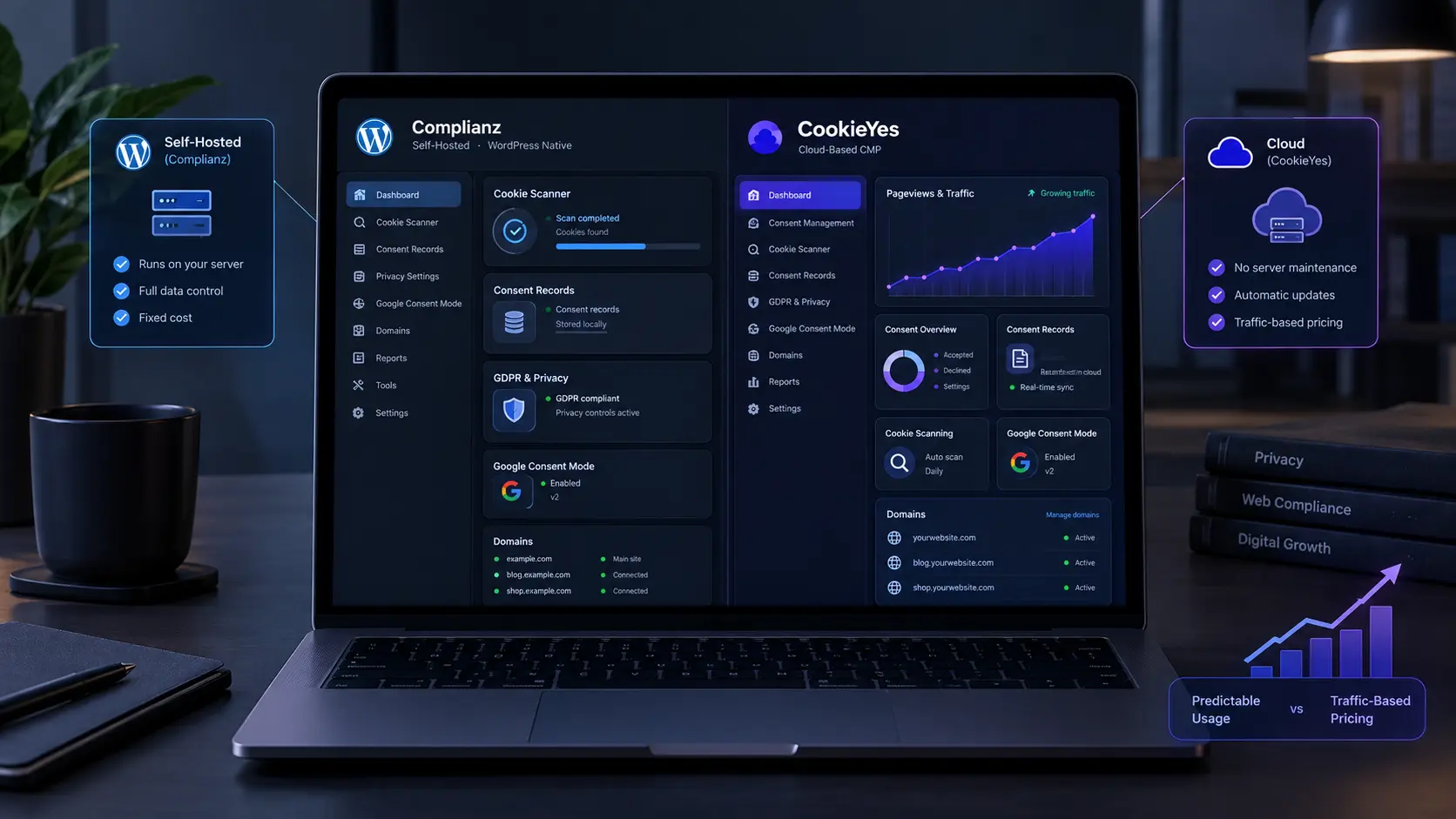
The real difference in the Complianz vs CookieYes debate is not the cookie banner. It is what happens behind that banner when traffic grows, websites use more tracking tools, or a business manages several domains. Complianz CMP takes a WordPress-first approach, with the consent system running as a native plugin. CookieYes CMP uses a cloud-based service with pageview-based plans. That creates an important practical difference: Complianz currently has no monthly pageview threshold, while CookieYes Basic and Pro plans have defined monthly limits. For site owners, that means the better cookie consent platform depends not only on features, but also on website traffic, platform, and how much control the team wants over its consent setup.
Complianz vs CookieYes: The Main Difference
Complianz is built specifically for WordPress. Its current premium plans include regional consent management, Records of Consent, Google Consent Mode v2, data request processing, A/B testing, statistics, and hybrid cookie scanning. Complianz also says its premium plans have unlimited consent records and no monthly pageview thresholds.
CookieYes works through a cloud-managed platform and supports multiple website platforms. Its current plans include cookie scanning, automatic blocking, Google Consent Mode v2, and other consent features. Its pricing is based partly on monthly pageviews.
| Feature | Complianz CMP | CookieYes CMP |
| Main approach | Native WordPress plugin | Cloud-managed platform |
| Monthly pageview limit | No | Yes, except Ultimate |
| Consent records | Unlimited on premium | Available |
| Google Consent Mode v2 | Yes | Yes |
| Cookie scanning | Hybrid/full-site options | Plan-based |
| Regional consent | Yes | Yes |
| Multi-platform focus | WordPress and Shopify | Broader platform support |
| Paid starting price | $59/year | $10/month/domain |
This makes the self-hosted vs cloud CMP choice more important than a simple feature checklist.
The Overlooked Issue: CMP Costs Can Change With Traffic
The biggest practical difference appears when website traffic increases. CookieYes currently charges $10/month per domain for Basic, which includes 100,000 pageviews per month. Pro costs $25/month per domain and includes 300,000 pageviews. Ultimate costs $55/month per domain and includes unlimited pageviews, subject to its fair-use policy.
CookieYes counts a pageview whenever a page containing its code loads or reloads. It counts these views whether visitors accept, reject, or ignore the cookie banner. Known bots and crawlers are filtered.
This creates a detail many CMP comparison articles miss. If a Basic account exceeds 100,000 pageviews, extra usage costs $0.30 per 1,000 additional pageviews when extra usage is enabled. If extra pageviews are not enabled, CookieYes says the banner can stop displaying after the limit is reached until the next billing cycle, an upgrade, or activation of extra usage.
For a site that can suddenly receive viral traffic, this is worth checking before choosing a plan. Complianz takes a different approach. Its current pricing page states that premium plans have no monthly pageview thresholds and unlimited Records of Consent.
Complianz CMP Is Built Around WordPress
Complianz is designed to work inside WordPress rather than relying on a separate external consent script. Its current documentation says the main plugin is exclusively for WordPress, while the company also offers a separate Shopify solution.
That native approach can matter for WordPress sites using caching, optimization tools, page builders, and multilingual plugins. Complianz’s September 2026 comparison guide also highlights compatibility with the WordPress ecosystem and the effect of external scripts on page performance.
Premium Complianz pricing currently starts at $59 for one website. Professional costs $179 for five websites, while Agency costs $399 for 25 websites. The Agency package also includes the multisite plugin.
For a WordPress-only business, this structure makes the cost easier to predict because the subscription is not tied to monthly pageviews.
CookieYes CMP Makes Traffic and Multi-Site Planning More Important
CookieYes has a different strength. Its cloud platform allows businesses to manage multiple domains from one account, while its Agency Partner Program provides bulk site management, consolidated billing, and client account monitoring.
Its current plans also scale scanning limits with the subscription:
- Free: 100 pages per scan and 5,000 pageviews per month
- Basic: 600 pages per scan and 100,000 pageviews
- Pro: 4,000 pages per scan and 300,000 pageviews
- Ultimate: 8,000 pages per scan and unlimited pageviews
CookieYes also updated its agency billing documentation in August 2026. Its agency tiers now provide discounts based on the number of active paid sites, reaching up to 50% for 100 or more sites.
GDPR Cookie Consent Needs More Than a Banner
A GDPR cookie consent solution should not be judged only by its design.
The European Commission states that people have the right to withdraw consent at any time. A website therefore needs a practical way for users to change or withdraw their choices after the first visit.
Both platforms provide tools designed to manage consent, but the website owner still needs to configure the system correctly. Analytics, advertising tags, third-party services, cookie categories, privacy notices, and consent settings must match what the website actually uses.
That is why a cookie consent management tool should be tested after installation rather than simply activated and forgotten.
Complianz vs CookieYes: Which Model Fits?
Complianz fits a WordPress-first setup
A WordPress-first CMP is worth considering when WordPress is the main platform and predictable usage matters. Its premium plans provide no monthly pageview threshold, unlimited consent records, regional consent management, and a native WordPress setup.
CookieYes fits a cloud-managed workflow
CookieYes makes more sense when centralized cloud management, multiple domains, or different website platforms are important. Its pageview-based system also gives teams clear usage limits, although unexpected traffic can create extra charges or affect banner availability if extra usage is disabled.
Check traffic before choosing
A site receiving 20,000 monthly pageviews and a site receiving 500,000 monthly pageviews have very different CMP requirements. With CookieYes, traffic directly affects the plan. With Complianz premium, pageviews do not create a separate usage threshold. That distinction can matter more than a small difference in the starting subscription price.
Final Takeaway
The strongest Complianz vs CookieYes comparison is really a comparison of operating models. Complianz puts the emphasis on native WordPress control and predictable usage, while CookieYes puts more emphasis on cloud management, platform flexibility, and traffic-based scaling.
The overlooked point is the cost and operational effect of traffic. CookieYes counts every qualifying page load toward its monthly allowance, while Complianz premium does not impose a monthly pageview threshold. For a growing website, that difference can become more important than the cookie banner itself.
Before choosing a self-hosted CMP or cloud CMP, we would therefore check three things first: your website platform, your monthly pageviews, and how your team wants to manage consent. That gives a more useful answer than comparing banner designs alone.
FAQ
Is Complianz completely self-hosted?
Complianz is primarily a native WordPress plugin, but some features use external services such as cookiedatabase.org for cookie information and updates.
Does CookieYes count rejected cookie-banner visitors?
Yes. CookieYes counts pageviews when pages containing its code load, regardless of whether visitors interact with the banner.
Can CookieYes suddenly stop showing the banner?
It can if the account reaches its pageview limit and extra pageviews are not enabled. CookieYes says the banner can resume after enabling extra usage, upgrading, or reaching the next billing-cycle reset.
Does Complianz have pageview limits?
Complianz currently states that its premium plans have no monthly pageview thresholds and unlimited consent records.
Leave a Reply