Pika AI is more than a simple AI video generator. Its current platform brings several video, image, and audio models into one place, while also offering creative tools for turning ideas, images, and existing content into videos. The biggest change to understand in 2026 is that Pika is now a multi-model generative media platform. Its current platform features Pika’s own models alongside models from other AI companies. Pika also offers dedicated apps for video, image, audio, and creative editing workflows.
What Is Pika AI?
Pika AI is a generative media platform designed for AI-powered video creation and other creative tasks. You can use text, images, keyframes, or existing videos as starting points to create and transform visual content with AI. For anyone researching a Pika AI review, this wider model selection is important. Pika is no longer just a single video-generation tool. Its current platform includes Pika 2.5 as well as models such as Seedance 2.5, Veo 3.1, GPT Image 2.5, and Nano Banana.
How the Pika AI Video Generator Works
The basic workflow is simple:
Start with an idea, prompt, or image.
Select an available model or creative feature.
Set the video options.
Generate the clip.
Review the result and create another version if needed.
This makes AI video creation useful for social media posts, advertisements, concept videos, product visuals, and other short-form projects. The important point is that AI video generation often works best as an iterative process. Instead of expecting one prompt to create the final video, creators can generate several versions and improve the result.
Pika AI Features to Know
Pika offers several creative tools alongside its video models. Its current platform includes Pika 2.5, Pikadditions, Pikaffects, Pikaswaps, and Pikaframes. Pika also offers dedicated audio models and creative applications.
Pikaframes is particularly useful when you want more control over how a video moves between images. Pika 2.5 can animate between two to five still images, with a prompt guiding the transitions.
Pikadditions and Pikaswaps are designed for modifying existing video content, while Pikaffects can be used for visual effects.
This means Pika can be useful for more than simply typing a prompt and waiting for a video.
Text to Video and Image to Video
The two main approaches most users look for are text to video AI and image to video AI. With text-to-video, you describe the scene you want the AI to create. Pika 2.5 can generate a video from a text prompt at 720p or 1080p.
With image-to-video, you provide an existing image and use AI to bring it to life with movement. Pika 2.5 supports 720p and 1080p image-to-video generation, with five- or ten-second duration options. Image-to-video can be especially useful for product visuals, artwork, character concepts, and social media content because the starting image gives the model a strong visual reference.
Pika AI Pricing in 2026
Pika’s current official pricing page shows the following plans:
Plan
Monthly price
Monthly credits
Commercial license
Free
$0
0
No
Starter
$10
900
No
Creator
$35
3,150
Yes
Fancy
$95
8,550
Yes
Annual billing reduces the listed prices to $8 for Starter, $28 for Creator, and $76 for Fancy. The Free plan currently provides access to models but has 0 monthly credits, with credit packs available separately.
Pika also sells one-time credit packs. The current pricing page lists packs starting at 1,500 credits for $25. This is important because some older Pika pages still show previous credit amounts. For current Pika AI pricing, the latest official pricing page is the better reference.
Pika 2.5 and Current Video Models
Pika 2.5 remains an important part of the platform. It supports text-to-video, image-to-video, and keyframe-based workflows.
For example, Pika’s current Pika 2.5 documentation says users can provide a prompt alone, attach a reference image, or use two to five still images as ordered keyframes.
At the same time, Pika’s current platform features other video models. Its apps page currently highlights Seedance 2.5 and Veo 3.1, among other models.
So it is more accurate to describe Pika as a multi-model AI video platform rather than calling Pika 2.5 the platform’s only or overall flagship model.
How to Use Pika AI for Better Results
If you want to learn how to use Pika AI, start with a clear visual idea rather than writing a very long prompt.
Describe:
The main subject
The movement
The camera action
The environment
The visual style
The mood
For image-to-video projects, start with a clear image and describe the specific movement you want to create.
For example, instead of writing a general prompt such as “make this cinematic,” describe the subject’s movement, camera motion, lighting, background action, and overall style.
Generate several versions and compare them. Even small changes to a prompt can lead to noticeably different results.
Pika AI API
Pika also offers an API for developers and businesses that want to add generative media to their own applications.
Pika’s current API documentation lists Pika 2.5 text-to-video and image-to-video from $0.04 per second, with charges applied only to successful runs.
The API also provides other models and tools, including Pikadditions, Pikaswaps, Pikaffects, and audio-generation models.
This API pricing should not be confused with Pika’s consumer subscription plans, which use monthly credits.
Who Should Use Pika AI?
Pika can be useful for content creators, marketers, designers, social media teams, and people experimenting with AI video.
It is especially useful when you need short visual clips, image animation, creative effects, or quick video concepts.
However, AI-generated video can still have problems with consistency, motion, objects, faces, and detailed instructions. For professional work, review every generated clip before publishing.
Final Thoughts
Pika AI has developed from a straightforward AI video generator into a broader generative media platform.
Its current platform combines Pika’s own models with access to other video, image, and audio models. Pika 2.5 remains useful for text-to-video, image-to-video, and keyframe workflows, while newer models such as Seedance 2.5 and Veo 3.1 are also featured on the platform.
For users interested in Pika AI, Pika AI review, AI video generator, text to video AI, image to video AI, and AI video creation, the main advantage is flexibility. You can start with an idea, image, or existing content and choose a workflow that fits the project.
For the latest Pika AI pricing, always check the official Pika pricing page, because plans, credits, models, and generation costs can change.
Frequently Asked Questions
Is Pika AI an AI video generator?
Yes. Pika provides AI video generation from text, images, and keyframes, along with tools for modifying and enhancing video content.
What is Pika AI used for?
Pika AI can be used for short videos, social media content, marketing visuals, image-to-video projects, creative effects, and AI-powered media production.
How much does Pika AI cost?
Pika currently lists a Free plan at $0, Starter at $10 per month, Creator at $35 per month, and Fancy at $95 per month. Annual billing offers lower listed prices.
Does Pika AI have a free plan?
Yes. Pika currently lists a Free plan with 0 monthly credits. Users can purchase additional credit packs separately.
Does Pika AI offer an API?
Yes. Pika provides API access to its video and generative media models. Pika 2.5 API generation currently starts from $0.04 per second for supported video generation.
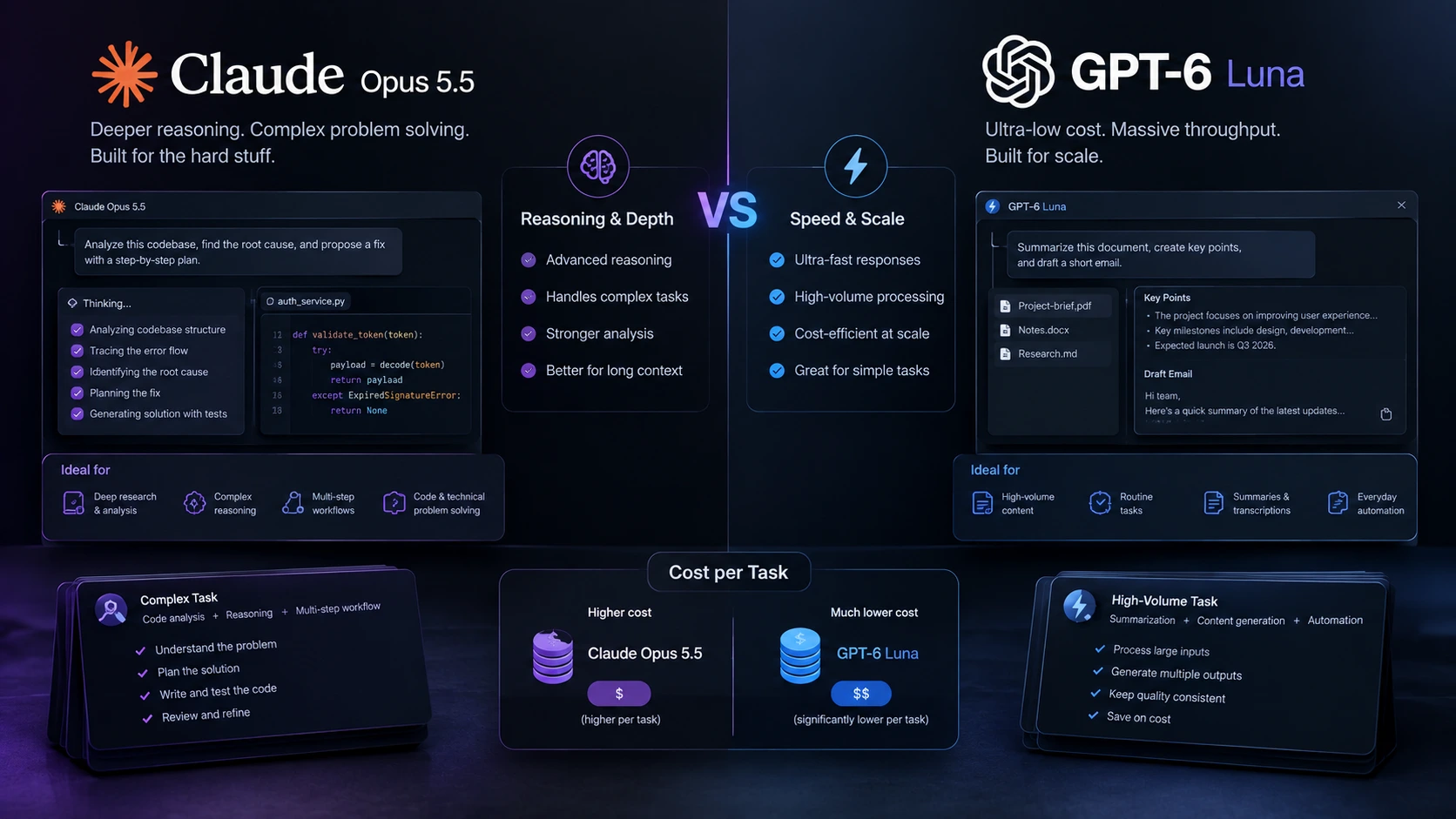
The biggest change in the latest AI model race is not simply better reasoning. It is the cost of getting useful work completed. Anthropic launched Claude Opus 5.5 on September 22, 2026, with $4 input and $20 output pricing per million tokens. OpenAI released GPT-6 Luna the same day at just $0.10 input and $0.50 output. But token prices alone hide an important detail: a cheaper model can still become expensive if it needs more steps, retries, or context. That makes Opus 5.5 vs GPT-6 Luna less about the cheapest token and more about how much useful work each dollar buys.
Opus 5.5 vs GPT-6 Luna Pricing Shows Two Very Different Strategies
The raw Opus 5.5 pricing is much higher than GPT-6 Luna.
Model
Input per 1M tokens
Output per 1M tokens
Claude Opus 5.5
$4
$20
GPT-6 Luna
$0.10
$0.50
OpenAI says GPT-6 Luna costs half as much as GPT-5.6 Luna on both input and output, with output falling from $1.20 to $0.50 per million tokens.
Anthropic took a different path. Opus 5.5 costs 20% less per token than Opus 5, but Anthropic says its typical workload cost is 40% lower because the model uses less compute. Cache reads also fell to $0.20 per million tokens. This is the overlooked part of the AI model comparison. The sticker price does not tell us the full cost.
The Real Test Is Cost Per Completed Task
For reasoning AI models, the number of tokens used is only one part of the bill. A coding agent may read a large codebase, plan changes, call tools, run tests, fix errors, and repeat the process. A model that finishes in fewer steps can cost less even if its token rate is higher. Anthropic reports that Opus 5.5 completed a 200,000-line code audit and fixes in under three hours in an early test. The company also says Opus 5.5 completed a C-to-Rust HAProxy rewrite in 9.5 hours, compared with 12 hours for Claude Fable 5.1, while costing 51% less in that test.
OpenAI’s GPT-6 Luna shows the opposite pricing advantage. On the DeepSWE 1.1 software engineering test, Luna at maximum effort scored 66.6%. OpenAI says that result was comparable to Opus 5 and Fable 5 at medium effort, while costing 93% less per task than Opus 5 and 96% less than Fable 5. These are company-reported evaluations, not a controlled head-to-head test of Opus 5.5 against Luna. That distinction matters.
Opus 5.5 Review: Efficiency Is Part of the Reasoning Story
The strongest part of the Opus 5.5 review is not its raw token price. It is the claim that the model can handle long, messy jobs with fewer retries. Anthropic reports that Opus 5.5 beat its previous model on FrontierCode at default effort. It scored 54.6%, compared with 53.3% for GPT-6 Astra’s top score in the company’s comparison, while Anthropic says Opus 5.5 used about one-fifth of Astra’s cost per task.
Anthropic also says Opus 5.5 produced output more than 30% faster than Opus 5. That combination matters for developers. A model that reasons well but repeatedly asks for more context or retries failed actions can create a larger bill and slower workflow.
GPT-6 Luna Review: The Low-Cost Model Changes the Math
The GPT-6 Luna review has a different focus. Luna is built for lower-cost, high-volume work. OpenAI describes Luna as useful for tasks such as summarizing documents, extracting information, and answering quick questions. The model also supports different reasoning effort levels, allowing developers to spend more compute on harder tasks. Its biggest technical advantage may be caching.
OpenAI says GPT-6 models can receive discounts of up to 90% on cached input-token reads. It also says improvements over the past several months reduced the share of prompt tokens needing fresh processing by more than 50% across billions of requests in GitHub’s use of OpenAI models. For applications that repeatedly send the same instructions or large context, that can matter more than the headline $0.10 input price.
What This Means for Best AI Models 2026
The new releases make one old way of comparing AI models less useful.
Instead of asking which model has the highest benchmark score, developers should track three numbers:
Quality per task
Tokens and tool calls needed
Total cost for a completed workflow
This matters especially for agents. A customer-support agent handling 100,000 requests does not care about the token price in isolation. The business cares about the total bill, response quality, failed actions, and how often a human must intervene.
Opus 5.5 vs GPT-6 Luna: The Practical Divide
The current evidence points to a clear difference in design.
Opus 5.5 is positioned around advanced reasoning, long coding tasks, research, and agentic work. Anthropic has also pushed its price down and improved token efficiency.
GPT-6 Luna is positioned around scale. Its very low token price, reasoning controls, and stronger caching make it suited to applications where thousands or millions of model calls can quickly add up.
Neither published source provides a clean, independent Opus 5.5 versus Luna test using the exact same prompts, tools, hardware, and effort settings. That means claims of a definitive overall performance winner would go beyond the available evidence.
The more useful finding is that AI pricing is moving from model price to workflow economics.
What should businesses measure?
Track cost per completed task, total tokens, retries, tool calls, latency, and human corrections. Those figures reveal the real cost of an AI workflow better than token pricing alone. The most important change in the Opus 5.5 vs GPT-6 Luna debate is therefore not simply that one model is expensive and the other is cheap. Both companies are trying to reduce the cost of useful intelligence, but they are doing it differently. Opus 5.5 focuses on doing complex work more efficiently, while Luna pushes the cost of large-scale AI usage dramatically lower. For 2026, workflow cost per successful result is becoming a more useful measure than the price printed beside a million tokens.
FAQ
Is Opus 5.5 more expensive than GPT-6 Luna?
Yes. At the published API rates, Opus 5.5 costs $4 per million input tokens and $20 per million output tokens, while Luna costs $0.10 and $0.50.
What is the main Opus 5.5 pricing change?
Anthropic cut Opus 5.5 input and output prices by 20% versus Opus 5 and says typical workloads cost 40% less.
Why is GPT-6 Luna so cheap?
OpenAI attributes the lower price to improvements in inference and caching. It also offers up to 90% discounts on cached input reads.
Is there a direct Opus 5.5 vs GPT-6 Luna benchmark?
Not yet in the published sources reviewed here. Anthropic and OpenAI publish different tests, settings, and cost measurements, so those results should not be treated as a controlled head-to-head comparison.
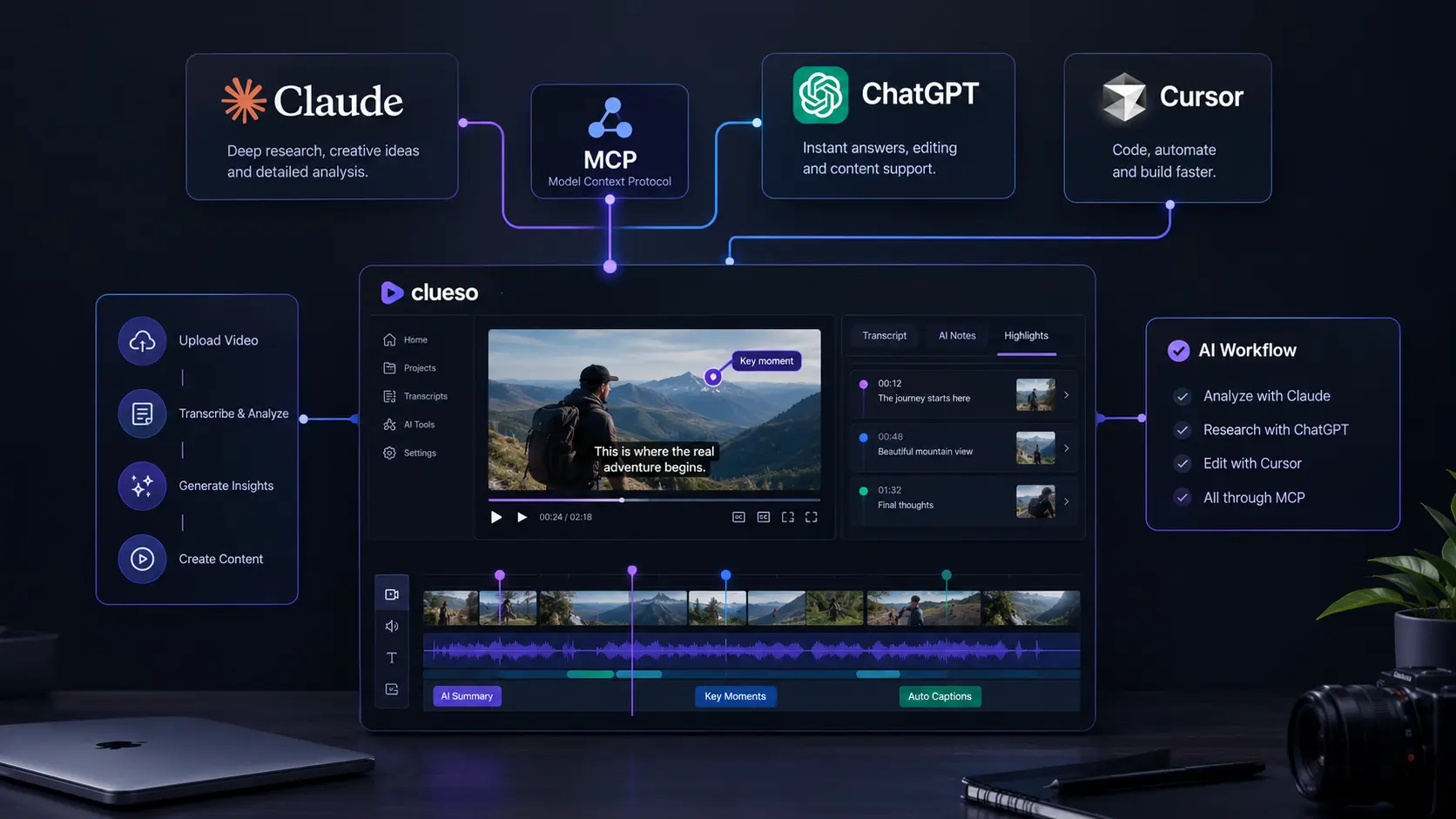
Clueso integration lets supported AI assistants connect with Clueso’s video creation and editing tools through the Model Context Protocol, or MCP. Instead of completing every video task manually, users can give natural-language instructions to an AI assistant and let it work with Clueso. Clueso also provides Agent Skills for common video workflows. These skills can help create videos from articles, edit existing videos, add captions, insert callouts, apply brand elements, and handle other video-production tasks. Clueso supports several AI environments, including Claude, ChatGPT, and Cursor. However, the setup process and available permissions are different for each platform.
What Is Clueso MCP?
Clueso MCP uses the Model Context Protocol to connect AI assistants with external tools. MCP is an open standard that allows an AI application to communicate with connected services and use their available capabilities. With Clueso MCP, compatible AI agents can access video-related functions. Depending on the available tools, these can include working with projects, clips, motion elements, AI voiceovers, and video exports.
This makes it possible to use natural-language instructions for video workflows. For example, you can ask an AI assistant to create a product walkthrough, turn an article into a narrated video, add captions, insert visual callouts, or make changes to an existing video project. The MCP connection provides the tool access, while Clueso Agent Skills provide additional instructions for specific workflows.
How to Set Up Clueso With Claude
The Clueso Claude integration uses Claude’s custom connector system.
The general setup process is:
Open Claude.
Go to Settings.
Open Connectors.
Select the option to add a custom connector.
Create a connector for Clueso.
Complete the Clueso authorization process.
Return to Claude and confirm that the connector is available.
After the connection is active, Claude can access the available Clueso tools when they are enabled for the conversation.
Clueso With Claude Code
Clueso can also be used with Claude Code through MCP. The setup is different from the standard Claude interface because the MCP connection needs to be configured through Claude Code. After adding the connection, the authorization process can be completed through the browser. The exact configuration can change as Claude Code and Clueso update their MCP support, so current configuration requirements should be followed.
How to Set Up Clueso With ChatGPT
The Clueso ChatGPT integration works differently from the Claude and Cursor setup. ChatGPT’s custom MCP functionality depends on the account plan and workspace configuration. Full MCP functionality, including actions that create or modify content, is currently available for supported Business, Enterprise, and Edu environments.
For a supported workspace, the general process is:
Open ChatGPT on the web.
Open the relevant developer or app settings.
Enable developer mode if it is available.
Create or configure a custom MCP application.
Add the required Clueso connection information.
Complete the authorization process.
Review the available Clueso tools.
Save or publish the application according to the workspace requirements.
Select the Clueso application when using it in a supported conversation.
Workspace administrators may need to approve the application or control which users can access it. Because ChatGPT’s MCP and custom app features continue to evolve, the exact settings and menu names can change.
ChatGPT MCP Permissions for Clueso
Permissions are an important part of the Clueso ChatGPT integration. Not every ChatGPT account has the same MCP capabilities. Some environments provide limited access, while supported business workspaces can provide broader functionality. This matters because many Clueso workflows require more than reading information. Creating or modifying videos requires the AI assistant to have the appropriate tool permissions. ChatGPT Agent mode should also not be confused with custom MCP applications. Custom apps have their own supported workflows and permissions.
How to Set Up Clueso With Cursor
The Clueso Cursor integration uses Cursor’s MCP support.
The general setup process is:
Open Cursor.
Open the MCP settings.
Select the option to add a custom MCP server.
Enter the Clueso MCP server information.
Complete the Clueso authorization process.
Confirm that the Clueso tools are enabled.
Start a Cursor agent workflow that can use the connected tools.
Cursor’s interface can change between releases, so the current MCP settings should be used if the location of these options differs. Once Clueso is connected, Cursor can use the available tools as part of supported agent workflows.
Clueso Agent Skills Explained
The Clueso Agent Skills system is an important part of the integration. MCP provides access to Clueso’s tools, while Agent Skills provide reusable instructions for specific tasks. This means an AI assistant does not simply have access to video tools. It can also use predefined workflows designed around common video-production requirements.
Clueso’s Agent Skills can cover tasks such as:
Creating videos
Editing existing videos
Adding animated captions
Adding callouts and arrows
Applying brand colors
Adding logos
Creating lower thirds
Adding zoom effects
Creating CTA end cards
Turning documents and articles into videos
For example, an article-to-video workflow can take written content, develop it into a video script, organize the content into scenes, add narration, and prepare the resulting video.
What Can You Do With Clueso MCP?
Once the Clueso MCP integration is configured, you can use natural-language instructions for different video tasks.
Some examples include:
Turn an article into a narrated video.
Create a product walkthrough from written content.
Add captions to an existing video.
Highlight important areas of a screen recording.
Add callouts and arrows.
Add a logo or branded element.
Apply brand colors.
Create a CTA end screen.
Build an animated explainer.
Divide long training content into sections.
Create localized versions of an existing video.
The goal is to make video production more conversational. Instead of manually completing every editing step, users can describe the desired result and let the connected AI tools handle supported actions.
Clueso MCP Troubleshooting
If the Clueso MCP connection does not work correctly, configuration and authorization are two areas to check first. Make sure the Clueso connection has been completed successfully and that the required tools are enabled. If Clueso does not appear after configuration, refreshing or restarting the AI application may help. You should also check whether your account or workspace has permission to use custom MCP tools.
ChatGPT users should pay particular attention to workspace permissions because administrators can control custom app access. The same principle applies to Claude and Cursor. Application interfaces can change, so older tutorials may show settings that are no longer located in the same place. Security is also important when using MCP. Connecting an external MCP service can give an AI assistant access to tools and actions. Users should understand what the connected service can access before authorizing it.
Why Use Clueso With AI Assistants?
The main benefit of connecting Clueso withClaude, ChatGPT, or Cursor is the ability to bring video creation into an existing AI workflow. Without an integration, users may need to switch between an AI assistant and a separate video editor for different parts of a project. With Clueso MCP, supported AI agents can interact with Clueso through connected tools. Agent Skills make this workflow more useful by providing instructions for repeatable tasks such as article-to-video creation, video editing, captions, motion effects, and branding.
This approach can be useful for product tutorials, customer education, training videos, software explainers, and other instructional content. The exact experience depends on the AI platform, account permissions, available Clueso tools, and the workflow being requested.
Frequently Asked Questions
Does Clueso MCP require an API key?
Clueso’s Agent Skills are designed to work through its MCP connection. The standard setup uses the hosted Clueso MCP service and an authorization process rather than requiring users to manually create an external API key.
Can I use Clueso with Claude, ChatGPT, and Cursor?
Yes. Clueso supports multiple AI environments, including Claude, ChatGPT, and Cursor. However, the setup process and available permissions can differ between platforms.
Can I use Clueso MCP with ChatGPT Free?
MCP availability depends on the ChatGPT plan and workspace configuration. Full write and modification functionality is not available across all ChatGPT plans, so users should check the MCP capabilities available to their account.
Does ChatGPT Agent mode support Clueso custom MCP apps?
Agent mode and custom MCP applications have different capabilities. Users should use the supported custom-app workflow when they need MCP tools to perform actions through Clueso.
What are Clueso Agent Skills?
Clueso Agent Skills are reusable instructions designed for specific workflows. They can help AI agents handle tasks such as video creation, video editing, captions, motion effects, branding, and article-to-video production.
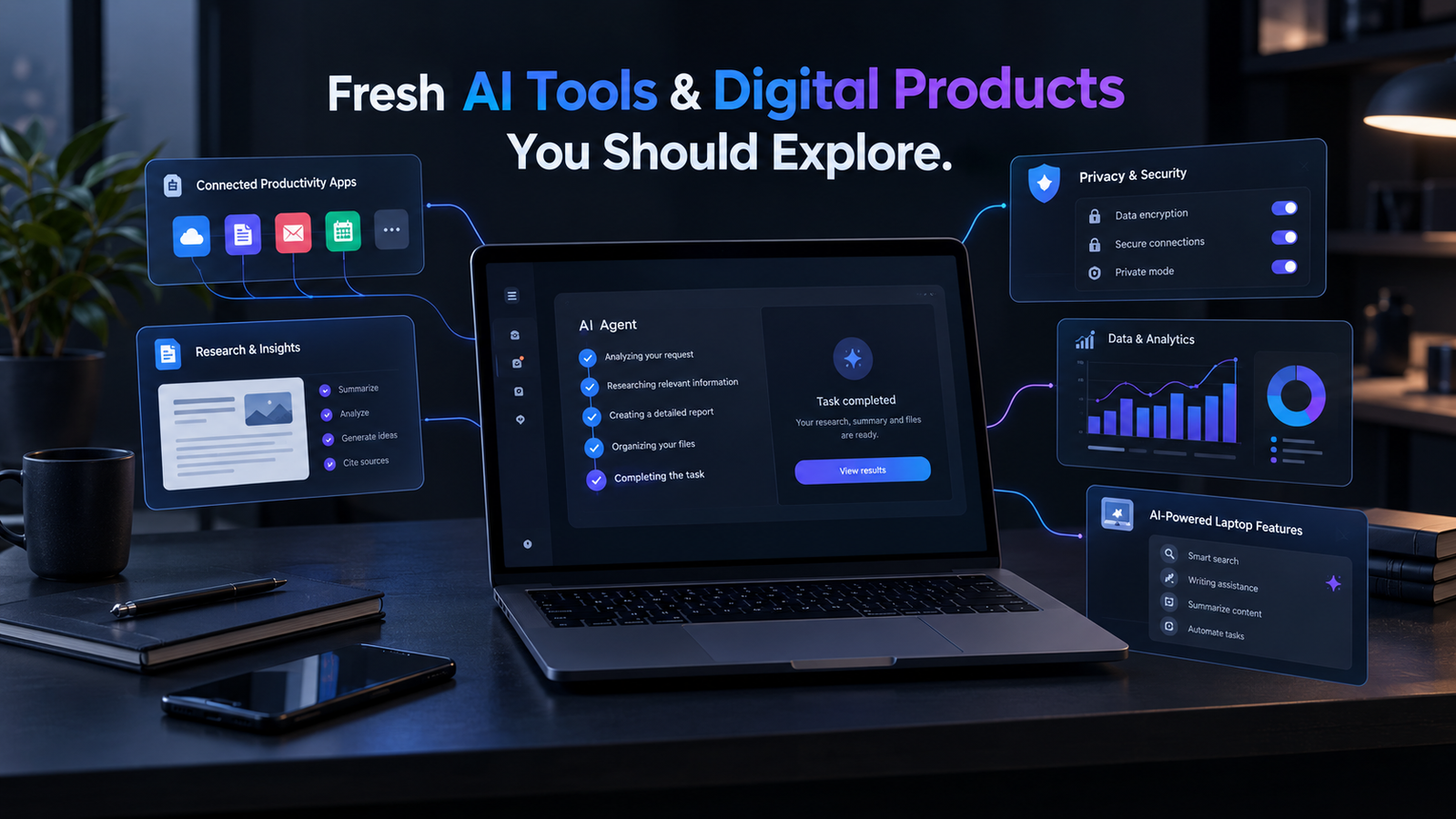
The most interesting AI tools and digital products arriving or evolving in 2026 are changing what we expect software to do. Instead of waiting for users to move between separate apps, newer products are starting to take action, use connected services, and complete multi-step work. That shift is easy to miss if we only compare model names and benchmark scores. A better way to judge fresh AI tools is to ask a simple question: What can the product actually finish for us?
Recent launches show this change clearly. Meta introduced Muse in September as a personal AI agent that can work across connected apps. Google introduced Googlebook with Gemini intelligence built directly into the laptop experience. Anthropic has also expanded Claude beyond basic chat through Cowork and integrations with productivity applications. Proton has continued developing Lumo as a privacy-focused AI assistant with reasoning, web search, memory, and data visualization features.
AI Tools Are Moving From Answers to Actions
The biggest development in new AI tools is not another chatbot window. It is the move from generating information to completing tasks. Traditional AI assistants mainly respond to prompts. Newer agentic products are increasingly designed to plan, use software, work with files, access connected services, and continue working through several steps. This is also changing how we should evaluate AI software. Instead of asking only how good an answer looks, it makes more sense to ask how much useful work the product can complete with appropriate user control.
Meta Muse Shows Where Personal AI Is Going
Meta introduced Muse on September 8, 2026, describing it as a personal AI agent designed to do work rather than simply answer questions. Meta says Muse can handle tasks such as sending emails and booking travel, open a browser, fill out forms, and work toward larger goals. It can also continue working after a user closes the app and return when it needs approval or when something changes.
Muse runs inside a dedicated Muse Secure VM, which contains the agent and a user’s data. Meta says a separate Sentinel system controls whether Muse can reach the internet. Sensitive actions, such as sending an email or making a purchase, require user approval, and Muse provides an audit trail of its actions.
Meta also says Muse can use Link by Stripe for checkout, with a one-time-use card designed to keep the user’s real payment details hidden. Muse is rolling out in the US on iOS, Android, and muse.ai, with availability planned for AI glasses.
For readers exploring AI agent platforms, this is an important development because it shows how AI agents are moving beyond conversation toward controlled execution.
For example, an AI that creates a travel plan is useful. An AI that can research the trip, organize the details, fill out forms, and complete approved bookings is a different kind of product.
Fresh AI Tools Are Becoming Complete Workspaces
Another important change is the blending of AI with traditional productivity software.
Anthropic’s Claude ecosystem is a good example. Claude Cowork brings agentic capabilities to broader knowledge work, while Claude has expanded into applications such as Excel and PowerPoint. Anthropic says Claude can work across Excel, PowerPoint, Word, and other productivity workflows, allowing context to move between applications instead of forcing users to copy information manually.
Claude in Excel can work with spreadsheets, while Claude in PowerPoint can help create presentations. Anthropic has also described workflows where information can move from Excel into PowerPoint, reducing the traditional copy-and-paste process between applications.
Cowork is also being used for longer-running tasks. Anthropic’s June 2026 Economic Index reported that Claude usage increasingly includes long-running agentic tasks through Claude Code and Cowork, showing how AI use is moving beyond simple conversational prompts.
This matters because users no longer need to think of AI as a separate window beside their normal software. The AI is becoming part of the workspace itself.
That creates practical possibilities for writers, students, marketers, analysts, and business teams. Instead of asking an AI for text and then manually moving that content into another application, more of the workflow can happen inside connected tools.
Readers interested in comparing current AI models can also look beyond model benchmarks and examine how those models are being turned into complete products.
Googlebook Brings AI Into the Laptop
AI is also moving deeper into computer hardware.
Google introduced Googlebook, a laptop designed around Gemini intelligence. Google says Googlebook combines ChromeOS foundations with Android technology and puts Gemini directly into the device experience. The company announced pre-orders on September 21, 2026.
One of its notable features is Magic Pointer. Google says the feature understands text, images, and context and brings Gemini into the area where the user is working. Google also highlights voice dictation and other built-in intelligence features designed to help users complete tasks more directly from the laptop.
The larger trend is important. AI is increasingly becoming a layer across operating systems and devices rather than a destination that users have to open separately.
Instead of asking, “Which AI website should I use?”, users may increasingly interact with AI directly through their laptop, browser, phone, or other connected hardware.
Privacy Is Becoming a Feature Worth Checking
The rush toward AI agents creates another issue that many tool lists overlook: how much access does the product need?
An AI that can read email, browse websites, remember information, access files, and make purchases needs more permission than a basic writing assistant. That makes privacy controls part of the product’s practical value.
Lumo from Proton provides an example of this approach. Proton describes Lumo as a privacy-focused AI assistant and says it does not use user data to train its AI models. Lumo 2.0, released in June 2026, added advanced reasoning, image generation, deep web search, and long-term memory.
In January, Proton also introduced Projects, giving users encrypted spaces for chats, files, and requirements connected to a particular task.
Then, on August 3, 2026, Proton added data visualization capabilities. Lumo can now create charts, graphs, and other visuals from spreadsheets, reports, and internal documents. Proton says the feature is designed to keep the information private while turning data into useful visual insights.
For anyone testing AI products, we should check three things before uploading sensitive material:
What data can the tool access?
Is our data used for model training?
Can we remove connected accounts or stored information?
These questions can matter more than a small difference in model performance.
How to Find the Best AI Tools 2026 Has to Offer
The phrase best AI tools 2026 can be misleading because the right tool depends on the job.
A better approach is to test products against a real task.
Use a Three-Step Test
First, give the tool one complete task.
Do not judge it only from a demo prompt. Ask it to produce something you would actually use.
Second, measure the work left afterward.
If an AI generates a report but requires heavy correction, its headline feature may save less time than expected.
Third, check the limits.
Look at usage caps, export options, connected services, privacy settings, and whether important features require a paid plan.
This approach is especially useful because AI products are changing quickly. A tool that was limited six months ago may now offer agents, file analysis, visual creation, memory, or deeper integrations.
For current information about AI products and models, the OpenAI API pricing page provides official product and pricing details.
Digital Products Worth Watching Beyond Chatbots
The newest products are spreading into areas that used to require separate software.
We are seeing AI agents, AI-native browsers, research tools, coding agents, privacy-focused assistants, AI workspaces, and AI-enabled hardware appear across the market.
Research-focused products are also becoming more capable. Tools such as NotebookLM show how AI can work with user-provided sources instead of relying only on general chatbot responses. This makes source-based AI useful for people who need to research documents, reports, notes, and other material.
Coding is another major area of development. AI coding products are increasingly moving from simple code generation toward planning, editing, debugging, and working across larger projects.
The same broader shift can be seen in AI automation platforms. Products increasingly combine models with tools and workflows so they can perform several connected actions instead of producing one response.
That does not mean every launch deserves attention. Many new products are experiments, beta services, or narrow tools. The better signal is whether a product removes a real step from an existing workflow.
A small tool that saves 30 minutes every day can be more useful for a particular user than a powerful AI system that they rarely use.
What Makes a Fresh AI Tool Worth Trying?
A useful way to evaluate fresh AI tools is to look at five practical areas.
Task Completion
Can the product finish a meaningful task, or does it only generate suggestions?
Integration
Can it work with the services, files, and applications you already use?
Reliability
Does it produce useful results consistently, or does every output require extensive checking?
Privacy and Control
Can you control its permissions, review its actions, delete stored information, and understand how your data is handled?
Cost and Limits
Does the free or paid plan provide enough usage for the actual workload?
These factors make a better evaluation framework than simply choosing the product with the newest model.
AI Agents Are Becoming More Practical
The growth of AI agents is one of the clearest themes in 2026.
Meta’s Muse can work across connected services and perform approved actions. Anthropic’s Cowork is designed for longer-running knowledge-work tasks. Other AI automation products are also moving toward workflows where AI can use tools rather than simply answer questions.
This does not mean traditional apps are disappearing.
Instead, AI may increasingly become the layer that connects existing applications. An agent could read information from one service, process it, create something in another application, and ask for approval before taking an important action.
For users exploring AI automation tools, this distinction is important. The value is not simply having an AI model. The value comes from what the model can safely do with the tools around it.
Conclusion
The most interesting AI tools and digital products in 2026 are not simply producing better answers. They are reducing the number of steps between an idea and a finished task. Meta Muse shows this through personal AI agents that can take approved actions. Googlebook shows how AI can become part of the computer itself. Anthropic is bringing agentic capabilities into knowledge work and productivity applications, while Proton is combining AI capabilities with a privacy-focused approach.
That makes task completion, privacy, integration, reliability, and control useful measures when exploring new products. As AI moves into documents, browsers, phones, laptops, and connected services, we should explore new products by asking what work they remove from our day. That is the opportunity in the current wave of fresh AI tools: not simply finding software with the biggest feature list, but finding products that can remove unnecessary steps from a real workflow.
FAQ About Fresh AI Tools and New AI Tools
What are fresh AI tools?
Fresh AI tools are newly launched products or established products with major new AI features. A tool does not have to be brand new to be worth exploring. A meaningful feature update can change how useful it is.
What should we look for in new AI tools?
Look for real task completion, useful integrations, clear privacy controls, reliable output, and reasonable usage limits. Avoid choosing a tool simply because it uses a newer model.
What are the best AI tools 2026 users should try?
There is no single best tool for everyone. The right option depends on the task. AI agents may help with automation, AI workspaces may help with documents and presentations, research tools can support source-based work, and privacy-focused assistants may matter more when handling sensitive information.
Are AI agents replacing normal apps?
Not completely. Current products show a gradual shift toward AI controlling or working across existing services. Access, permissions, compatibility, reliability, and user trust still shape what these systems can actually do.
Why are AI tools becoming more connected?
Connected AI tools can reduce the need to move information manually between applications. Instead of generating an answer and stopping there, an agent can potentially use files, applications, browsers, and other services to complete multiple steps with appropriate user approval.
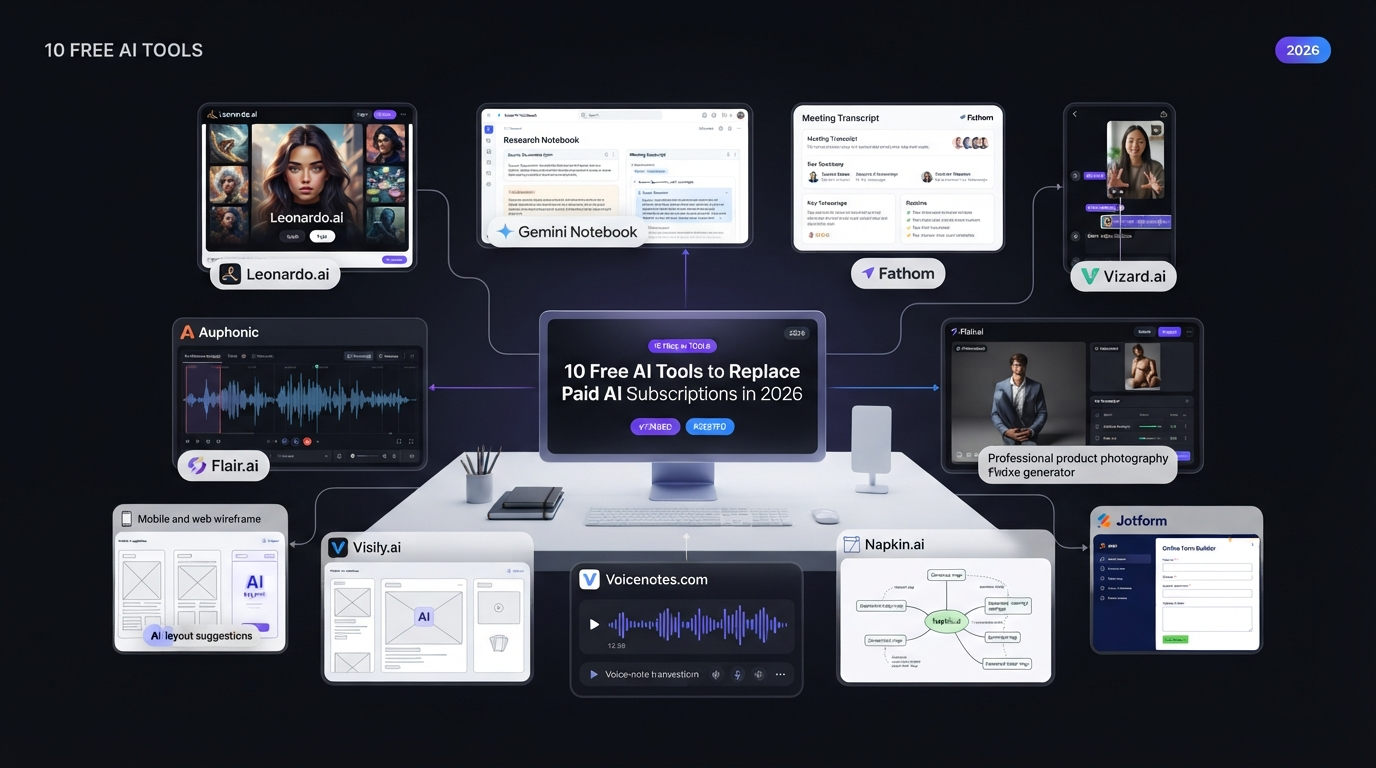
AI subscriptions can become expensive very quickly. One tool for image generation, another for research, one for meeting notes, another for video editing, and more for audio, design, dictation, and forms can create a large monthly bill. The good news is that many AI tools now offer useful free plans in 2026. These free options can help students, freelancers, creators, marketers, small businesses, and everyday users complete common tasks without paying for several premium subscriptions.
A free plan does not always provide everything included in a paid plan. You may face limits on credits, exports, storage, projects, processing time, or advanced features. However, if you only use an AI tool occasionally, the free allowance may be enough. Here are 10 free AI tools that can help replace or reduce the need for paid AI subscriptions in 2026.
Quick Comparison of Free AI Tools
Free AI Tool
Main Use
Paid Alternative
Paid Alternative Price
Leonardo AI
Image Creation
Ideogram Plus
$20/month
Gemini Notebook
AI Research
Elicit Plus
$11/month annually
Fathom
AI Meeting Notes
Granola Business
$14/user/month
Vizard
Long Video to Shorts
OpusClip
Varies by plan
Auphonic
Audio Cleanup
Descript Hobbyist
$24/month
Flair AI
Product Photography
Pebblely Lite
$9/month
Visily
UI/UX Prototyping
Uizard Pro
$12/month annually
Voicenotes
Voice Typing
Wispr Flow Pro
$15/month
Napkin AI
Visual Thinking
XMind Premium
$8.25/month
Jotform
AI Form Creation
Typeform Basic
$39/month
Prices and plan limits can change, so users should check official pricing pages before purchasing a subscription.
1. Leonardo AI for Image Creation
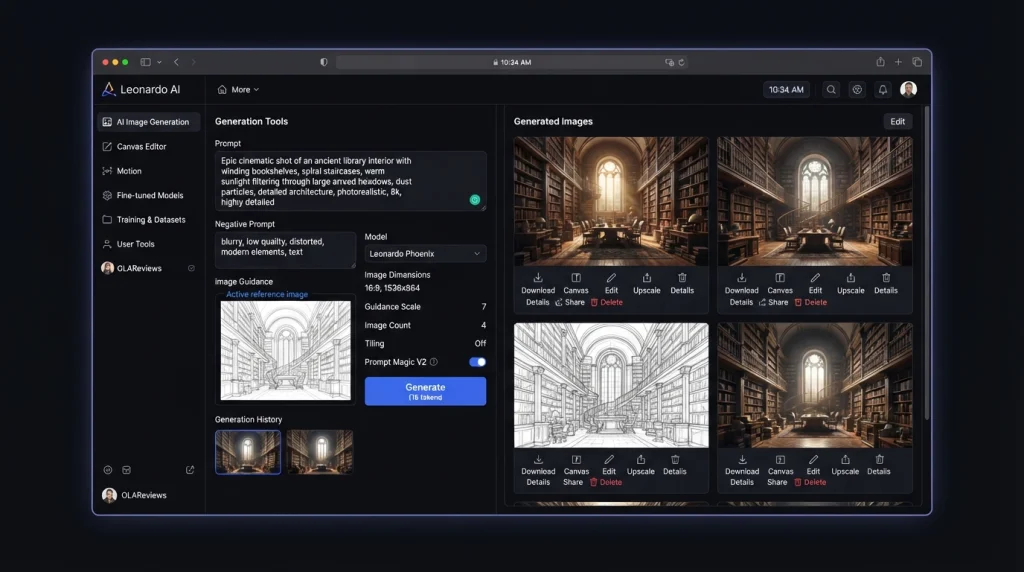
Leonardo AI is a popular AI image-generation platform that can create visuals from text prompts. It is useful for people who need images for blogs, social media, marketing campaigns, presentations, games, and creative projects. Its free plan provides daily Fast Tokens that can be used for image generation and other supported creative features. This gives casual users an opportunity to create AI images without immediately paying for a monthly subscription.
Leonardo AI can be useful for:
Blog featured images
Social media graphics
Concept art
Marketing visuals
Character designs
Game assets
Product concepts
Creative experiments
One important difference between Leonardo AI and Ideogram is their focus. Both generate images, but Ideogram is particularly useful when accurate text inside an image is important, while Leonardo AI provides a broader creative generation workflow. Ideogram Plus currently costs $20 per month when billed monthly, with a lower effective monthly price when billed annually.
Why Try Leonardo AI for Free?
If you only need a few images every day, the free allowance can be useful. It allows you to test different prompts and styles before deciding whether you actually need a premium image-generation subscription. Free plans can have privacy and licensing differences from paid plans, so businesses should review the current terms before using generated images commercially.
2. Gemini Notebook for AI Research
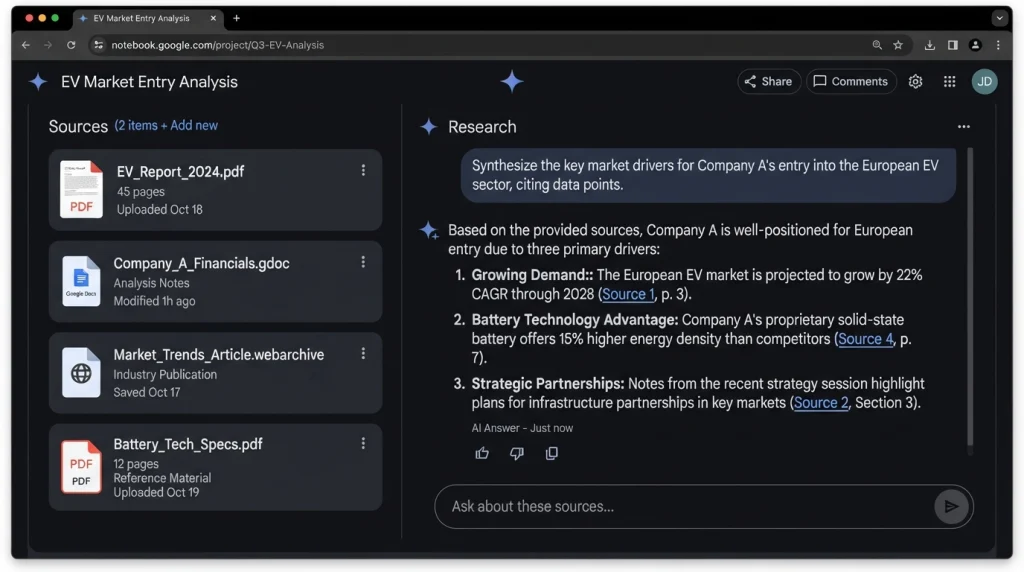
Google’s former NotebookLM has been renamed Gemini Notebook. It is designed for research and learning using information from sources supplied by the user. This makes it different from simply asking a general-purpose chatbot a question. Gemini Notebook documentation can work with documents and other supported sources and provide answers based on that material.
It can be useful for:
Research projects
Studying PDFs
Understanding reports
Summarizing documents
Creating study material
Business research
Source-based questions
Learning from uploaded material
Google provides a free tier with limits on notebooks, sources, questions, and certain AI generations. Paid Google AI plans increase these limits considerably.
Gemini Notebook vs Elicit
Elicit is designed specifically around academic and scientific research. Its free Basic plan provides access to a large academic-paper database, paper summaries, and research features, with limits on some advanced functions.
Elicit Plus currently costs $11 per user per month when billed annually.
For general document research, Gemini Notebook can be a useful free option. For academic literature research, Elicit provides a more specialized workflow.
3. Fathom for AI Meeting Notes
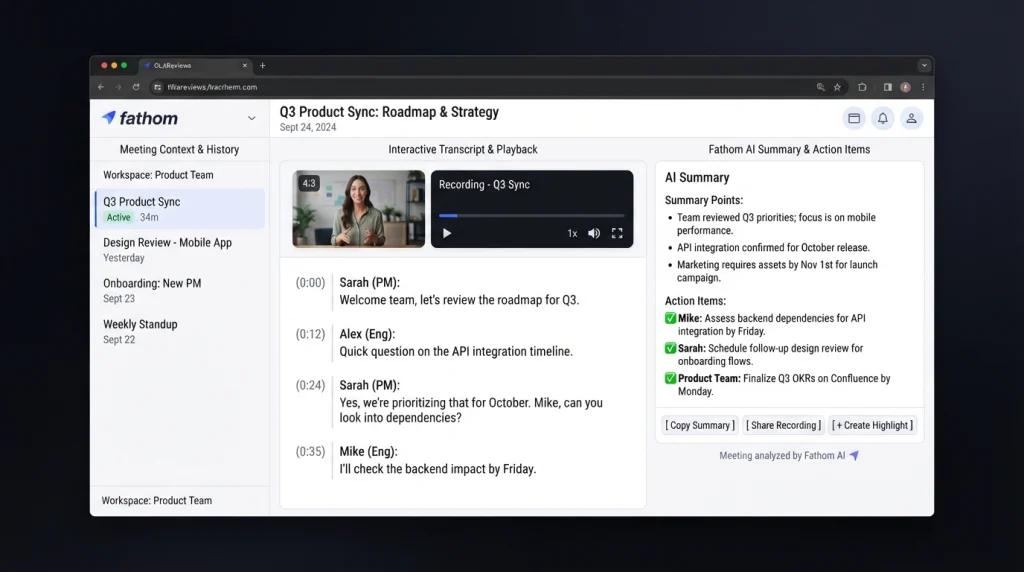
Fathom is an AI meeting assistant designed to record, transcribe, and summarize online meetings. It is useful for people who spend a large part of their workday in meetings. Instead of manually writing every discussion point, Fathom can create transcripts and AI-generated summaries.
Common uses include:
Meeting summaries
Action items
Follow-up notes
Transcripts
Important decisions
Customer conversations
Sales meetings
Team meetings
Fathom’s free individual plan provides unlimited recordings, storage, and transcription, along with limits on some advanced AI summary features. This makes it particularly useful for freelancers, consultants, sales professionals, recruiters, agencies, and small teams.
Fathom vs Granola
Granola is another AI meeting-notes platform. Its free plan provides AI meeting notes and other features, while the Business plan adds additional capabilities for teams and organizations.
Granola Business currently costs $14 per user per month.
The main difference is that these tools are not simply interchangeable subscriptions. Their recording methods, AI workflows, integrations, collaboration features, and supported platforms can differ. For someone who mainly wants automated meeting notes, Fathom’s free plan may be sufficient.
4. Vizard for Turning Long Videos Into Shorts
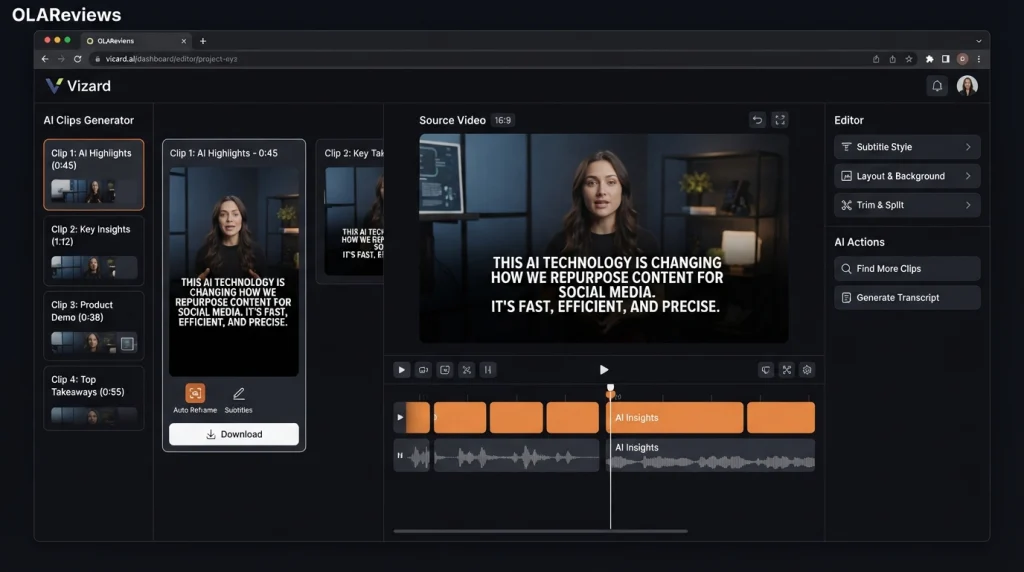
Vizard is designed to turn long-form video into short-form social content. This is particularly useful for creators who publish podcasts, interviews, webinars, educational videos, livestreams, and YouTube content. Instead of watching an entire video and manually searching for interesting sections, AI can identify potential highlights and turn them into shorter clips.
Vizard can help with:
YouTube Shorts
TikTok videos
Instagram Reels
Podcast clips
Webinar highlights
Interview clips
Marketing videos
Educational content
The free plan has limits on video processing, exports, storage, and other features. Free exports may also include branding.
Vizard vs OpusClip
OpusClip is another popular AI video-repurposing platform. It can identify highlights from longer videos and turn them into short clips. The exact features and limits differ between the two services. Vizard is useful for creators who want to test AI-powered video repurposing without immediately paying for another subscription. If you only publish a few videos each month, a free plan may be enough. High-volume creators are more likely to reach free-plan limits.
5. Auphonic for Audio Cleanup
Auphonic is an automated audio-processing platform that can improve spoken audio.
It is useful for:
Podcasts
Interviews
Voice recordings
Online courses
YouTube videos
Presentations
Spoken-word content
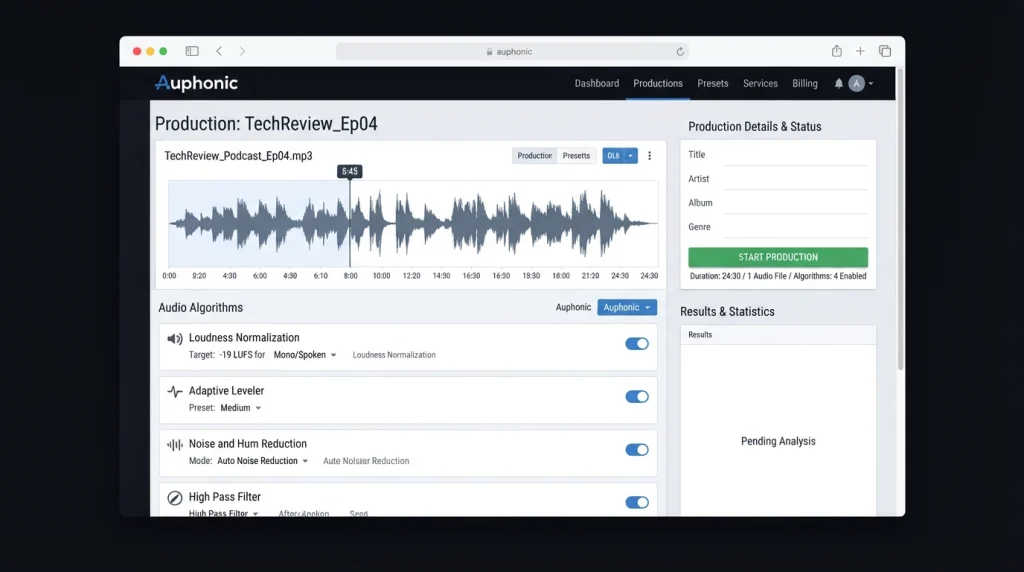
Auphonic can perform tasks such as loudness normalization, leveling, and noise reduction.
The free plan currently provides up to two hours of audio processing per month. Free productions include Auphonic branding in the form of an audio jingle.
For someone who records a small number of podcasts or voice clips, two hours can be enough for basic monthly needs.
Auphonic vs Descript
Descript is a broader audio and video editing platform. It combines transcription, editing, AI tools, and media production features.
Descript’s Hobbyist plan currently costs $24 per month when billed monthly, with a lower effective monthly price when billed annually.
Descript can make sense for users who need a complete editing environment. Auphonic is more focused on automated audio processing.
If your main requirement is improving the quality and loudness of recorded speech, you may not need a complete paid editing platform.
6. Flair AI for Product Photography
Flair AI is designed for creating product photography and marketing visuals with AI.
Traditional product photography can require cameras, lighting equipment, backgrounds, props, and editing software. AI tools can simplify the process by allowing businesses to create product scenes digitally.
Flair AI can be used for:
E-commerce images
Product advertisements
Social media content
Promotional graphics
Marketing campaigns
Product concepts
Online-store visuals
This can be particularly useful for small businesses that need attractive product visuals but do not have a large photography budget.
Flair AI vs Pebblely
Pebblely is another AI product-image platform. Its Lite plan currently costs $9 per month and provides a limited number of generated images and background options.
Paid plans increase image limits and provide additional capabilities.
The main benefit of trying a free product-photography tool first is that you can determine whether the generated images meet your quality requirements.
Always check product images carefully before publishing them. AI can sometimes alter small details such as packaging, labels, logos, text, proportions, or product features.
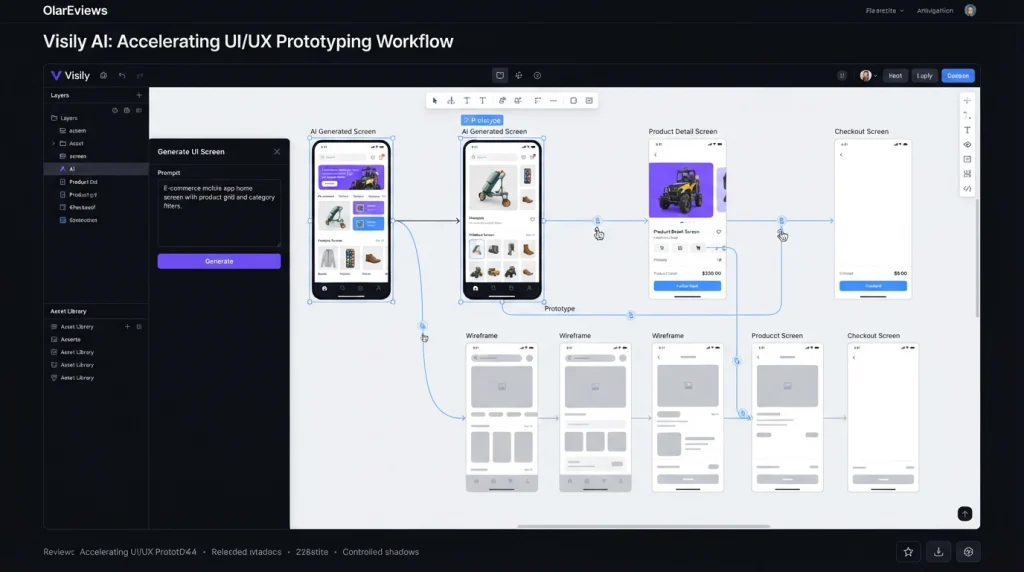
7. Visily for UI and UX Prototyping
Visily is an AI-powered design and prototyping platform for creating website and application interfaces.
It can help users turn ideas into wireframes, mockups, and prototypes without requiring advanced design skills.
Typical uses include:
Website wireframes
Mobile app concepts
UI mockups
UX planning
Product prototypes
Design brainstorming
Early-stage product ideas
Visily’s free Starter plan currently includes a limited monthly AI-credit allowance along with standard design functionality.
Its Pro plan costs about $11 per editor per month when billed annually and increases AI credits while adding features such as more boards, Figma support, code export, and additional design capabilities.
Visily vs Uizard
Uizard is another AI-powered UI and UX design platform.
Its free plan allows users to create a limited number of projects and AI generations. Uizard Pro is currently priced at $12 per month when billed annually.
For people who are simply experimenting with website or app ideas, a free Visily account can be enough to create initial concepts.
A paid design platform becomes more relevant when you need larger projects, more AI generations, private projects, or developer handoff features.
8. Voicenotes for Voice Typing and Dictation
Voicenotes is designed for people who prefer speaking instead of typing.
You can use it to capture ideas, reminders, meetings, personal notes, and other spoken information.
Its free Basic plan currently includes:
100 minutes of transcription and summaries per week
Unlimited raw recordings
30-day history
A limited dictation trial
The weekly transcription allowance makes Voicenotes useful for people who regularly capture short voice notes.
Voicenotes vs Wispr Flow
Wispr Flow focuses more strongly on voice-powered typing and dictation across supported applications.
Wispr Flow offers a free individual plan, while its Pro plan costs $15 per month or $144 annually, which works out to $12 per month.
Voicenotes is more focused on recording and organizing notes, while Wispr Flow is designed around using your voice as an input method while working across applications.
The right option depends on whether you mainly want a voice notebook or a voice-first typing system.
9. Napkin AI for Visual Thinking
Napkin AI turns written ideas into visual content such as diagrams, charts, and other visual explanations.
This can be useful when information is easier to understand as a visual rather than a paragraph.
Napkin AI can help with:
Business presentations
Blog diagrams
Process explanations
Strategy documents
Educational content
Visual brainstorming
Concept explanations
Business storytelling
Napkin’s free plan currently provides a weekly AI-credit allowance and supports visual editing and exports, although free visuals include Napkin branding.
The Plus plan currently costs $9 per person per month and provides a higher credit allowance along with additional export and branding features.
Napkin vs XMind
XMind is more directly focused on mind mapping and structured brainstorming.
XMind Premium currently costs about $8.25 per month and includes additional AI and collaboration features.
Napkin is more focused on turning written information into polished visual explanations, while XMind is strongly associated with traditional mind maps and structured idea organization.
For presentations and content creation, Napkin can be useful. For classic mind mapping, XMind may provide a more focused workflow.
10. Jotform AI for AI Form Creation
Jotform is an online form-building platform that can help businesses and individuals create forms for different purposes.
It can be used for:
Contact forms
Surveys
Registration
Customer feedback
Lead collection
Applications
Order forms
Payment forms
Jotform offers a free Starter plan with usage limitations and Jotform branding.
Its wide range of templates, widgets, integrations, and form features makes it useful for small businesses that need online forms without building everything from scratch.
Jotform vs Typeform
Typeform documentation is another well-known online form platform. Its Basic plan currently costs $39 per month when billed monthly or $28 per month when billed annually.
Typeform is known for its interactive form experience and conversational approach.
Jotform provides a broader selection of form-related tools and workflows, while Typeform focuses strongly on the user experience of answering forms.
For basic data collection, Jotform’s free plan can be enough. If you need higher response limits, additional branding controls, or advanced business functionality, you may need a paid plan.
Can Free AI Tools Really Replace Paid Subscriptions?
Free AI tools can replace some paid subscriptions, but they do not necessarily replace every premium feature. The most important factor is how often you use a tool. Someone who generates a few images each week may be comfortable with a free image generator. A professional designer producing hundreds of images may quickly reach the free limit.
The same applies to meeting assistants, video tools, research platforms, and form builders. Before paying for a subscription, consider these five factors.
1. Usage Limits
Check how many credits, minutes, generations, projects, responses, or exports are included.
2. Watermarks
Some free tools add branding to exported images, videos, documents, or other content.
3. Privacy
Before uploading confidential business information, review the provider’s current privacy policy and data-handling terms.
4. Export Options
A free plan may restrict high-resolution exports, premium formats, or advanced file options.
5. Integrations
API access, automation, CRM connections, team management, and advanced integrations are often reserved for paid plans.
How to Choose the Right Free AI Tool
You do not need to use all 10 tools.
Start with the task you perform most often.
If you create images, test Leonardo AI. If you conduct research using documents, try Gemini Notebook. For online meetings, Fathom may cover your basic needs.
Content creators can test Vizard for short-form video and Auphonic for audio. E-commerce businesses can explore Flair AI. Product teams can experiment with Visily, while people who prefer speaking can use Voicenotes.
Napkin AI is useful for visual explanations, and Jotform can handle many everyday form-building requirements.
If you are also exploring AI tools for broader business workflows, you can read our related guide on AI Agent Platforms and autonomous AI tools to understand how AI agents differ from standard software tools.
The goal is not to collect dozens of free AI accounts. The goal is to find the smallest set of tools that can handle your actual workload.
Final Thoughts
In 2026, free AI tools can handle many tasks that once required multiple paid subscriptions. Leonardo AI creates images, Gemini Notebook supports research, Fathom captures meeting notes, and Vizard turns long videos into shorts. Auphonic improves audio, while Flair AI helps create product visuals. Visily supports UI design, Voicenotes handles voice notes, Napkin AI creates visual content, and Jotform helps build online forms. The best approach is to test each free plan before subscribing. If its limits meet your needs, you can avoid another monthly expense. If you need more credits, storage, exports, or advanced features, upgrade when necessary. Always check official pricing pages because AI plans and limits can change frequently.
Customer research can become slow when every interview requires recruiting, scheduling, moderation, transcription, and manual analysis. Listen Labs takes a different approach by using AI to conduct customer interviews, analyze conversations, and turn qualitative feedback into structured research.
The company has also attracted attention because of an unusual financing development. Listen Labs reportedly signed a term sheet for a $125 million Series C at a $1.5 billion valuation, but later walked away from the deal amid reported acquisition discussions with Salesforce. The funding story is interesting, but for product managers, marketers, founders, and researchers, the bigger question is what Listen Labs can actually do.
How We Evaluate Listen Labs
We evaluated Listen Labs around the workflow teams typically follow when turning a research question into customer insights. Instead of looking only at a feature checklist, we considered whether the platform can reduce repetitive research work while still giving teams enough evidence to make informed decisions.
Our evaluation focused on research setup, participant recruitment, AI moderation, qualitative analysis, research outputs, and scalability. We also considered practical SaaS and marketing use cases, including usability testing, concept research, customer interviews, and feedback analysis. For more information about our review approach, see our testing process.
What We Looked At
Research setup: How quickly you can create a study and interview guide.
Participant recruitment: Options for finding relevant respondents.
Interview quality: Whether AI can ask meaningful follow-up questions.
Analysis: How conversations become themes, quotes, and behavioral signals.
Outputs: Whether findings can be shared with stakeholders.
Scale: Languages, audience reach, and simultaneous interviews.
At-a-Glance Comparison
Tool Name
Best For
Starting Price
Listen Labs
AI-moderated customer interviews and end-to-end qualitative research
Custom pricing / demo
Listen Labs: Best AI Customer Research Tool for End-to-End Interviews
If you want customer research to move from an initial question to analyzed interviews without stitching together several separate tools, Listen Labs offers a broad end-to-end approach. You can define a research objective, create or upload an interview guide, recruit participants, run AI-moderated interviews, and analyze the resulting conversations within the same research workflow.
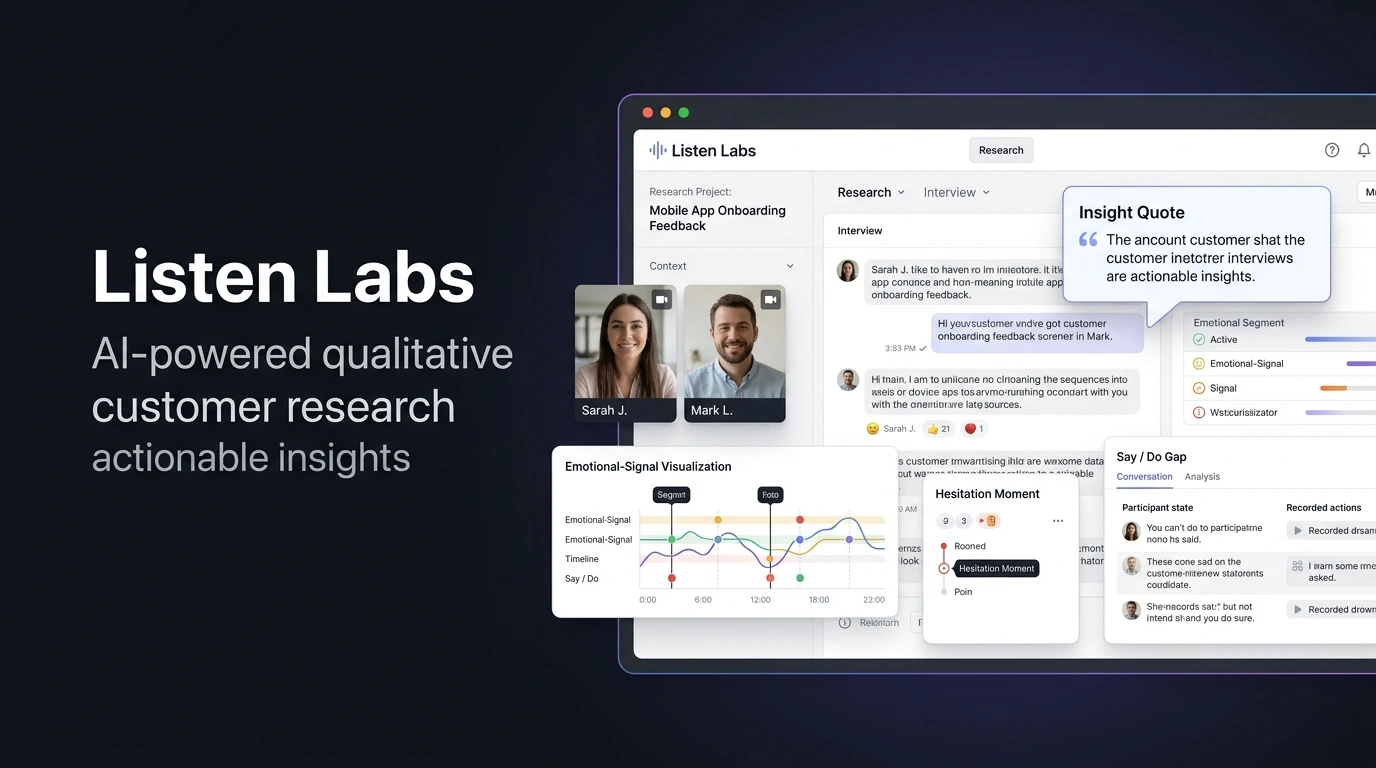
The AI moderator is where the platform becomes more interesting than a basic questionnaire. Rather than only following predetermined questions, Listen can use follow-up questions to explore what participants say. This allows researchers to investigate the reasoning behind an answer instead of collecting short responses. The platform also supports video, audio, text, and screen-based research.
For SaaS teams, that means you can investigate what customers think about a feature while also observing how they interact with a product or prototype.
Pros
End-to-end workflow: Study design, recruitment, interviews, analysis, and deliverables can be managed in one platform.
Detailed qualitative signals: The platform can surface themes, quotes, hesitation moments, and Say/Do Gaps.
Cons
Custom pricing: You don’t get a simple public self-serve pricing page with standard monthly tiers.
Human review is still important: AI can accelerate research, but important studies still require researchers to check questions and findings.
Pricing: Listen Labs currently uses a demo/custom-pricing approach instead of publishing standard Starter, Pro, and Enterprise tiers. Its pricing research notes that AI-moderated qualitative research across the market can commonly cost around $25–$50 per interview. However, this is a market benchmark and should not be treated as Listen Labs’ official rate.
What Makes Listen Labs Different?
Many AI customer research tools concentrate on one part of the research process. One product might handle surveys, another may recruit participants, while another turns interview transcripts into summaries. Listen Labs is designed to bring several of these stages together. This can reduce the number of separate handoffs between your research question and final findings. The platform can also identify details that may be easy to overlook when reviewing large numbers of transcripts.
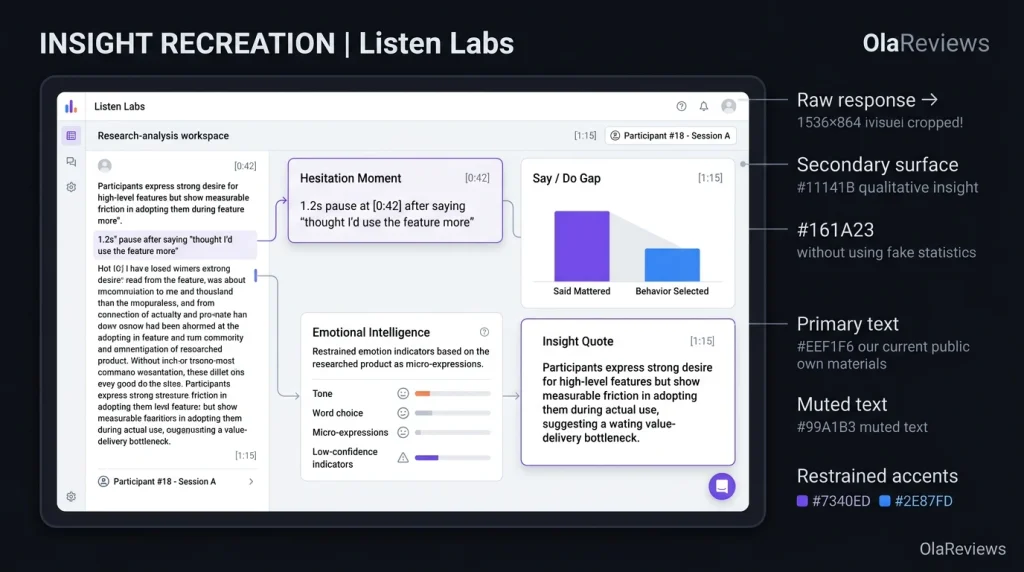
For example, Listen showcases “Hesitation Moments” that highlight pauses in participant responses and “Say/Do Gaps” that reveal differences between what customers claim matters and what they actually choose. This type of analysis can be useful because customer feedback rarely arrives in neat categories. A customer may say price is the most important factor but choose a product because it is more convenient. Another person might describe a feature as useful but struggle to complete the workflow during a usability session.
Listen also positions its platform for research across multiple audiences and markets. Its current materials state that AI-moderated interviews can operate across 120+ languages, while its participant network provides access to more than 50 million potential respondents. These figures come from Listen’s own materials, so teams should validate audience availability for their specific market before planning a large study.
What Can You Use Listen Labs For?
Listen Labs goes beyond conventional one-on-one customer interviews. You can use the platform for concept testing, prototype research, usability studies, creative testing, customer insights, B2B research, and brand-related research. That range makes it relevant when you need to understand the reasoning behind customer behavior rather than simply collect yes-or-no responses.
For a product manager, you could test a new onboarding flow before development is complete. A marketer could investigate why a campaign resonates with one audience but not another. A founder could interview potential customers before committing to a new product direction.
Common Use Cases
Concept testing: Get reactions before investing heavily in development.
Usability testing: Observe customers interacting with products or prototypes.
Creative testing: Explore reactions to advertisements and messaging.
B2B research: Interview professional and specialized audiences.
Consumer research: Explore preferences, motivations, and purchasing behavior.
For SaaS teams, screen-based research can be especially valuable because it adds behavioral context to spoken feedback. Instead of asking someone whether a workflow feels simple, you can observe how they actually navigate it. That distinction matters because customers sometimes describe an experience as easy while hesitating, searching, or taking an unexpected route during the task.
Listen Labs and AI Interview Tools
The rise of AI interview tools is changing the economics and speed of qualitative research. A human moderator can ask nuanced questions, but conducting dozens or hundreds of interviews manually requires considerable time. AI moderation can allow multiple conversations to happen in parallel while maintaining a consistent research framework. However, that does not automatically make AI moderation suitable for every study.
Sensitive interviews, complex stakeholder research, or highly specialized research may still benefit from an experienced human moderator. Listen’s value is better understood as an additional research engine. It can help teams collect more conversations and identify patterns faster while researchers remain responsible for study design, context, validation, and interpretation.
Listen Labs vs. Traditional Customer Research
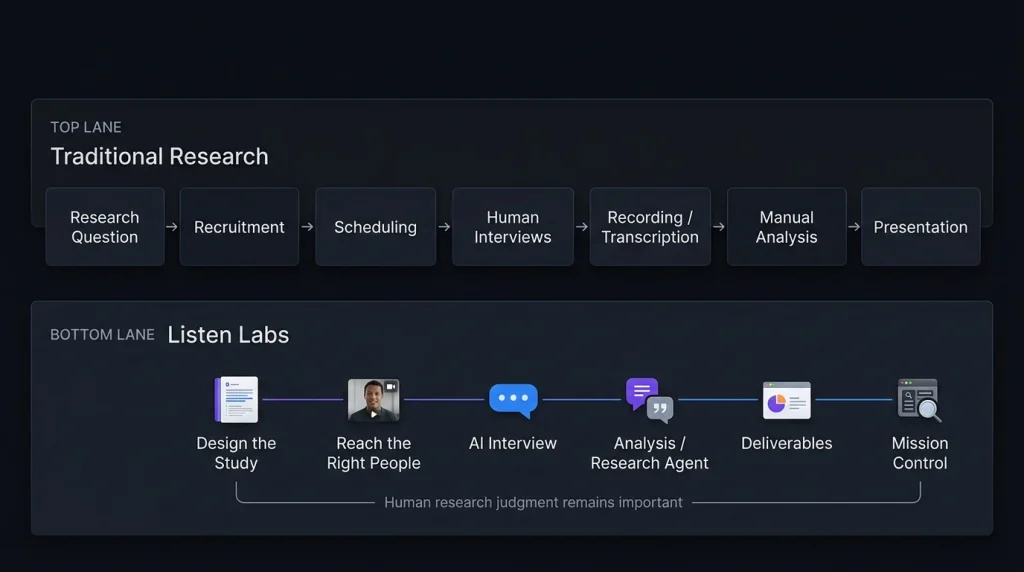
Traditional qualitative research can involve several separate stages. You define the study, recruit respondents, schedule interviews, moderate conversations, record sessions, transcribe them, organize themes, analyze findings, and eventually prepare a presentation. Each handoff can introduce delays or lost context. Listen Labs attempts to compress much of that workflow into one platform, covering study design, participant access, AI-moderated interviews, analysis, and research deliverables.
For teams that conduct customer research regularly, reducing these operational steps could be as important as any individual AI feature. The bigger question is what happens after the AI generates the findings. You still need to determine whether a theme is meaningful, whether the sample represents the audience you care about, and whether a customer statement reflects a broader pattern or an isolated opinion. Automation can shorten the path to evidence, but it does not remove the need for research judgment.
Why the $125M Series C Story Matters
Listen Labs’ financing story has become part of the company’s recent profile. TechCrunch reported that Listen had signed a term sheet for a $125 million Series C at a $1.5 billion valuation, with Menlo Ventures reportedly expected to lead the financing. The company subsequently walked away from the agreement amid reported discussions involving Salesforce. Business Insider separately reported that Salesforce had discussed acquiring Listen Labs for approximately $2 billion.
It also reported rapid company growth, including more than one million interviews conducted within a nine-month period. These figures are reported by the company or media outlets rather than independently verified product-performance measurements. They provide useful business context, but they should not be treated as evidence that the platform will deliver a specific research outcome for your team.
Final Thoughts on Listen Labs
Listen Labs sits at an interesting intersection of AI, customer research, and qualitative analysis. Its strongest proposition is not simply that AI can conduct an interview. Instead, recruitment, moderation, analysis, and research outputs can be connected within one workflow. If you are exploring more AI tools for productivity, marketing, research, and business workflows, you can discover additional options on Olareviews.
For product managers, marketers, founders, researchers, and SaaS teams, this approach can make large-scale qualitative research easier to organize. If you’re comparing AI customer research tools, the practical next step is to request a demo and test the workflow against one genuine research question. The real test is whether Listen can help you uncover customer insights that are difficult to identify from your existing data alone.
FAQ
Is Listen Labs an AI research tool?
Yes. Listen Labs is an AI-powered qualitative research platform for study design, participant recruitment, AI-moderated interviews, analysis, and research outputs.
Can Listen Labs replace researchers?
It can automate parts of the research process, but human judgment remains important. Researchers still need to define questions, review interviews, understand sample limitations, validate findings, and interpret results.
Are AI interviews safe to use?
Teams should obtain appropriate consent, explain recording and analysis practices, avoid collecting unnecessary sensitive information, and follow relevant privacy requirements.
Editorial disclosure:This article is an independent evaluation based on current public product information and available product materials as of September 2026.
AI Agents are moving beyond simple chatbots. Instead of only answering questions or generating text, modern agents can use software, follow workflows, complete tasks, and return to humans when approval is needed. Trooper is built around this idea. It positions AI agents as digital teammates that can work across business tools and handle real tasks instead of simply responding to prompts. For this review, we evaluated Trooper as an AI agent platform during the September 2026 review cycle, focusing on its task execution, integrations, memory, workflows, security, deployment options, and pricing. The platform is aimed at business owners, developers, marketers, SaaS users, and technical teams that want more than a standard AI assistant.
What Is Trooper?
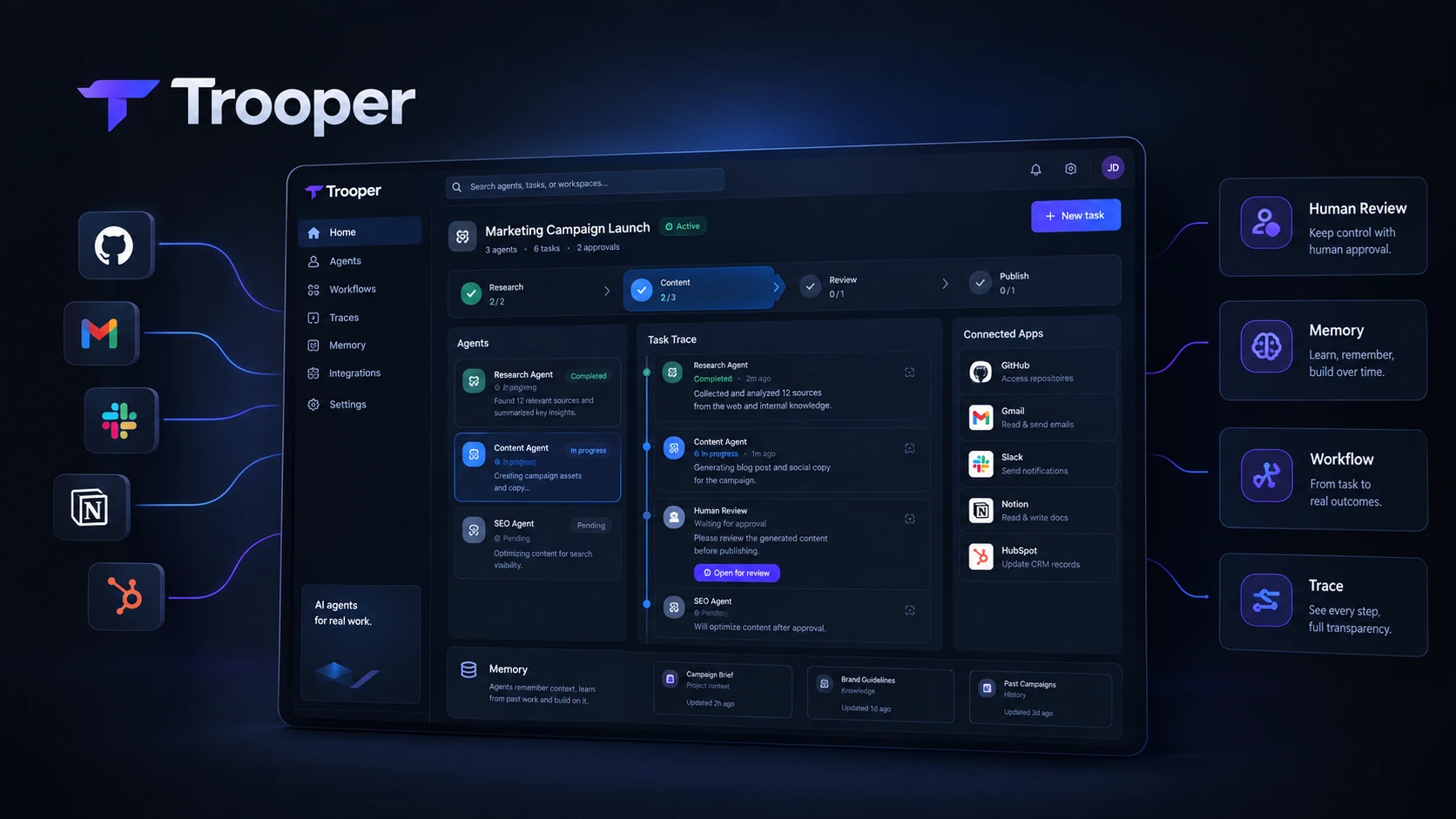
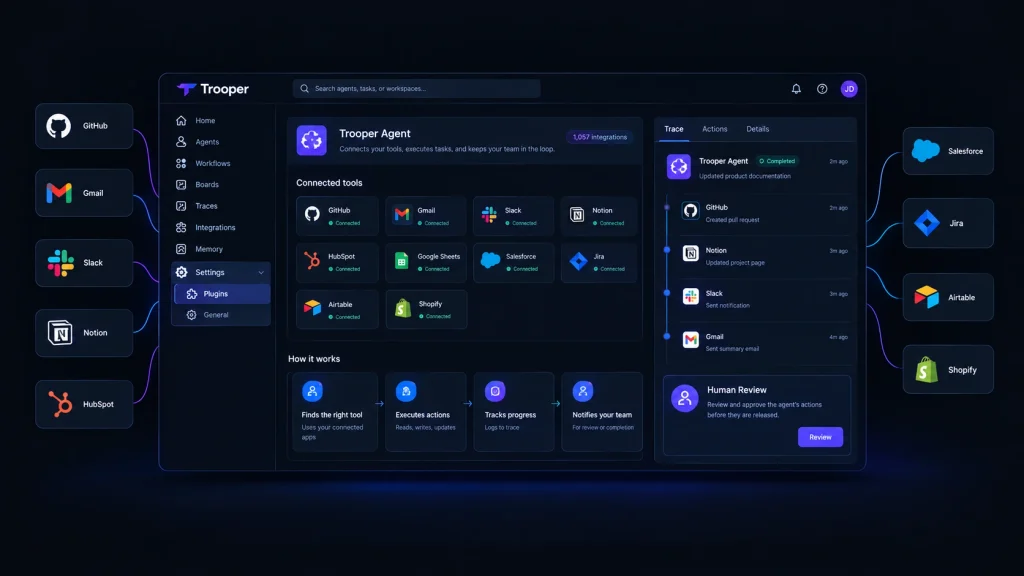
Trooper is an AI agent platform designed to give AI agents access to the tools people already use for work. Instead of keeping the agent inside a chat window, Trooper lets agents work with applications such as GitHub, Gmail, Slack, Notion, Linear, Figma, HubSpot, Salesforce, Jira, Airtable, Shopify, Intercom, Asana, Google Docs, LinkedIn, Trello, and many others. Its website currently lists more than 1,000 integrations. This makes Trooper closer to an AI workforce platform than a traditional chatbot. You can give an agent a task, let it work through connected tools, and require human approval before important actions are completed. Trooper also supports persistent memory, workflows, browser automation, and different deployment options. The main idea is simple: tell the agent what needs to be done, give it access to the required tools, and let it execute the work.
Trooper Features
AI Agent Platforms Built for Task Execution
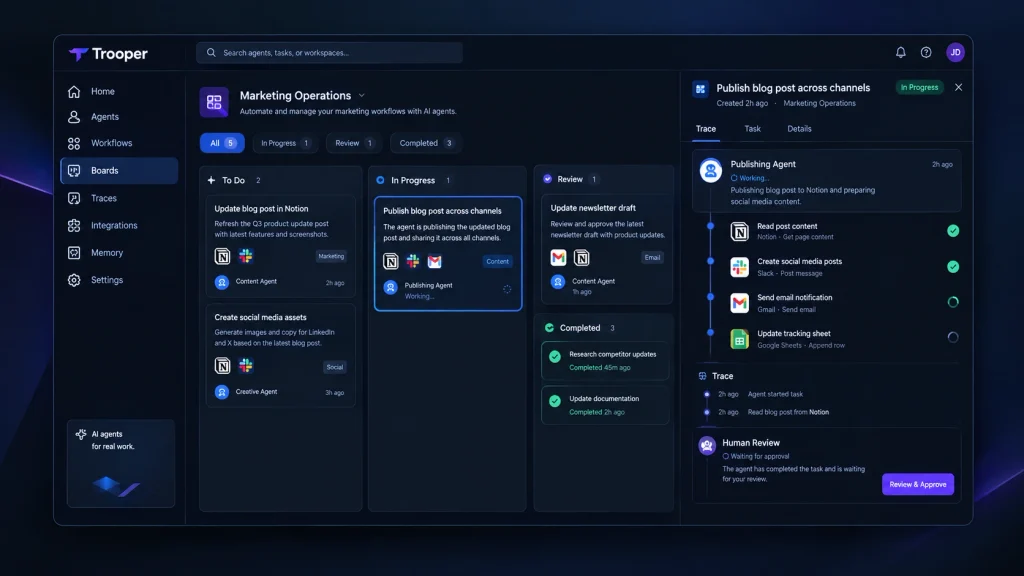
Many AI Agent Platforms still focus heavily on conversation. Trooper takes a more action-oriented approach. Agents can create issues, update files, send emails, work with business applications, and complete multi-step tasks. The platform also provides traces so users can follow what happened during a mission. This is important for teams that want AI automation tools to handle operational work rather than only generate content.
For example, Trooper’s operations workflow describes a process where an agent follows an operations runbook, executes steps across connected tools, sends failures to Slack with context, and updates the related runbook in Notion after completing the work. That type of workflow shows where Trooper fits best: repetitive business processes that involve several applications.
Human Approval and Control
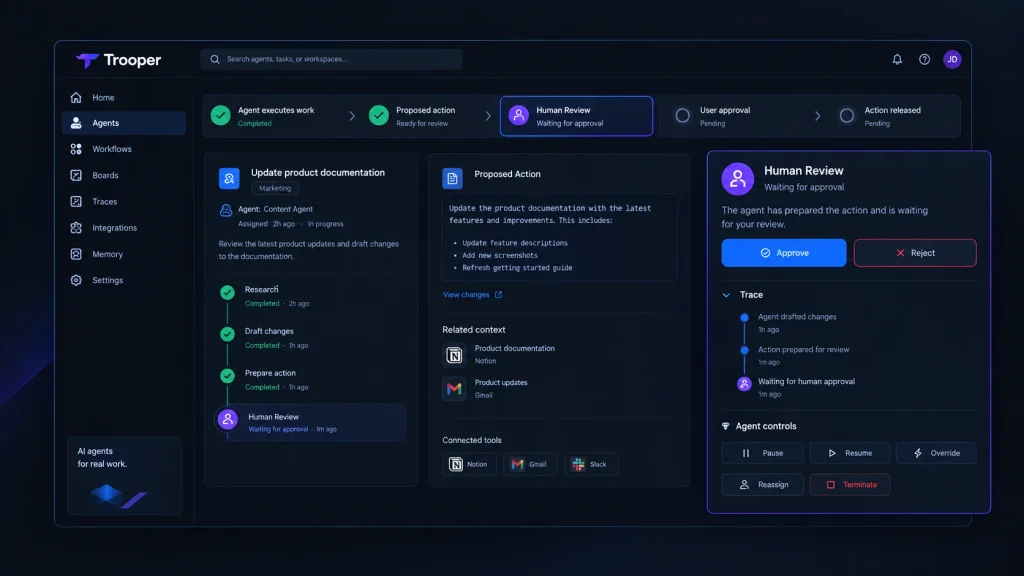
Autonomous AI agents can create problems if they are allowed to perform every action without supervision. Trooper takes a more controlled approach. Its system includes human review gates, meaning important actions can wait for approval before being released. The company says commits, replies, and campaigns can remain in Human Review until the user approves them.
This is one of Trooper’s stronger features for business use. Instead of choosing between full automation and manual work, teams can create a middle ground. The agent handles the repetitive work while a human remains responsible for final approval.
Persistent Memory
Trooper also includes adaptive memory. The purpose is to help agents retain useful business context, decisions, preferences, and information from previous work. This can reduce the need to repeat the same instructions whenever an agent starts a new task. For teams running recurring workflows, persistent memory can be especially useful because the agent can work with more context instead of treating every task as completely new.
Integrations
Integrations are one of Trooper’s biggest strengths. The platform currently lists more than 1,057 integrations, covering development, communication, CRM, productivity, marketing, finance, and other business categories. Some notable integrations include GitHub, Gmail, Slack, Notion, Linear, Figma, HubSpot, Stripe, Salesforce, Google Sheets, Jira, Airtable, Zendesk, Shopify, Discord, Intercom, Asana, Google Docs, LinkedIn, Trello, GitLab, Sentry, Calendly, Dropbox, ClickUp, OpenAI, Supabase, Vercel, Zoom, Mailchimp, Canva, Telegram, WhatsApp, and QuickBooks. This broad integration layer is important because an AI agent becomes much more useful when it can operate inside the same systems a business already uses.
Browser Automation and Desktop Access
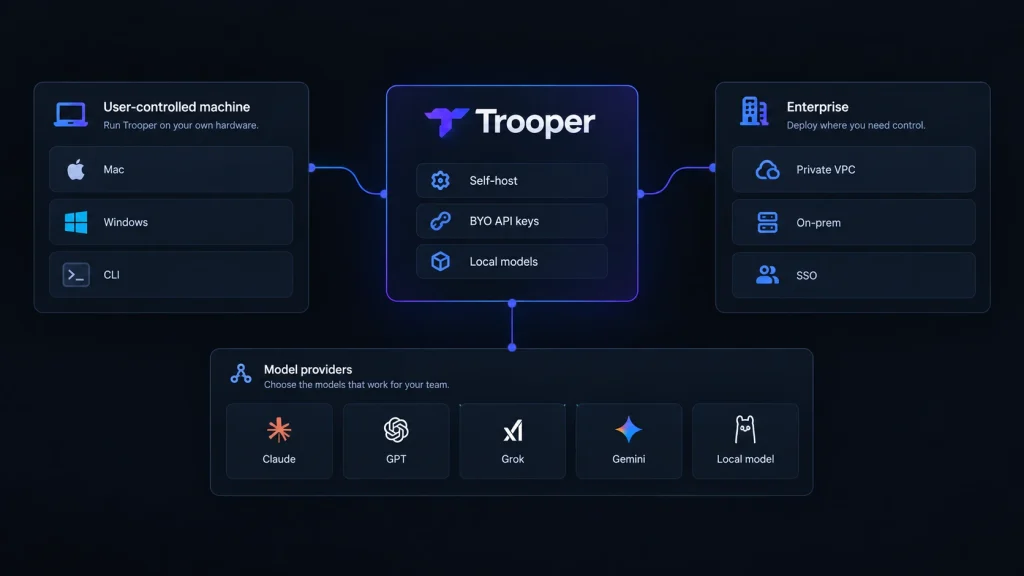
Trooper is not limited to API-based integrations. The platform also supports browser automation and desktop access. Its self-hosted offering can run on hardware controlled by the user, with Mac and Windows applications available. This can make Trooper useful for workflows where a direct API integration is not available. For technical users, this provides another way to connect agents with existing processes without moving every task into a separate system.
Trooper for Business Automation
Trooper makes the most sense when a business has recurring processes that require multiple steps. Consider an operations team that receives a request, checks information in a CRM, updates a spreadsheet, sends a message in Slack, and records the result in Notion. A conventional chatbot can help write the message or explain the process. Trooper is designed to take a larger part of the workflow itself. This is where autonomous AI agents can provide more value than standard AI assistants.
The platform also provides specific use cases for operations, CRM updates, sales research, and marketing. Its CRM workflow, for example, focuses on keeping customer information updated across business systems. For small teams, this can reduce the amount of repetitive administrative work handled manually.
Trooper for Developers
Developers can use Trooper for software-related workflows involving tools such as GitHub and other development platforms. An agent can be assigned work, interact with connected tools, and keep users informed about what it is doing. The human approval model is also useful for development teams. Instead of allowing an agent to automatically release every change, teams can keep a review step between the agent’s work and the final action. Trooper also supports self-hosting, which can be attractive to technical teams that want more control over where the system runs and how models are connected.
Trooper Security and Self-Hosting
Security and control are important when AI agents can access business systems. Trooper says API keys are not stored on its servers and that organizations receive isolated workspaces with encrypted connections. The platform also supports running Trooper on hardware controlled by the user. The Trooper self-hosting option allows users to run the platform on their own machine or VM. Users can connect models such as Claude, GPT, Grok, Gemini, or local models, with model usage billed directly by the relevant provider.
This approach gives technical teams more control over deployment and model selection. Trooper also places limits on agent autonomy. According to its documentation, agents cannot hire other agents, increase their own budgets, or execute an unreviewed strategy. That makes the platform more practical for businesses that want automation without giving an AI system unlimited authority.
Trooper Pricing
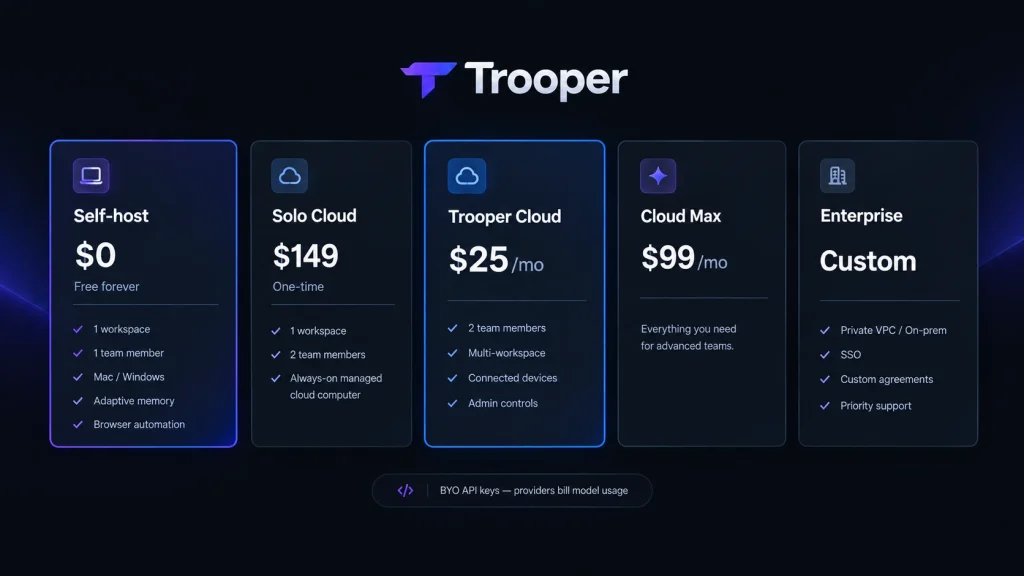
Trooper uses a deployment-based pricing model.
Self-Host
The self-hosted version includes one workspace and one team member. It includes unlimited agents and chats, adaptive memory, shared workflows, skills, integrations, browser automation, and Mac or Windows support. Users bring their own API keys, so model usage is paid directly to the relevant AI provider.
Solo Cloud
Solo Cloud provides hosted access with two team members and one workspace. It includes an always-on managed cloud computer and lifetime hosted access. This plan may appeal to users who want Trooper hosted for them rather than managing the infrastructure themselves.
Trooper Cloud
Trooper Cloud includes two team members. Additional members cost $10 per month. The plan also adds multi-workspace support, connected devices, admin controls, and team collaboration features. Users still bring their own API keys.
Cloud Max
Trooper currently lists Cloud Max at $99 per month in its pricing options. The exact limits and capabilities should be checked on the current Trooper pricing page before purchasing because plan details can change.
Enterprise
Enterprise pricing is custom. The enterprise offering includes private cloud or VPC deployment, on-premises options, SSO, custom domains, agreements, and priority support with an SLA.
Trooper Pros and Cons
Pros
Strong focus on real task execution
More than 1,000 listed integrations
Persistent memory and shared workflows
Human approval gates
Browser automation
Mac and Windows support
Self-hosting option
BYO API keys
Multiple deployment options
Useful for operations, sales, marketing, and development
Cons
Model usage is billed separately
Advanced features can require technical knowledge
Self-hosting requires more responsibility from the user
The platform may be more complex than a basic AI chatbot
Businesses need to carefully configure permissions and approval workflows
Who Should Use Trooper?
Trooper is a strong fit for businesses that want AI to perform multi-step work rather than simply answer questions.
Business Owners
Business owners can use Trooper for repetitive operations, customer workflows, research, and administrative processes.
Developers
Developers can connect AI agents to development tools and create workflows around software projects.
Marketers
Marketing teams can use agents for research, content workflows, campaign tasks, and communication processes.
SaaS Teams
SaaS companies can use Trooper to connect multiple business systems and automate recurring internal workflows.
Technical Teams
Teams that care about deployment control, self-hosting, local models, and API access may find Trooper particularly interesting.
Is Trooper Worth It in 2026?
Trooper is worth considering if you want AI agents that can actually interact with your business systems. Its strongest advantage is the combination of task execution, integrations, persistent memory, workflows, and human approval. Instead of treating AI as a tool for generating answers, Trooper treats agents more like digital workers that operate inside existing software.
The self-hosted $0 option also makes it easier to experiment without committing to a monthly subscription, although users still need to pay their AI model providers for usage. The biggest question is whether you actually need this level of automation. If you mainly want writing, brainstorming, summaries, or basic questions, a traditional AI assistant may be simpler. If your goal is to automate recurring business processes across multiple applications, Trooper becomes much more interesting.
Final Verdict
Trooper is a serious AI agent platform for users who want software that can do more than chat. Its combination of integrations, task execution, persistent memory, browser automation, workflows, and human approval makes it suitable for real business automation. The self-hosting option is another major advantage for technical users who want greater control over their environment. The biggest limitation is complexity. Trooper is not simply another chatbot that you open and start asking questions. To get the most value from it, users need to think about workflows, permissions, connected tools, model costs, and approval rules. For businesses, developers, marketers, and SaaS teams that are ready to move from AI assistance toward AI execution, Trooper is one of the more interesting platforms to watch in 2026.
Best for: Business automation, AI agents, multi-step workflows, technical teams, and users who want self-hosting.
Pricing: Free self-host option, $149 one-time Solo Cloud, $25/month Trooper Cloud, $99/month Cloud Max, and custom Enterprise pricing.
FAQs
What is Trooper AI?
Trooper is an AI agent platform that lets AI agents work across connected business tools, execute tasks, follow workflows, and return to humans for approval when required.
Is Trooper free?
Yes. Trooper offers a self-hosted plan that costs $0 forever. Users bring their own API keys and pay AI providers directly for model usage.
Does Trooper support self-hosting?
Yes. Trooper can be installed on hardware controlled by the user, including Mac or Windows systems, and it can also work with local models.
Who is Trooper best for?
Trooper is best suited to businesses, developers, marketers, SaaS teams, and technical users who want AI agents to perform real work across multiple applications instead of only generating responses.
Understanding what happens on your website can get complicated fast. You may have traffic in Google Analytics, clicks in another tool, heatmaps somewhere else, and conversion data spread across several reports. AI Website Analytics tools aim to reduce that mess by turning raw website activity into clearer answers and useful recommendations. Page Pulse takes a simpler approach. Instead of trying to replace every analytics platform, it combines traffic, clicks, conversions, heatmaps, and AI insights in one dashboard. Its free plan also removes the usual traffic-based pricing problem, which makes it interesting for smaller websites. I evaluated Page Pulse alongside seven major analytics alternatives using current product information, pricing, features, and setup workflows available in September 2026.
How We Evaluate AI Website Analytics Tools
For this comparison, I evaluated eight website analytics platforms during a September 2026 review pass. The goal was not simply to count features. I focused on how useful each platform is when you need to move from “something changed” to “here is what I should investigate next.”
The main criteria were:
Ease of installation and initial setup
Traffic, conversion, and behavioral analytics
AI-powered insights and recommendations
Heatmaps and session recordings
Privacy and data ownership
Pricing limits and scalability
I also checked current pricing pages and product documentation because analytics pricing can change quickly, particularly when billing depends on sessions, events, pageviews, or tracked pages.
AI Website Analytics Tools at a Glance
Tool Name
Best For
Starting Price
Page Pulse
Simple analytics with AI insights
Free
Google Analytics 4
Advanced website and marketing analytics
Free
Microsoft Clarity
Heatmaps and session recordings
Free
Plausible Analytics
Privacy-focused website analytics
$9/mo
Fathom Analytics
Simple privacy-first analytics
$15/mo
Hotjar
Behavioral analysis and user research
Free
Matomo
Data ownership and advanced analytics
Free
Mixpanel
Product analytics and event tracking
Free
Page Pulse: Best AI Website Analytics for Simple Dashboards
Page Pulse is the most interesting option if you want AI Website Analytics without building a complicated reporting stack. Its main dashboard brings together visitors, page views, leads, conversion rate, bounce rate, clicks, and other website signals. It also adds heatmaps and AI insights. The setup is intentionally lightweight. Page Pulse says its tracking script is under 3 KB, and its workflow is essentially to install the script, wait for data, and open the dashboard. One useful detail is that the platform does not charge based on traffic. Even the free plan includes unlimited traffic, although the number of tracked pages is limited. That makes the product especially appealing when your website is growing but you do not want every traffic spike to increase your analytics bill. Its AI layer is also more practical than simply adding an “AI” label to a dashboard. The platform describes AI insights as a way to surface issues and opportunities automatically, while its heatmaps show where visitors click, scroll, and engage.
Pros
Unlimited traffic on every plan
Combines analytics, conversions, heatmaps, and AI insights
Cons
Free plan tracks only one page
Less mature for highly complex enterprise analytics
Pricing: Free includes 1 page, unlimited traffic, 14 days of data retention, basic analytics, and 15 AI insights per month. Starter is $29/month for 2 pages and 100 AI insights. Growth is $79/month for 5 pages and 250 AI insights. Pro is $129/month for 10 pages and 750 AI insights. Scale is $199/month for 20 pages and 1,500 AI insights per month.
Google Analytics 4: Best AI Analytics Tools for Advanced Reporting
Google Analytics remains difficult to ignore because it can handle far more than basic visitor counting. Its machine-learning features can detect unusual changes, generate insights, and provide predictive metrics when your property has enough eligible data. The biggest 2026 development is its growing AI layer. Google has introduced generated insights and an Ask Advisor experience powered by Gemini. Ask Advisor can answer questions about a property, generate visualizations, and point you toward relevant reports. There is also a useful change for businesses measuring AI traffic. Google Analytics can identify visits coming from recognized AI assistants through a dedicated AI Assistant channel. This makes GA4 particularly useful if you want to understand how traditional search and generative AI are contributing to website traffic.
Pros
Extremely deep reporting and attribution capabilities
Strong machine-learning and AI functionality
Cons
More complicated than lightweight analytics platforms
Setup quality depends heavily on correct event tracking
Pricing: The standard Google Analytics 4 product is available at no charge. Google Analytics 360 is the paid enterprise offering with additional capabilities and limits.
Microsoft Clarity: Best for Free Behavioral Analytics
Microsoft Clarity is the easiest recommendation when your main question is not “where did visitors come from?” but “what did they actually do?” The platform provides session recordings and heatmaps, allowing you to watch visitor journeys and see where people click, scroll, or stop engaging. Its current product also includes AI summaries, AI chat, and AI visibility features. The useful part is that you can use Clarity alongside another analytics platform rather than replacing it. For example, GA4 can tell you that a landing page has a weak conversion rate, while Clarity can help you inspect the behavior behind that result. Microsoft says Clarity is free forever and does not impose traffic-based pricing. Its 2026 AI visibility features are also notable because Clarity can show how AI experiences surface your brand and which pages receive citations.
Pros
Free with no traffic limit
Excellent combination of recordings, heatmaps, and AI summaries
Cons
Not designed to replace every advanced marketing analytics function
Reporting depth is different from GA4 or Mixpanel
Pricing: Free forever, with no traffic-based charge.
Plausible Analytics: Best for Privacy-Focused Website Analytics Software
Plausible Analytics is a strong fit if you want useful website analytics without turning your dashboard into an analytics laboratory. It focuses on core traffic metrics, goals, events, segments, and reporting while keeping privacy central to the product. The current Starter plan begins at $9/month for up to 10,000 monthly pageviews. Growth is $14/month and Business is $19/month, with higher plans adding features such as funnels, user journeys, revenue attribution, custom properties, and API access. One practical detail is its installation testing tool. Plausible provides a testing feature inside the site settings that can send traffic to your website and verify whether the integration is working correctly. That is the kind of small operational feature you appreciate when you do not want to troubleshoot a tracking script manually.
Pros
Lightweight, privacy-focused analytics
Straightforward pricing based on usage
Cons
No permanent free plan
Less behavioral analysis than Clarity or Hotjar
Pricing: Starter is $9/month, Growth is $14/month, and Business is $19/month at the current 10,000 monthly pageview tier. Plausible also offers a 30-day free trial without a credit card.
Fathom Analytics: Best for Simple Privacy-First Reporting
Fathom Analytics takes the minimalist route. Instead of trying to become an enormous analytics suite, it focuses on helping you understand website traffic while avoiding cookies and keeping visitor privacy at the center. Its plans include features such as event tracking, ecommerce tracking, API access, unlimited email reports, unlimited data exports, and permanent data retention. The interesting pricing detail is how Fathom handles occasional traffic spikes. It does not immediately shut off analytics when you exceed your pageview limit. Instead, it looks at sustained usage and contacts you when an upgrade is appropriate. For a content site or SaaS business that occasionally gets featured or goes viral, that is a much friendlier approach than an instant tracking wall.
Pros
Simple privacy-first analytics
Includes API, events, ecommerce tracking, and exports
Cons
No permanent free hosted plan
Fewer behavioral visualization features than Clarity
Pricing: Fathom starts at $15/month with a 7-day free trial. Plans scale according to average monthly pageviews.
Hotjar: Best AI Analytics Tools for Understanding User Behavior
Hotjar is particularly useful when numerical analytics are not enough. Its Observe product combines heatmaps and recordings, while the wider platform also includes surveys, feedback, interviews, and user testing. The free Basic plan tracks up to 35 daily sessions and includes unlimited heatmaps. The Plus plan starts at $39/month and supports up to 100 daily sessions, while Business starts at $99/month for 500 daily sessions. One detail worth noticing is that Hotjar defines a session as a visitor’s complete journey across pages. That matters because the number on your analytics dashboard is not necessarily comparable with a pageview-based product. Hotjar is therefore strongest when your workflow is: identify a problem in your analytics, watch sessions, inspect the heatmap, then collect direct feedback.
Pros
Strong behavioral analytics
Combines recordings, heatmaps, surveys, and feedback
Cons
Paid plans can become expensive as session volume grows
More focused on behavior than broad marketing attribution
Pricing: Basic is free. Plus starts at $39/month, Business at $99/month, and Scale at $213/month.
Matomo: Best for Data Ownership
Matomo is the choice to consider when control over your analytics data matters as much as reporting. Its major distinction is that you can use the cloud-hosted version or run Matomo yourself. The self-hosted Community edition is free, while paid cloud and enterprise options scale according to traffic and requirements. Matomo states that its hosting options provide data ownership and privacy compliance. For organizations with technical teams, the self-hosting route can be particularly attractive because the company controls where the analytics infrastructure operates. The trade-off is complexity. You gain control, but you also inherit more responsibility for infrastructure and maintenance.
Pros
Strong data ownership options
Powerful analytics and ecommerce capabilities
Cons
Self-hosting requires technical resources
Advanced cloud plans can become expensive
Pricing: Matomo On-Premise Community is free. Matomo Cloud pricing currently starts at $26/month for 50,000 hits and reaches $204/month for 1 million hits.
Mixpanel: Best for Product and Event Analytics
Mixpanel is better suited to product teams than a simple content website. Its strength is understanding events, funnels, retention, feature usage, and user behavior inside digital products. The free plan supports up to 1 million events per month, 10,000 session replays, and up to 10 active feature flags. The pricing model also demonstrates why analytics tools cannot always be compared by monthly subscription alone. Mixpanel’s Growth plan is based heavily on event volume. Its current pricing calculator shows $120/month on annual billing for 18 million events per year. If your website is really a product with logins, workflows, subscriptions, and hundreds of meaningful user actions, Mixpanel can provide much deeper product intelligence than a traditional pageview dashboard.
Pricing: Free includes up to 1 million events/month. Growth starts at $0 and scales with event usage, while Enterprise pricing is custom.
Feature Comparison: Which Analytics Platform Fits Your Workflow?
Tool
AI Insights
Heatmaps
Session Recordings
Free Plan
Main Pricing Limit
Page Pulse
Yes
Yes
No
Yes
Tracked pages
Google Analytics 4
Yes
No
No
Yes
Advanced enterprise features
Microsoft Clarity
Yes
Yes
Yes
Yes
None for traffic
Plausible
Limited
No
No
Trial
Pageviews
Fathom
No major AI layer
No
No
Trial
Pageviews
Hotjar
AI features
Yes
Yes
Yes
Daily sessions
Matomo
Advanced analytics
Add-ons/options
Add-ons/options
Yes, self-hosted
Hosting/traffic
Mixpanel
AI/product intelligence
No
Yes
Yes
Events
Final Verdict: Is Page Pulse Worth Trying?
Page Pulse is worth a look if you want AI Website Analytics without building a complicated analytics stack. Its strongest advantage is the combination of simple reporting, conversions, heatmaps, and AI insights, while unlimited traffic on every plan keeps the pricing easier to predict. For advanced marketing analytics, GA4 remains hard to beat. Clarity is the better free choice for recordings, while Plausible and Fathom are strong privacy-focused options. But as AI becomes a normal part of analytics, will the best analytics tool eventually be the one that answers your questions instead of simply showing you charts?
FAQ
What are AI Website Analytics tools?
AI Website Analytics tools use machine learning or generative AI to help you interpret website data instead of forcing you to manually inspect every report. Page Pulse combines AI insights with traffic, conversions, clicks, and heatmaps, while Microsoft Clarity now provides AI summaries, AI chat, and AI visibility features.
Is Page Pulse better than Google Analytics?
It depends on what you need. Page Pulse is easier to understand if you want a compact dashboard with analytics, conversions, heatmaps, and AI insights. Google Analytics is the stronger choice when you need detailed attribution, event analysis, advertising measurement, and deeper customization.
Can you use two analytics tools together?
Yes. In fact, that can be the better approach. You might use GA4 for acquisition and conversion reporting, then Clarity for recordings and heatmaps. Similarly, a privacy-focused tool such as Plausible or Fathom can provide a simpler reporting layer while another platform handles specialized analysis.
Editorial disclosure: This is an independent review based on current product documentation, public pricing, and product workflows. Pricing and features can change.
Creating SEO content can become a repetitive cycle. You research keywords, check competitors, plan topics, write articles, add internal links, upload everything to your CMS, and then start over again. That is where AI SEO Tools can make a practical difference. Instead of using separate platforms for research, writing, publishing, and tracking, newer tools aim to connect those steps into one workflow. Distribb takes that approach further by combining keyword research, AI-generated content, CMS publishing, backlinks, content scheduling, and AI-search visibility tracking. It is designed for SEO professionals, content marketers, SaaS businesses, bloggers, and website owners who want more of the process automated.
How We Evaluate AI SEO Tools
For this review, we evaluated Distribb’s current workflow, published feature set, supported integrations, pricing structure, and the practical steps involved in turning a keyword idea into published SEO content. The evaluation focuses on what matters when you are considering an AI SEO platform for an active website rather than simply testing an AI writing demo.
We looked at:
Keyword and buyer-intent research
SEO article generation and original research
Internal linking and content clustering
CMS integrations and publishing controls
Backlink and AI-search visibility features
Monthly limits, pricing, and scalability
The review is written from an SEO-focused perspective, with particular attention to whether the platform can reduce repetitive work without removing editorial control.
At-a-Glance Comparison
Tool Name
Best For
Starting Price
Distribb
Automated SEO content and organic growth workflows
$97/month
Distribb Review: Best AI SEO Tool for Automated Content Growth
Distribb is built around a simple idea: you should not have to move between five different dashboards just to publish one optimized article. The setup starts with connecting your website and CMS. Distribb currently supports WordPress, Webflow, Shopify, Wix, Ghost, Notion, Framer, GoHighLevel, and custom webhooks. Its site says the initial connection can take about two minutes. Once connected, the platform researches your niche and competitors, identifies buyer-intent keywords, and builds a content calendar.
One useful detail is that the platform does not treat publishing as the final step. Its workflow can include the article, generated images, internal links, metadata, schema, and CMS publishing. You can also choose whether to review content before publication or allow scheduled publishing. The Distribb AI Content Writer page details this publishing workflow. That makes Distribb different from many AI SEO writing tools that mainly help you produce a draft. Here, content creation is connected to the rest of the SEO workflow.
Original Research Is a Major Differentiator
A particularly interesting feature is Distribb’s original research workflow. According to its product documentation, the system collects real data and can build source-backed tables inside articles. One example shown by the company compares pricing and AI availability across 12 CRM products, with individual sources attached to the data. That matters because generic AI-written articles often repeat information that already exists everywhere. Adding sourced comparisons, pricing information, or other original findings can give your article something more useful to say. Distribb also supports more than 150 languages, making it relevant if your website publishes beyond English. The company says keyword research, internal linking, and publishing can operate in the project’s selected language.
Pros
Combines keyword research, content creation, internal linking, scheduling, and CMS publishing in one workflow.
Includes original research, cited data, backlink features, and AI-search visibility tracking.
Cons
The $97/month entry price is higher than basic AI writing subscriptions.
Automatic publishing still requires editorial judgment if your site covers sensitive, technical, or highly regulated topics.
AI Agent and Content Workflow
Distribb also includes a built-in AI agent that you can interact with using plain-English instructions. For example, the product demonstrates requests such as finding buyer-intent opportunities or creating and improving an article. The agent can then show the completed work rather than simply returning a block of generated text. Another unusual option is connecting your own AI assistant. Distribb says its skill can work with Claude, Codex, Cursor, and other AI agents, allowing those assistants to research, write, publish, and perform SEO tasks through Distribb. For someone already using AI SEO software, this could be useful because you do not necessarily have to abandon your preferred AI environment.
Content Optimization and Internal Linking
Distribb positions its system as more than an article generator. Its AI content writer can create a complete SEO article with headings, a table of contents, internal links, a featured image, meta description, and schema markup. It also reads your existing website to help match the project’s brand voice and writing instructions. The internal-linking component is especially relevant for larger websites. Instead of manually searching through old posts every time you publish something new, the system can connect new content to existing pages as part of the publishing workflow. That makes it closer to a group of SEO content optimization tools combined into one platform rather than a standalone writing assistant.
Backlinks and AI Search Visibility
Content is only one part of organic growth. Distribb also offers a backlink exchange designed to provide contextual links from other business websites. The platform says its Pro plan includes 3–5 backlink-exchange links per month.
It also provides AI-search visibility tracking. According to the current product information, you can monitor visibility across AI engines, see which prompts trigger mentions, identify pages receiving citations, and compare your visibility against competitors.
This is increasingly relevant because SEO is no longer limited to traditional blue-link rankings. If your customers use ChatGPT, Gemini, Perplexity, or AI-generated search answers to research products, being mentioned there can become another visibility goal.
Publishing Control
You do not have to hand everything over to automation. Distribb provides a review workflow where you can edit or rewrite an article before publication. You can also choose approval-first publishing or allow your content calendar to publish automatically. That distinction is important. Automation works well for predictable content, but you may want a human review for product comparisons, pricing pages, financial topics, medical information, or content that represents your company’s expertise.
Pricing
Distribb’s current Pro plan is listed at $97/month and includes a 3-day free trial, 30 SEO-optimized articles per month, automatic keyword research, the AI agent, high-DR backlinks, link-outreach research, CMS integration, AI-generated images, content scheduling, and support. The Accelerator plan is listed at $495/month and increases the article allowance to 90 per month. It also adds eight done-for-you videos, eight Medium syndication placements, eight Instagram carousels, done-for-you link outreach campaigns, and priority backlink support. For agencies, Distribb also lists volume discounts, beginning with 10% off for 2–5 client sites and increasing for larger site counts.
Distribb Features at a Glance
Feature
Distribb
AI keyword research
Yes
Buyer-intent research
Yes
SEO article generation
Yes
Original cited research
Yes
Internal linking
Yes
Content calendar
Yes
Automatic publishing
Yes
CMS integrations
WordPress, Webflow, Shopify, Wix, Ghost, Notion, Framer, GoHighLevel and webhook
Languages
150+
AI agent
Yes
Backlink network
Yes
AI-search visibility tracking
Yes
AI-generated images
Yes
Free trial
3 days
Who Should Use Distribb?
Distribb makes the most sense if you want to automate a meaningful portion of your organic-growth workflow. For a SaaS business, the buyer-intent research and content calendar can help turn commercial searches into a structured publishing plan. Distribb also provides a SaaS-focused workflow around original research and organic growth. For content marketers, the combination of research, writing, internal linking, images, scheduling, and CMS publishing can remove many repetitive production steps. For bloggers and website owners, the biggest advantage is consolidation. Instead of paying for separate AI writing, content planning, internal-linking, and publishing tools, you can put much of that workflow into one platform. However, if you only need an occasional AI-generated article, $97/month may be difficult to justify. The platform becomes more interesting when you intend to publish consistently and actually use its wider SEO features.
Final Verdict
Distribb is aimed at a specific problem: reducing the amount of manual work between finding an SEO opportunity and getting useful content in front of potential customers. Its combination of keyword research, AI writing, original research, internal linking, CMS publishing, backlinks, and AI-search tracking makes it broader than a typical AI writing application. If you publish frequently, the 3-day trial gives you a practical way to see whether the workflow fits your site before committing. Among modern AI SEO Tools, Distribb is particularly interesting if your goal is not just to write more content, but to automate more of the organic-growth process. The bigger question is whether you want SEO to remain a collection of separate tasks or become one connected workflow?
FAQ
Is Distribb one of the best AI SEO Tools for automatic publishing?
It can be a strong option if your priority is automation rather than simply generating text. Distribb combines keyword research, content creation, internal links, images, scheduling, and CMS publishing. You can review content manually or allow the platform to publish according to your calendar.
Can Distribb replace traditional SEO software?
Not necessarily for every SEO team. Traditional SEO suites can provide very deep keyword databases, competitor research, technical auditing, and reporting. Distribb focuses more heavily on turning SEO opportunities into published content and supporting organic growth afterward. For teams that want a more automated workflow, that distinction matters.
Is AI-generated SEO content safe to publish automatically?
You should still review important content before it goes live. AI can misunderstand facts, pricing, product details, or industry-specific claims. Distribb gives you the option to approve articles before publication, so automatic publishing does not have to mean completely removing human oversight.
Editorial disclosure: This review is independently researched using Distribb’s current product documentation and pricing information available in September 2026.
Creating enough content to stay visible can quickly become a second full-time job. AI Content Creation tools promise to reduce that workload, but many still leave you jumping between prompts, chats, templates, and editing windows. Solo Content Studio takes a different approach. Instead of presenting itself as a general-purpose AI chatbot, it organizes content creation around a virtual team of specialized writers and marketers. You can train the system around your brand voice, choose a content format, and generate drafts for blogs, newsletters, social posts, videos, emails, and more. We looked at its workflow, available formats, credit system, projects, automation features, and pricing to see where it fits among modern AI content writing tools.
How We Evaluate AI Content Creation Tools
We evaluated Solo Content Studio during September 2026, focusing on how practical it is for someone who needs to produce regular marketing content rather than simply experiment with AI.
Our evaluation focused on:
Content workflow: How quickly you can move from an idea to a usable draft.
Brand voice: How the platform collects and applies your writing preferences.
Content formats: Blogs, social posts, newsletters, videos, emails, and other outputs.
Automation: Whether recurring content can be prepared without starting from scratch.
Usage limits: Credits, projects, regenerations, and plan restrictions.
Pricing: What you actually receive at each subscription level.
Our perspective is based on evaluating AI writing software and content platforms from a practical publishing and SEO perspective, where consistency matters as much as raw generation speed.
At-a-Glance Comparison
Tool
Best For
Starting Price
Solo Content Studio
Coaches and solo businesses building consistent branded content
$0 for 7 days, then $99/month
Solo Content Studio: Best AI Content Creation Tool for Coaches and Solo Brands
Solo Content Studio is designed around a fairly specific customer: a coach or solo business owner who needs a lot of content but does not want every post to sound machine-written. That focus is both its biggest strength and its biggest limitation.
The workflow starts with your brand information and writing samples. You then train individual specialists around your voice. The platform currently presents ten specialists covering areas such as blog writing, newsletters, social content, video, podcasts, email sequences, sales pages, and repurposing. One particularly useful workflow is the Composer. You enter a topic and can select formats such as newsletter, text post, short video, blog post, podcast, or YouTube outline. Rather than manually asking for each piece, the system can create different drafts from the same underlying idea.
The Repurposer is another practical feature. It can take an existing piece and turn it into five fresh angles across selected formats. That makes more sense for a busy creator than simply generating another version of the same paragraph. You also get Autopilot, where you choose a publishing cadence and queue topics for future drafts. The platform says the system can prepare content on a schedule for review rather than automatically publishing it for you.
Pros
Strong focus on maintaining a consistent brand voice across different content formats.
Includes ten specialized content roles plus Composer, Repurposer, Idea Generator, and Autopilot.
Cons
The product is heavily focused on coaches rather than general-purpose content teams.
The paid plans are considerably more expensive than many basic AI writing tools.
Pricing: Solo Content Studio has a 7-day free trial with 100 credits, up to two projects, and access to all ten specialists and Autopilot. Standard costs $99/month with 1,000 monthly credits and up to two projects. Pro costs $199/month with 2,500 credits, unlimited projects, and unlimited regenerations. Annual billing saves 20%.
What Makes Solo Content Studio Different?
The interesting part of Solo Content Studio is not simply that it uses AI to write. Plenty of content creation tools already do that. Its approach is closer to building a repeatable content operation around your existing voice. Instead of repeatedly explaining your audience and preferred style inside a chatbot, Solo Content Studio stores brand information and specialist training inside the platform. The current product identifies Claude Opus 4.7 as the model powering the Studio, while the subscription includes the model usage rather than requiring you to purchase a separate Claude subscription.
That distinction matters if you are producing content every week. A general chatbot can produce an excellent article, but you may still spend time explaining what your company does, who the audience is, what tone you want, and which formats you need. Solo Content Studio tries to turn those instructions into a reusable system. The platform also supports separate projects. Standard is limited to two projects, while Pro allows unlimited projects. Switching between projects is designed for businesses handling different brands, with each project keeping its own brand context.
Solo Content Studio Content Formats
You are not limited to conventional blog writing.
The current platform supports formats including:
Content Type
Available
Blog posts
Yes
Newsletters
Yes
Social posts
Yes
Short-form video scripts
Yes
YouTube outlines/scripts
Yes
Podcast outlines
Yes
Email sequences
Yes
Sales pages
Yes
Carousels
Yes
Slide decks
Yes
Content ideas
Yes
Content repurposing
Yes
That breadth is important because the real time savings come from turning one idea into multiple assets.
For example, instead of writing a blog post and then separately creating social content around it, you can use the platform’s repurposing workflow to create multiple angles from an existing draft.
Solo Content Studio Credits and Output Limits
The credit system deserves attention before you subscribe. Standard provides 1,000 credits per month, while Pro provides 2,500 credits. Different formats consume different amounts, so a credit does not represent one universal piece of content. Solo Content Studio gives an example of what 1,000 credits can represent: around six newsletters, four blog posts, three email sequences, 40 tweets, ten LinkedIn posts, four podcast episodes, four YouTube videos, and 20 Reels. These are illustrative usage levels rather than a fixed monthly quota because actual consumption depends on the formats you generate.
That means you should think about your actual publishing schedule before choosing a plan. If you mostly create short social posts, 1,000 credits can stretch considerably further. If your strategy revolves around long-form blogs, newsletters, and scripts, you will use credits faster.
Is Solo Content Studio Worth It for AI Content Creation?
Solo Content Studio makes the strongest case for itself when you value voice consistency and repeatable workflows more than the lowest possible subscription price. If you are a coach who creates content personally, the specialization can be useful. You can train the platform with your writing samples and preferences, then use different specialists without rebuilding the same instructions every time. It is also more structured than simply opening ChatGPT or Claude and starting a new conversation for every article.
However, that structure comes with a price. At $99 per month for Standard, this is not positioned as a cheap AI writing assistant. You are paying for the complete content system, including specialized workflows, brand training, projects, and automation. For a blogger who only needs occasional articles, cheaper AI content writing tools may make more financial sense. For a coach producing content across several formats every week, the economics can look different.
Final Verdict
Solo Content Studio is an unusually focused approach to AI Content Creation. Rather than competing mainly on the number of templates, it tries to build a repeatable content team around your voice, audience, and publishing routine. The seven-day trial gives you 100 credits and access to the platform’s main specialists, making it sensible to test your own real content before paying. If keeping your content consistent across blogs, social posts, newsletters, videos, and emails is the problem you’re trying to solve, Solo Content Studio is worth exploring. But is a specialized AI content team the next step for solo creators, or will general AI assistants catch up?
FAQ
Is Solo Content Studio suitable for beginners?
Yes. The provider says the initial setup takes roughly 30 minutes and uses questions and writing samples rather than requiring you to construct complicated prompts. You can then train a specialist and begin generating drafts.
Do you need ChatGPT or Claude separately?
No. Solo Content Studio says its subscription includes the underlying AI usage, so you do not need a separate Claude or ChatGPT subscription to operate the platform. It currently identifies Claude Opus 4.7 as the model powering the Studio.
Is Solo Content Studio good for general AI content creation?
It depends on your needs. If you want broad experimentation, a general AI assistant may offer more flexibility. If your goal is structured AI Content Creation around one or more brands, Solo Content Studio’s specialized workflow is more relevant. Its strongest audience is business, marketing, and lifestyle coaches who are the face of their brands.
Editorial disclosure: This article is independently researched using the provider’s current September 2026 product and pricing information.