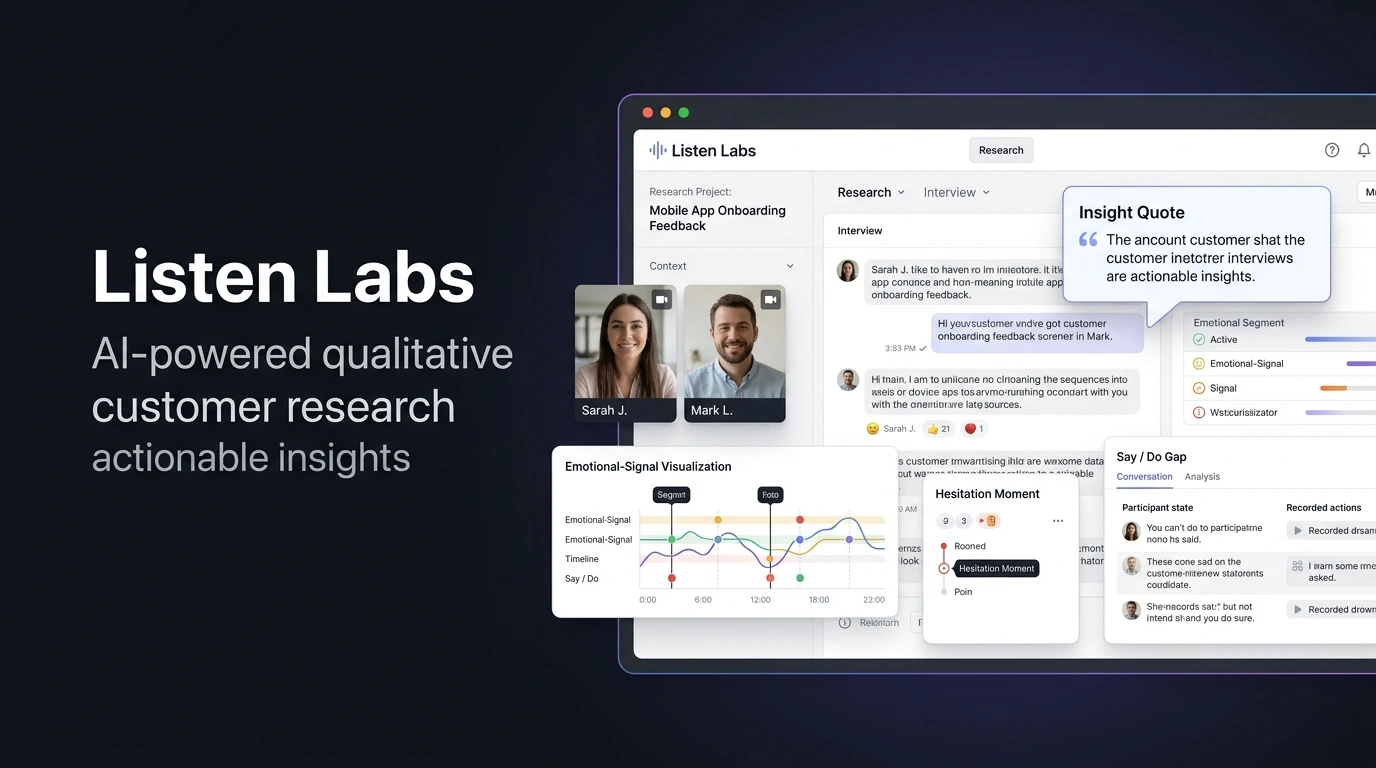
Customer research can become slow when every interview requires recruiting, scheduling, moderation, transcription, and manual analysis. Listen Labs takes a different approach by using AI to conduct customer interviews, analyze conversations, and turn qualitative feedback into structured research.
The company has also attracted attention because of an unusual financing development. Listen Labs reportedly signed a term sheet for a $125 million Series C at a $1.5 billion valuation, but later walked away from the deal amid reported acquisition discussions with Salesforce. The funding story is interesting, but for product managers, marketers, founders, and researchers, the bigger question is what Listen Labs can actually do.
How We Evaluate Listen Labs
We evaluated Listen Labs around the workflow teams typically follow when turning a research question into customer insights. Instead of looking only at a feature checklist, we considered whether the platform can reduce repetitive research work while still giving teams enough evidence to make informed decisions.
Our evaluation focused on research setup, participant recruitment, AI moderation, qualitative analysis, research outputs, and scalability. We also considered practical SaaS and marketing use cases, including usability testing, concept research, customer interviews, and feedback analysis. For more information about our review approach, see our testing process.
What We Looked At
- Research setup: How quickly you can create a study and interview guide.
- Participant recruitment: Options for finding relevant respondents.
- Interview quality: Whether AI can ask meaningful follow-up questions.
- Analysis: How conversations become themes, quotes, and behavioral signals.
- Outputs: Whether findings can be shared with stakeholders.
- Scale: Languages, audience reach, and simultaneous interviews.
At-a-Glance Comparison
| Tool Name | Best For | Starting Price |
| Listen Labs | AI-moderated customer interviews and end-to-end qualitative research | Custom pricing / demo |
Listen Labs: Best AI Customer Research Tool for End-to-End Interviews
If you want customer research to move from an initial question to analyzed interviews without stitching together several separate tools, Listen Labs offers a broad end-to-end approach. You can define a research objective, create or upload an interview guide, recruit participants, run AI-moderated interviews, and analyze the resulting conversations within the same research workflow.
The AI moderator is where the platform becomes more interesting than a basic questionnaire. Rather than only following predetermined questions, Listen can use follow-up questions to explore what participants say. This allows researchers to investigate the reasoning behind an answer instead of collecting short responses. The platform also supports video, audio, text, and screen-based research.
For SaaS teams, that means you can investigate what customers think about a feature while also observing how they interact with a product or prototype.
Pros
- End-to-end workflow: Study design, recruitment, interviews, analysis, and deliverables can be managed in one platform.
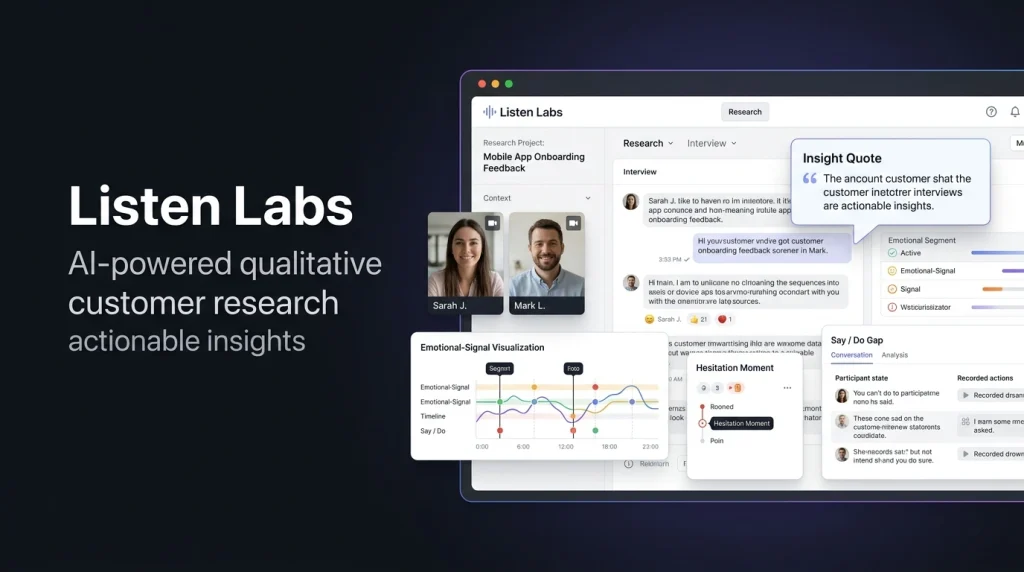
- Detailed qualitative signals: The platform can surface themes, quotes, hesitation moments, and Say/Do Gaps.
Cons
- Custom pricing: You don’t get a simple public self-serve pricing page with standard monthly tiers.
- Human review is still important: AI can accelerate research, but important studies still require researchers to check questions and findings.
Pricing: Listen Labs currently uses a demo/custom-pricing approach instead of publishing standard Starter, Pro, and Enterprise tiers. Its pricing research notes that AI-moderated qualitative research across the market can commonly cost around $25–$50 per interview. However, this is a market benchmark and should not be treated as Listen Labs’ official rate.
What Makes Listen Labs Different?
Many AI customer research tools concentrate on one part of the research process. One product might handle surveys, another may recruit participants, while another turns interview transcripts into summaries. Listen Labs is designed to bring several of these stages together. This can reduce the number of separate handoffs between your research question and final findings. The platform can also identify details that may be easy to overlook when reviewing large numbers of transcripts.
For example, Listen showcases “Hesitation Moments” that highlight pauses in participant responses and “Say/Do Gaps” that reveal differences between what customers claim matters and what they actually choose. This type of analysis can be useful because customer feedback rarely arrives in neat categories. A customer may say price is the most important factor but choose a product because it is more convenient. Another person might describe a feature as useful but struggle to complete the workflow during a usability session.
Listen also positions its platform for research across multiple audiences and markets. Its current materials state that AI-moderated interviews can operate across 120+ languages, while its participant network provides access to more than 50 million potential respondents. These figures come from Listen’s own materials, so teams should validate audience availability for their specific market before planning a large study.
What Can You Use Listen Labs For?
Listen Labs goes beyond conventional one-on-one customer interviews. You can use the platform for concept testing, prototype research, usability studies, creative testing, customer insights, B2B research, and brand-related research. That range makes it relevant when you need to understand the reasoning behind customer behavior rather than simply collect yes-or-no responses.
For a product manager, you could test a new onboarding flow before development is complete. A marketer could investigate why a campaign resonates with one audience but not another. A founder could interview potential customers before committing to a new product direction.
Common Use Cases
- Concept testing: Get reactions before investing heavily in development.
- Usability testing: Observe customers interacting with products or prototypes.
- Creative testing: Explore reactions to advertisements and messaging.
- B2B research: Interview professional and specialized audiences.
- Consumer research: Explore preferences, motivations, and purchasing behavior.
- Brand research: Track changing customer perceptions.
For SaaS teams, screen-based research can be especially valuable because it adds behavioral context to spoken feedback. Instead of asking someone whether a workflow feels simple, you can observe how they actually navigate it. That distinction matters because customers sometimes describe an experience as easy while hesitating, searching, or taking an unexpected route during the task.
Listen Labs and AI Interview Tools
The rise of AI interview tools is changing the economics and speed of qualitative research. A human moderator can ask nuanced questions, but conducting dozens or hundreds of interviews manually requires considerable time. AI moderation can allow multiple conversations to happen in parallel while maintaining a consistent research framework. However, that does not automatically make AI moderation suitable for every study.
Sensitive interviews, complex stakeholder research, or highly specialized research may still benefit from an experienced human moderator. Listen’s value is better understood as an additional research engine. It can help teams collect more conversations and identify patterns faster while researchers remain responsible for study design, context, validation, and interpretation.
Listen Labs vs. Traditional Customer Research
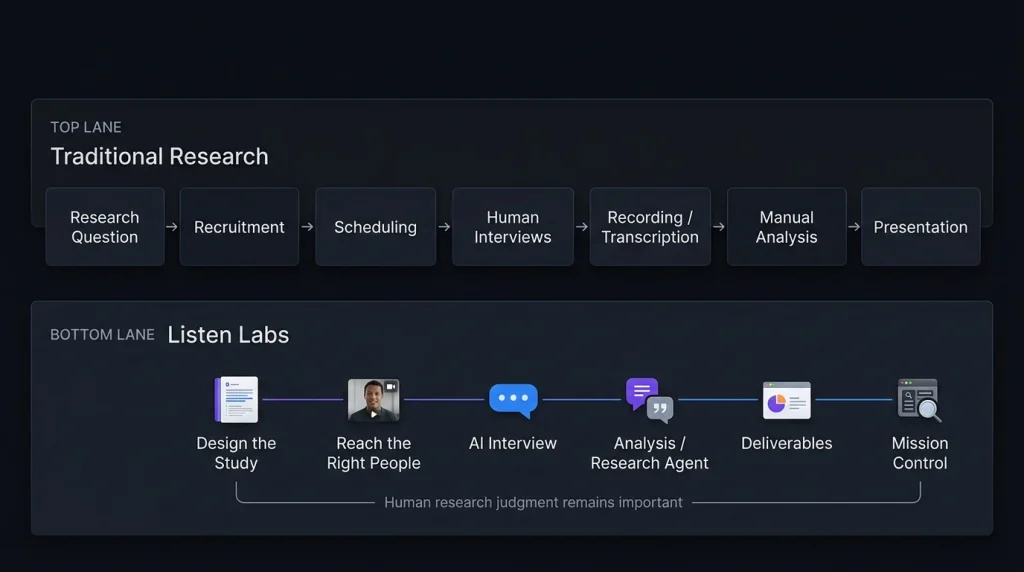
Traditional qualitative research can involve several separate stages. You define the study, recruit respondents, schedule interviews, moderate conversations, record sessions, transcribe them, organize themes, analyze findings, and eventually prepare a presentation. Each handoff can introduce delays or lost context. Listen Labs attempts to compress much of that workflow into one platform, covering study design, participant access, AI-moderated interviews, analysis, and research deliverables.
For teams that conduct customer research regularly, reducing these operational steps could be as important as any individual AI feature. The bigger question is what happens after the AI generates the findings. You still need to determine whether a theme is meaningful, whether the sample represents the audience you care about, and whether a customer statement reflects a broader pattern or an isolated opinion. Automation can shorten the path to evidence, but it does not remove the need for research judgment.
Why the $125M Series C Story Matters
Listen Labs’ financing story has become part of the company’s recent profile. TechCrunch reported that Listen had signed a term sheet for a $125 million Series C at a $1.5 billion valuation, with Menlo Ventures reportedly expected to lead the financing. The company subsequently walked away from the agreement amid reported discussions involving Salesforce. Business Insider separately reported that Salesforce had discussed acquiring Listen Labs for approximately $2 billion.
It also reported rapid company growth, including more than one million interviews conducted within a nine-month period. These figures are reported by the company or media outlets rather than independently verified product-performance measurements. They provide useful business context, but they should not be treated as evidence that the platform will deliver a specific research outcome for your team.
Final Thoughts on Listen Labs
Listen Labs sits at an interesting intersection of AI, customer research, and qualitative analysis. Its strongest proposition is not simply that AI can conduct an interview. Instead, recruitment, moderation, analysis, and research outputs can be connected within one workflow. If you are exploring more AI tools for productivity, marketing, research, and business workflows, you can discover additional options on Olareviews.
For product managers, marketers, founders, researchers, and SaaS teams, this approach can make large-scale qualitative research easier to organize. If you’re comparing AI customer research tools, the practical next step is to request a demo and test the workflow against one genuine research question. The real test is whether Listen can help you uncover customer insights that are difficult to identify from your existing data alone.
FAQ
Is Listen Labs an AI research tool?
Yes. Listen Labs is an AI-powered qualitative research platform for study design, participant recruitment, AI-moderated interviews, analysis, and research outputs.
Can Listen Labs replace researchers?
It can automate parts of the research process, but human judgment remains important. Researchers still need to define questions, review interviews, understand sample limitations, validate findings, and interpret results.
Are AI interviews safe to use?
Teams should obtain appropriate consent, explain recording and analysis practices, avoid collecting unnecessary sensitive information, and follow relevant privacy requirements.
Editorial disclosure: This article is an independent evaluation based on current public product information and available product materials as of September 2026.
Leave a Reply