Google Is Forcing Android Apps to Fix Foldable Support
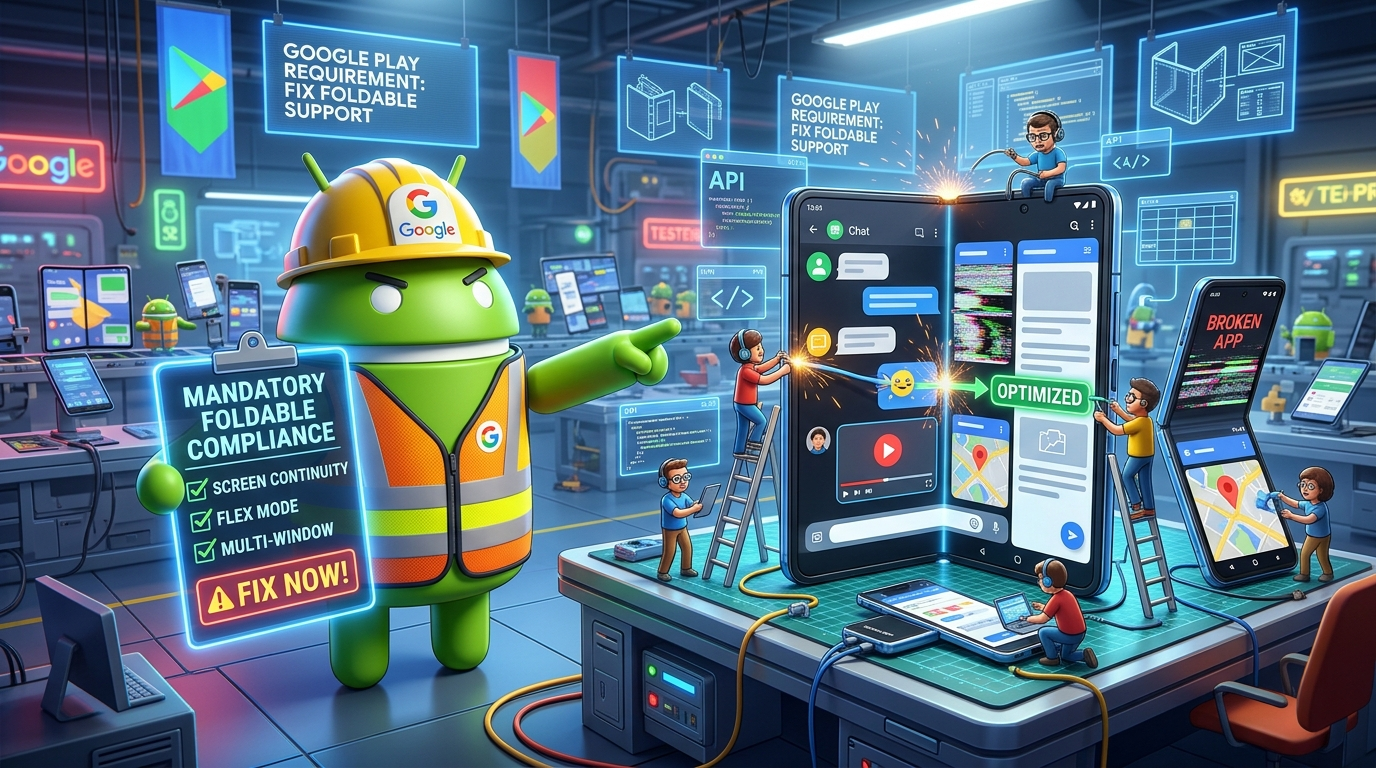
Google has spent years politely suggesting that Android developers make their apps work properly on foldable phones. Most ignored it. On Wednesday the suggestion became a rule: from April 2027, apps that do not meet a minimum foldable quality standard will not be publishable or updatable on the Play Store. Here is what Google’s new adaptive app quality requirements demand, the deadline that matters, and why this is really about the money large-screen users spend.
What Google Announced
The company published new quality requirements for foldables on its Android Developers Blog, following an October signal that it would begin evaluating foldable app quality.
Here is the substance of it. Once April 2027 arrives, anything listed on the store has to clear Tier 3, the lowest rung of Android’s adaptive quality ladder for folding devices.
Miss that bar and the penalty is severe: no new releases, and no updates either, according to Android Authority. The app simply stops moving.
What Tier 3 actually means
In practice, the baseline asks for apps that behave like proper software rather than a stretched phone layout:
- Fill the whole screen. No letterboxing, meaning no black bars around a phone-shaped app on a large display.
- Handle folding and unfolding without breaking or losing state.
- Survive rotation and resizing cleanly.
- Work in split screen and multi-window arrangements.
The requirements extend beyond foldables to tablets and Android XR devices, since the same adaptive layout work covers all of them.
The Screenshot Rule
A second change will be obvious to anyone browsing the store. Alongside the usual pair of phone images, listings will need three more taken on folding hardware:
- One shot of the inner screen at 1:1
- One of the inner screen at 4:3
- One showing the outer screen
No physical device is required. Google says images produced in its own inner-display emulators, at both aspect ratios, count toward the rule.
That part is open already. From November 2026 onwards, these images can go up through the Play Console, surfacing on listings in the weeks that follow. There is no reason to wait.
The Carrot Alongside the Stick
Google is not relying solely on enforcement. Developers who go beyond the minimum to Tier 2 or Tier 1 can earn:
- A premier badge attached to the listing
- Inclusion in the store’s editorial roundups
- Stronger merchandising and more prominent placement
Quality on bigger screens now feeds discovery as well, so apps that adapt properly surface higher when users browse the store’s tablet and folding categories.
Why Google Is Doing This
The commercial logic is not subtle. Google’s own developer material notes that large-screen users, meaning tablet, foldable and Chromebook owners, typically spend around five times more than phone-only users.
Every badly adapted app on a foldable is a worse experience for the highest-spending segment of the Android base, and Samsung, Google and others have invested heavily in hardware that developers have largely treated as an afterthought.
The platform has been laying groundwork too. With Android 17, the escape hatch disappeared: developers can no longer decline resizing or orientation changes on big displays. Apps that once sat politely letterboxed are now stretched wide, ready or not, which means anything that was quietly surviving on a phone-only layout is suddenly, visibly broken.
What Developers Should Do Now
- Audit your app on a foldable emulator, checking both inner and outer displays.
- Test the fold transition, since losing state when the device opens is a common failure.
- Check split-screen behavior, which the guidelines require.
- Upload foldable screenshots today, because that part is already available.
- Aim above Tier 3 if visibility matters, since the incentives sit at Tiers 2 and 1.
- Do not leave it to 2027. Adaptive layout work is a refactor, not a checkbox.
For more on the Android ecosystem, see our guides to Xiaomi’s HyperOS 4 rollout and the Galaxy S27 Ultra leaks.
The End of the Stretched Phone App
Google has run out of patience with apps that treat a foldable as a slightly odd phone, and tying compliance to publishing rights is the strongest lever it has. April 2027 sounds distant, but adaptive layouts are not a weekend job. Test on a foldable emulator now, upload your foldable screenshots today, and treat Tier 3 as the floor rather than the target.
Frequently Asked Questions
Both the quality bar and the screenshot rule bite in April 2027.
It cannot be released or updated on the store until it complies.
Three minimum, covering the inner screen at two aspect ratios and the outer screen, on top of the standard phone pair.
No. Emulator captures at the required aspect ratios are accepted.