Doctors Warn Antibiotic Resistance Is Outpacing Australia’s Response
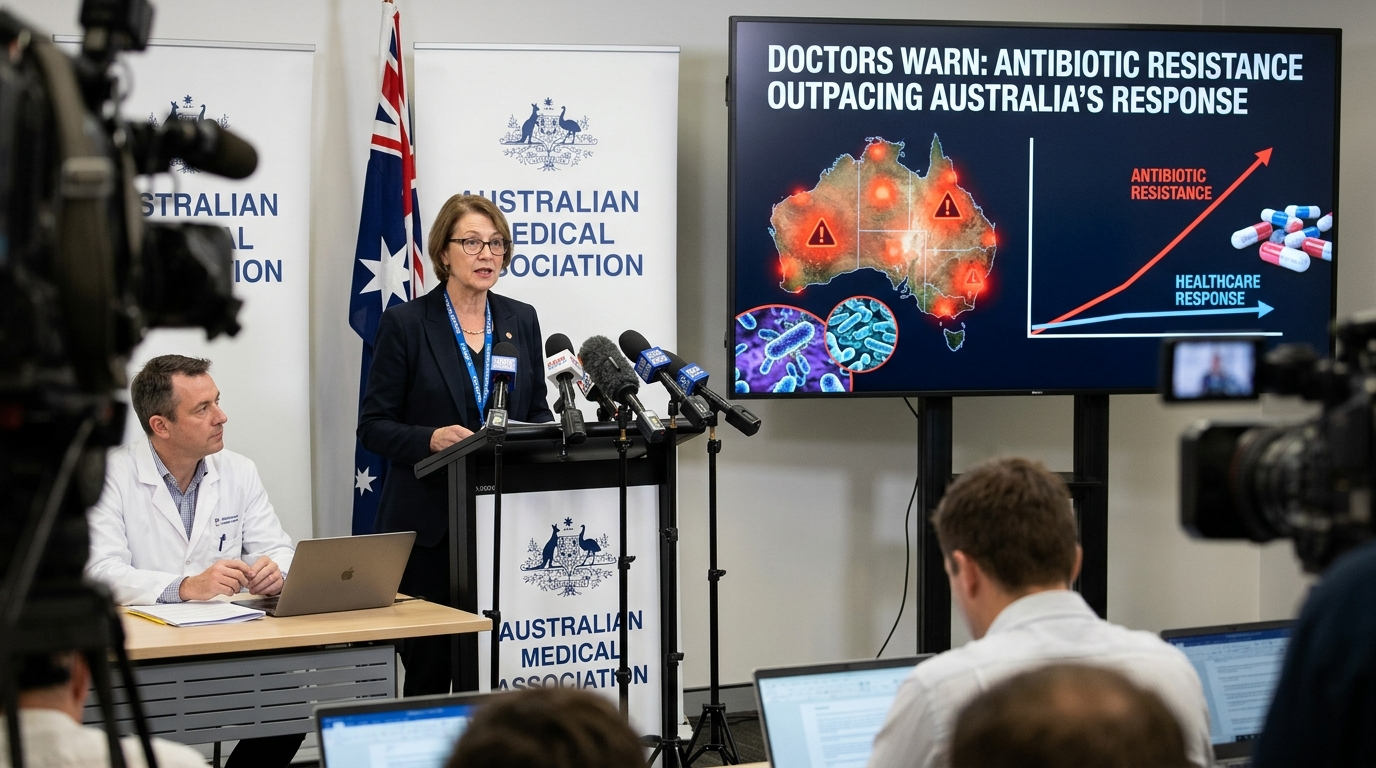
Australia’s leading medical body has delivered a blunt warning: the medicines that make modern surgery, cancer treatment and childbirth survivable are losing their effectiveness, and Australia’s response is not keeping pace. A new report from the Australian Medical Association puts the global death toll on track to reach 39 million people in the coming decades. Here is what the AMA found on antibiotic resistance, the Australian figures behind it, and what ordinary people can actually do.
What the AMA Said
The AMA released its report on 17 November 2026, timed to coincide with World Antimicrobial Awareness Week.
Its core conclusion: the danger facing Australia keeps growing, and resistance is moving faster than the country’s response to it.
Speaking as AMA president, Michael Bonning described consequences that are already devastating, and a threat that could hollow out the basis on which modern medicine rests, in remarks reported by the ABC.
That phrase is not rhetorical excess. Routine operations, chemotherapy and intensive care all depend on being able to treat infections reliably. Without that, procedures that are currently low-risk become dangerous.
The Australian Numbers
National surveillance figures, published by Australia’s recently established disease control body, fill in the detail:
- Critical resistance reports climbed 25.2% during 2024.
- Subsidised prescriptions reached 23.2 million that year, 4.8% more than in 2023.
- Overall antibiotic use remains about 21% lower than a decade ago, which is the genuinely encouraging number.
- Around 60% of antibiotics used in Australia go to animals rather than people.
- Resistant infections are estimated to add roughly $10,000 to the cost of treating a patient.
Among the organisms growing harder to treat are E. coli, golden staph, and the bacteria behind meningitis and gonorrhoea.
The contradiction worth noting
Those figures pull in opposite directions, and it is worth being honest about that. Australians are taking fewer antibiotics than a decade ago, yet resistance is climbing. The explanation lies less in total volume than in how antibiotics are used: the choice of drug, the length of the course, and prescribing in settings such as surgery and aged care, where earlier reporting found substantial room for improvement.
Resistant organisms are also acquired overseas and brought back, which makes this a regional problem rather than a purely domestic one.
Where Australia Is Falling Short
Previous AMA work identified gaps that remain relevant: public awareness, antimicrobial stewardship in hospitals, incentives for research into new drugs, and coordinated One Health governance linking human, animal and environmental policy.
The research gap is the hardest. Developing a new antibiotic is expensive, and the commercial reward is poor precisely because a successful new drug should be used sparingly. That broken incentive is why the pipeline has thinned.
There is new machinery in place. A national disease control centre formally began work on 1 January 2026, and it now handles the country’s surveillance reporting.
What You Can Actually Do
Individual behaviour genuinely matters here:
- Do not ask for antibiotics for colds or flu. They do nothing against viruses.
- Finish the course exactly as prescribed, and follow your doctor’s instructions on length.
- Never take leftover antibiotics or medication prescribed to another person.
- Avoid purchasing antibiotics online unless you have a valid prescription.
- Keep vaccinations current. Preventing infection avoids the need for treatment.
- Wash your hands properly, which remains among the most effective interventions available.
A Slow Emergency
Antimicrobial resistance lacks the urgency of an outbreak because it arrives gradually, which is precisely what makes it dangerous. Australia is using fewer antibiotics than it once did, yet resistance keeps rising. Take antibiotics only when genuinely needed, follow the prescription exactly, and keep your vaccinations up to date.
Frequently Asked Questions
It warned that the threat in Australia is growing and that resistance is outpacing the national response, with the global toll on track to reach 39 million deaths in coming decades.
Subsidised prescriptions grew 4.8% during 2024, yet total consumption sits around 21% below where it stood ten years ago.
Resistance is rising in E. coli and golden staph, and in the organisms responsible for meningitis and gonorrhoea.
Estimates put the additional cost at around $10,000 per patient treated.