Blog

  • Loom vs ShareX: Is Paying for Screen Recording Actually Worth It?

    Loom vs ShareX: Is Paying for Screen Recording Actually Worth It?

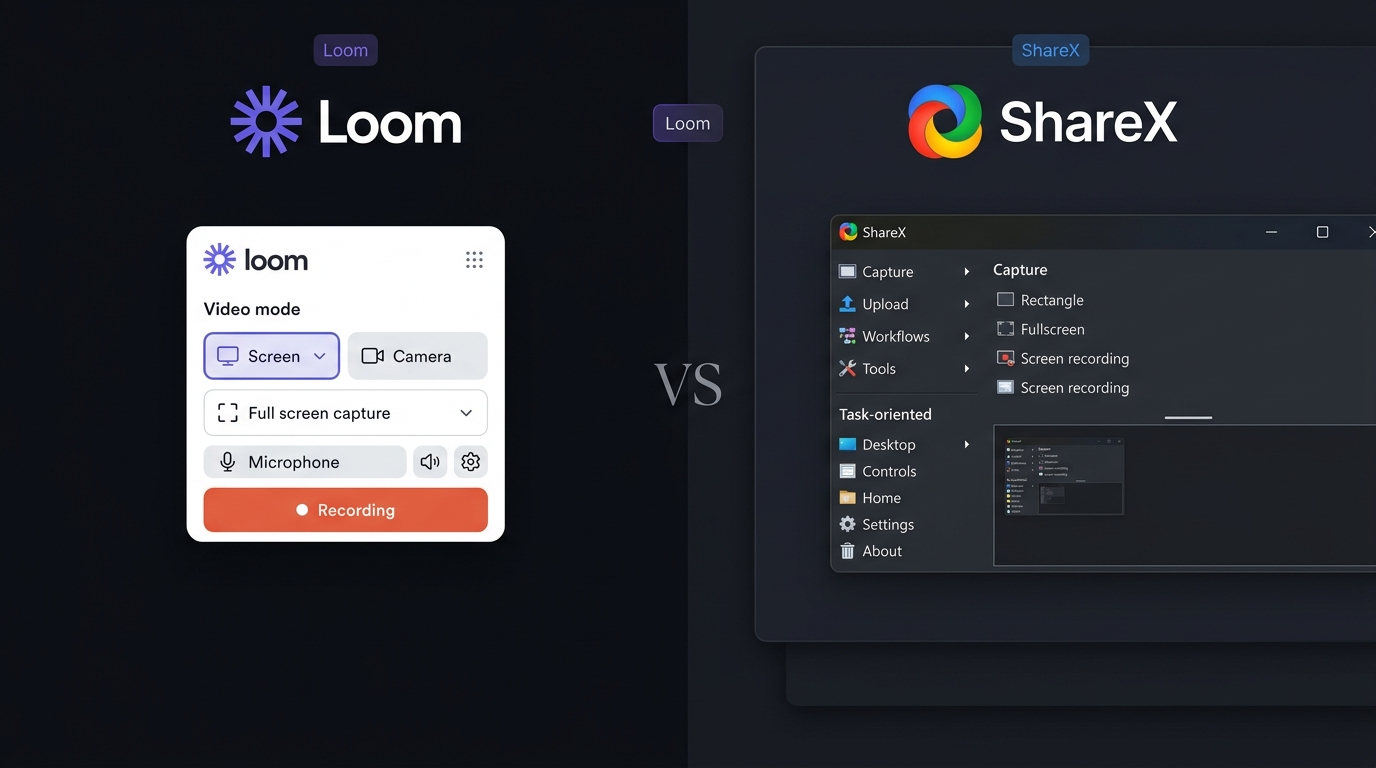
    Choosing between Loom vs ShareX depends on what you expect from a screen recording tool. Loom focuses on recording videos that are easy to share, while ShareX is a free and open-source Windows tool built around screenshots, screen capture, recording, and file sharing. For users who only need basic screen recording, paying for Loom may not make sense. However, people who create video explanations for clients, coworkers, students, or customers may find Loom more useful. The rise of AI tools also makes features such as automatic summaries, transcripts, and video assistance more valuable for modern workflows.

    Loom vs ShareX: What Is the Main Difference?
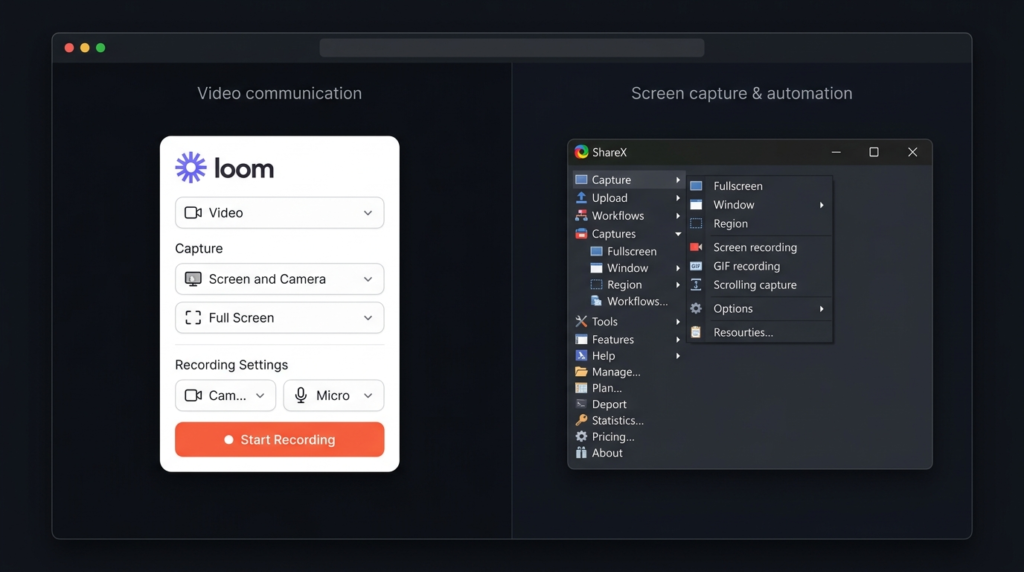
    The biggest difference in Loom vs ShareX is their purpose.

    Loom is designed for video communication. You can record your screen, webcam, microphone, or a combination of them and then share the recording through a link. This makes it useful for remote teams, customer support, education, product demonstrations, and feedback.

    ShareX takes a broader screen-capture approach. It lets Windows users take screenshots, record their screen, create GIFs, annotate images, upload files, and customize capture workflows.

    So, Loom is mainly a video communication tool, while ShareX is primarily a screen capture and recording tool.

    Loom vs ShareX Features Comparison

    FeatureLoomShareX
    Screen recordingYesYes
    Screenshot captureYesExcellent
    Webcam recordingYesLimited
    Microphone recordingYesYes
    Video editingYesBasic
    Screen annotationYesYes
    GIF recordingYesYes
    Instant video sharingYesYes, through supported services
    Video commentsYesNo
    TranscriptionsYesNo
    CaptionsYesNo built-in equivalent
    AI featuresYes, on eligible plansNo built-in AI suite
    Scrolling screenshotsLimitedYes
    OCRLimitedYes
    WindowsYesYes
    MacYesNo
    Free optionYesYes
    Best forVideo communicationScreen capture and recording

    The Loom vs ShareX feature difference is clear. Loom puts more attention on recorded communication, while ShareX gives users extensive control over screenshots and captures.

    Loom vs ShareX: Which Has Better AI Tools?
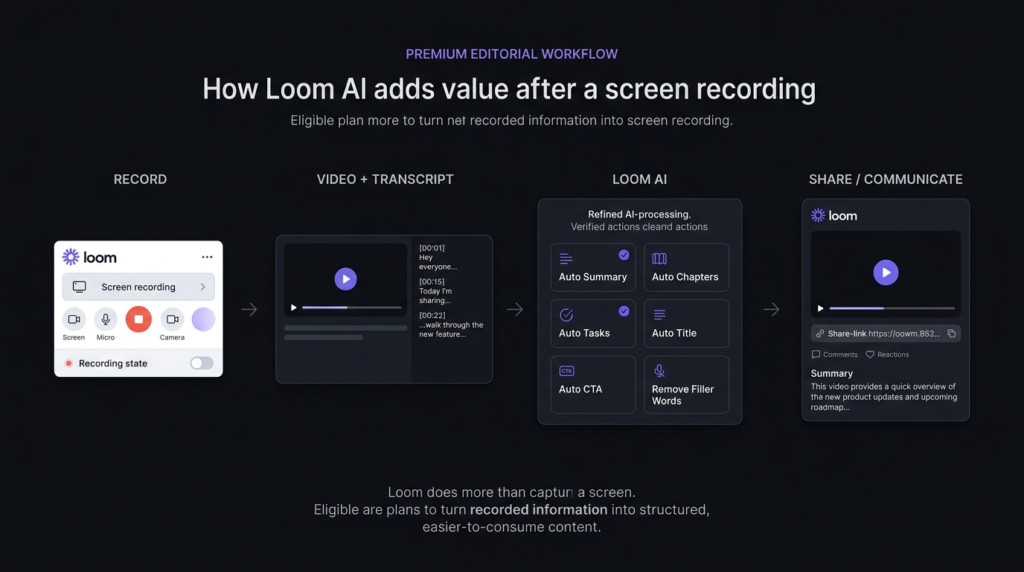
    When comparing modern AI tools, Loom has an advantage because AI features are part of its broader video workflow. Depending on the plan and available features, Loom can help with tasks such as creating summaries, working with transcripts, and making recorded information easier to understand and share.

    ShareX does not try to compete as an AI video platform. Its main strength is its large collection of capture and automation options. If you want AI-powered assistance specifically inside your screen recorder, Loom is the more relevant choice. However, users should not pay for AI features simply because they are available. If you rarely create videos, basic recording software may still be enough.

    Loom vs ShareX: Screen Recording Experience
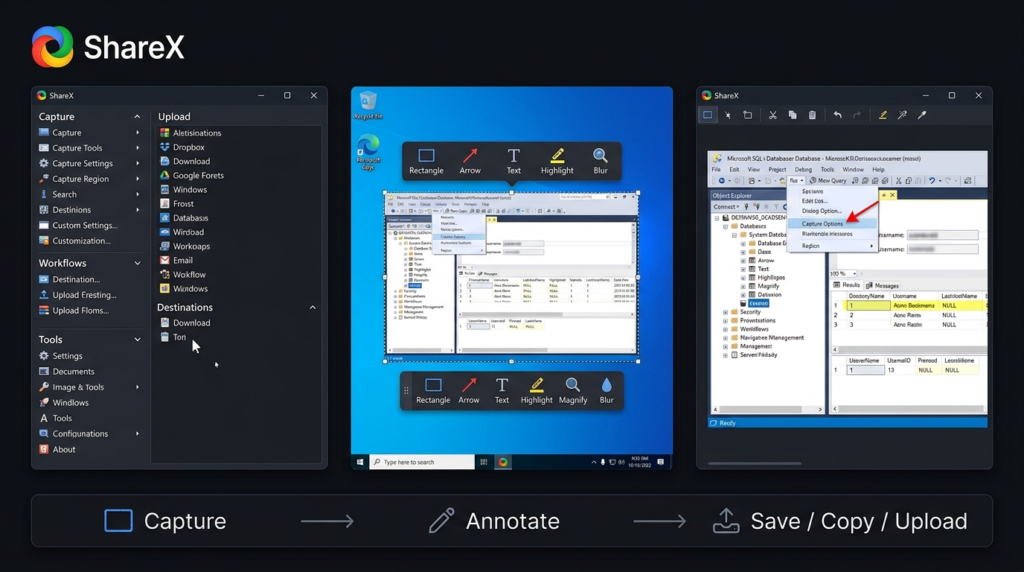
    Loom makes recording simple. You can choose what you want to capture, record your explanation, and share the result without treating the recording as a traditional video-file project. This works particularly well when you need to explain something quickly. For example, a manager can record feedback instead of writing several paragraphs. A teacher can demonstrate a process, while a support team can show a customer how to fix a problem.

    ShareX gives you more control over capture options. It is particularly strong for users who frequently take screenshots or need different capture methods. It can also record screens and create GIFs. For simple video communication, Loom has the smoother workflow. For flexible screen capture, ShareX has the advantage.

    Loom vs ShareX: Pricing Compared
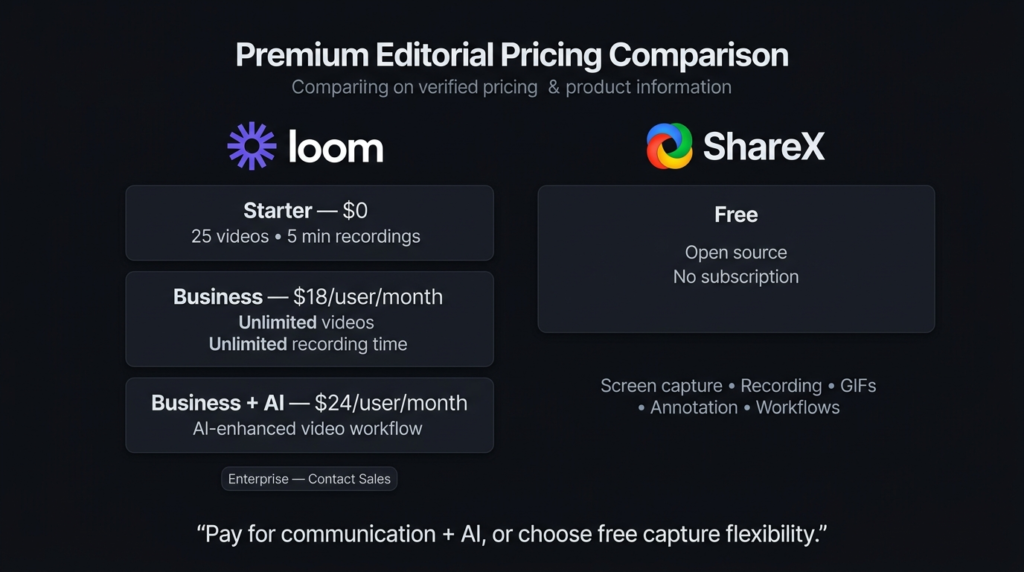
    Price is one of the biggest reasons people search for Loom vs ShareX.

    Loom Pricing

    Loom offers a free Starter plan, but it comes with limits. The free plan currently allows up to 25 videos per person and recordings of up to five minutes. Paid plans provide more advanced recording, editing, collaboration, and AI capabilities. Because Loom uses a paid model for more advanced features, it is worth considering how frequently you record videos before upgrading.

    ShareX Pricing

    ShareX is free and open source. There is no subscription required to use its main screen capture and recording features. This makes ShareX difficult to beat for users whose priority is keeping costs at zero.

    Pricing FactorLoomShareX
    Free versionYesYes
    Cost for basic screen captureFree option$0
    Paid plansYesNo
    Subscription required for advanced featuresSome featuresNo
    AI featuresAvailable on eligible plansNo built-in AI suite
    Open sourceNoYes
    Best value for free captureGoodExcellent

    Pricing can change, so users should check the official pricing pages before purchasing a plan.

    Loom vs ShareX: Which Is Easier to Use?

    Loom is generally easier for beginners who want to record and share a video without spending time configuring many options. The workflow is straightforward: record, make necessary changes, and share.

    ShareX has more settings and capture choices. That flexibility is helpful for experienced users, but beginners may need some time to understand how different options work. Therefore, in the Loom vs ShareX usability comparison, Loom is the better choice for simple video communication, while ShareX is better for users who want more control.

    Loom vs ShareX: Which Is Better for Teams?

    Loom is the stronger option for teams that frequently communicate through recorded videos. A team member can record a product explanation, project update, training video, or customer response and send it to others. This can be faster than arranging another meeting or writing a long explanation.

    ShareX can still be useful in a workplace, especially for screenshots, bug reports, quick captures, and technical documentation. But it is not built around team video communication in the same way.

    Loom vs ShareX: Which Is Better for Personal Use?

    For personal use, ShareX is an excellent choice if you mainly need screenshots and occasional screen recordings. You do not have to pay for a subscription, and its wide range of capture options makes it useful for everyday Windows tasks.

    Loom becomes more attractive when you regularly communicate through video. Freelancers, teachers, marketers, developers, support workers, and remote employees may find its sharing workflow more useful.

    Loom vs ShareX: Pros and Cons

    Loom Pros

    • Easy screen and webcam recording
    • Simple video sharing
    • Useful for team communication
    • Helpful video feedback features
    • Transcription and caption features
    • AI tools available on eligible plans

    Loom Cons

    • Free plan has limits
    • Advanced features require paid plans
    • May be unnecessary for occasional recording
    • Some users may not need its collaboration features

    ShareX Pros

    • Completely free
    • Open source
    • Powerful screenshot tools
    • Screen and GIF recording
    • Extensive customization
    • Useful upload and sharing options
    • No subscription required

    ShareX Cons

    • Windows-focused
    • More complicated for beginners
    • Not designed around video communication
    • No built-in AI video feature set like Loom

    Loom vs ShareX: Which One Should You Choose?

    Choose Loom if you regularly create videos for clients, coworkers, customers, students, or online teams. It is especially useful when recording is part of your communication process. Choose ShareX if you want a free Windows application for screenshots, screen recordings, GIFs, annotations, and other capture tasks. For people exploring AI tools, Loom is the better fit if AI-assisted video features are important to their workflow. But if your only goal is recording your screen without paying, ShareX provides strong value.

    Loom vs ShareX: Final Verdict

    The winner of Loom vs ShareX depends on your priorities. ShareX wins on price and capture flexibility. It is free, open source, and packed with useful screen capture features. Loom wins on communication and convenience. It provides a more focused experience for recording, sharing, explaining, and collaborating through video, with AI features available on eligible plans. So, is paying for screen recording actually worth it? Only if the extra workflow and communication features save you enough time. If you simply want to record your screen, ShareX may be all you need. If you regularly use video to communicate, Loom can be worth paying for.

    FAQs About Loom vs ShareX

    Is Loom better than ShareX?

    Loom is better for video communication, team collaboration, and quick sharing. ShareX is better for free screen capture, screenshots, GIFs, and flexible recording on Windows.

    Is ShareX completely free?

    Yes. ShareX is free and open source, making it a strong option for users who do not want to pay a monthly subscription for screen recording.

    Is Loom worth paying for?

    Loom can be worth paying for if you frequently create videos for work, teaching, customer support, or team communication. If you only make occasional recordings, ShareX may offer better value.

    Does Loom have AI features?

    Yes. Loom offers AI-powered features on eligible plans, including tools that can work with recorded video and transcripts. These features can be useful for people who want more than basic screen recording.

    Which is better for AI tools: Loom or ShareX?

    Loom is the better choice if you specifically want AI-assisted video features. ShareX focuses on screen capture and customization rather than providing a built-in AI feature suite.
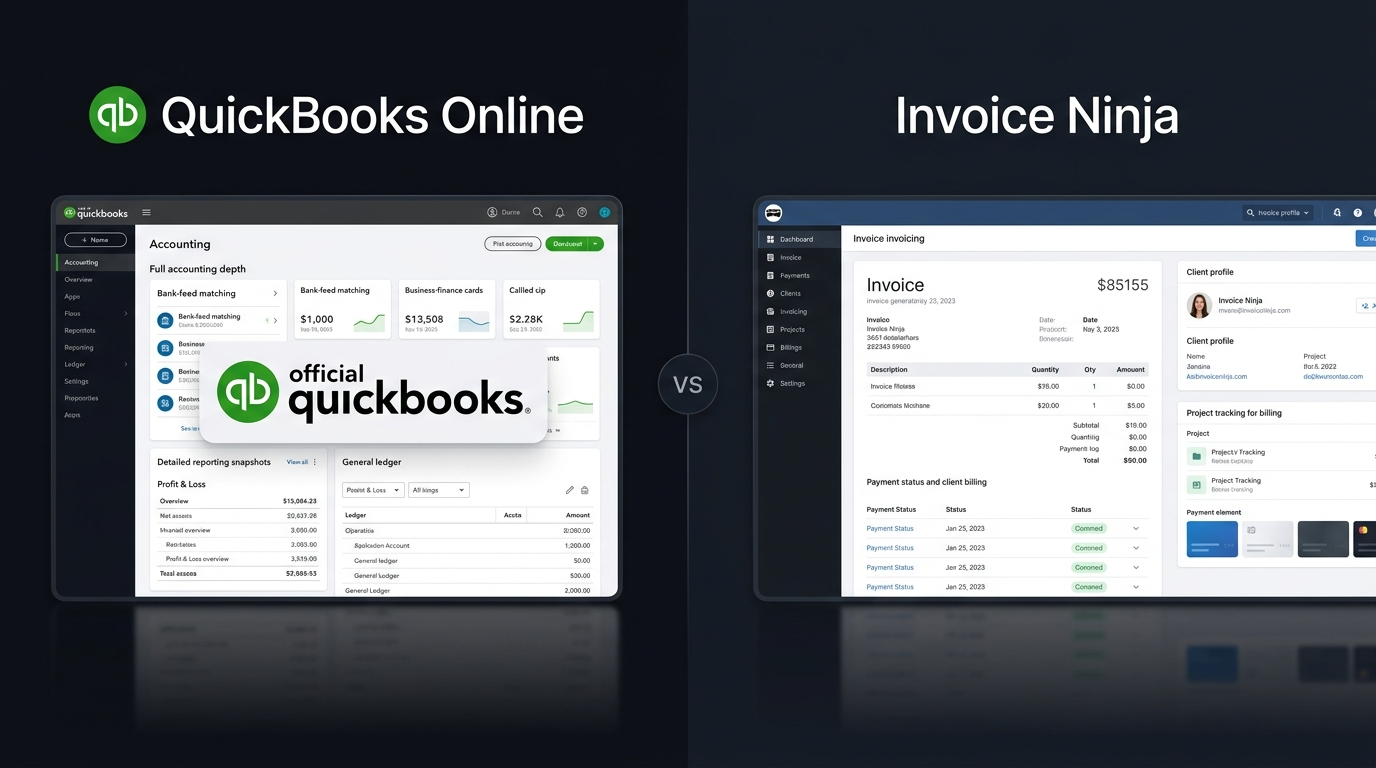
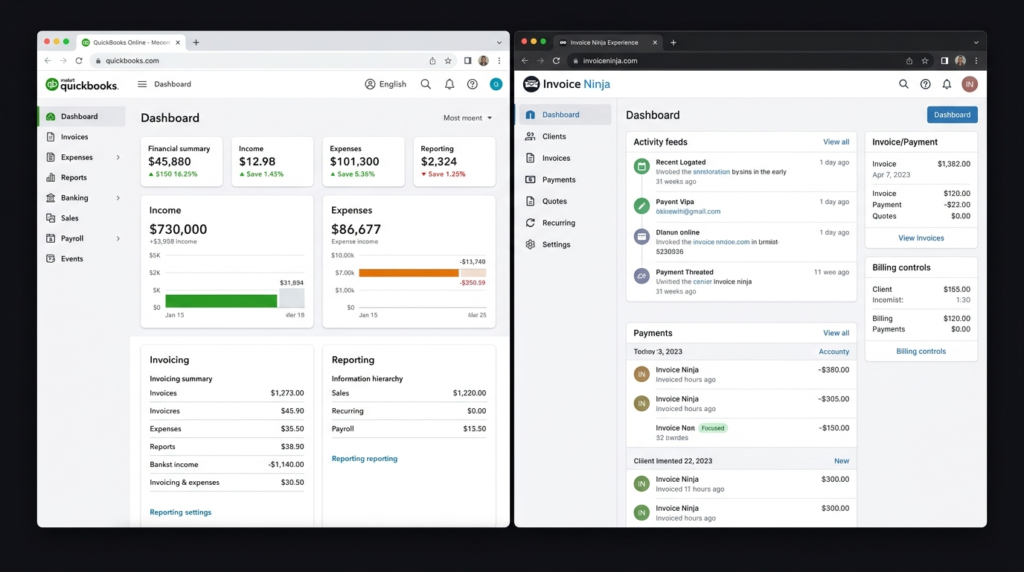
  • QuickBooks vs Invoice Ninja: Full Accounting Suite or Lean Invoicing Tool?

    QuickBooks vs Invoice Ninja: Full Accounting Suite or Lean Invoicing Tool?

    Choosing between QuickBooks vs Invoice Ninja depends on how much financial management your business needs. QuickBooks is designed as a broader accounting platform, while Invoice Ninja focuses heavily on invoicing, payments, clients, expenses, projects, and time tracking. Both tools can help small businesses manage money and get paid, but they serve different types of users. QuickBooks makes more sense when accounting is a major part of your daily work. Invoice Ninja can be a better fit when your main goal is creating invoices, collecting payments, and managing client work at a lower cost.

    QuickBooks vs Invoice Ninja: What Is the Main Difference?

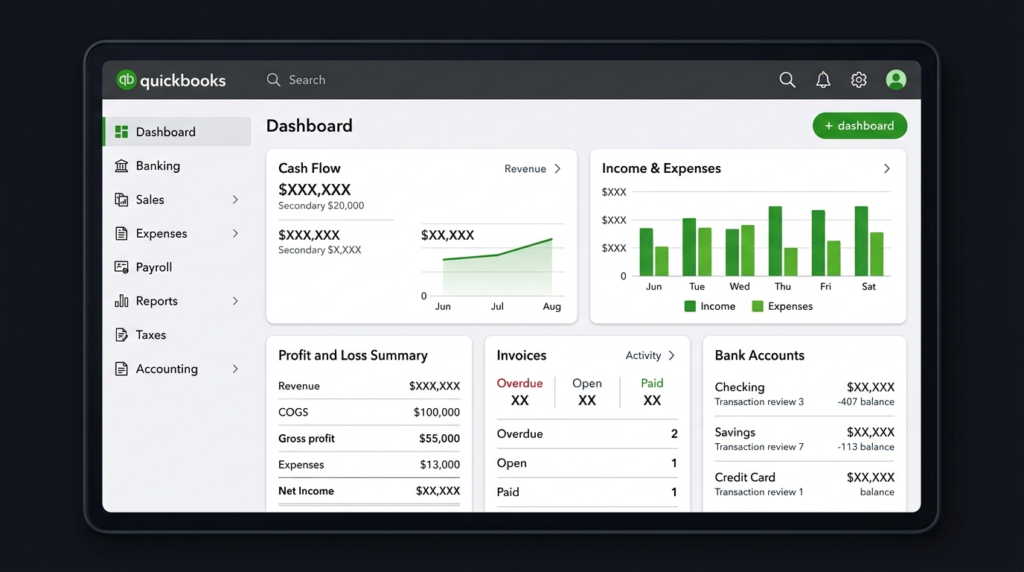
    The main difference in QuickBooks vs Invoice Ninja is the depth of their financial tools. QuickBooks offers invoicing, expense tracking, bank feeds, tax features, financial reports, inventory, bills, and other accounting functions depending on the plan. Its official feature list includes income and expense tracking, bank feeds, tax tools, inventory, invoicing, and receipt management. Invoice Ninja takes a more focused approach. It provides invoices, quotes, recurring billing, online payments, expenses, projects, time tracking, inventory, client portals, and other tools for freelancers and small businesses. So, QuickBooks vs Invoice Ninja is not simply a choice between a good tool and a basic tool. Invoice Ninja offers a wide set of business features, but QuickBooks goes deeper into traditional accounting.

    QuickBooks vs Invoice Ninja: Features Compared

    FeatureQuickBooksInvoice Ninja
    Main purposeBusiness accountingInvoicing and business billing
    InvoicingYesYes
    Recurring invoicesYesYes
    Online paymentsYesYes
    Expense trackingYesYes
    Bank connectionsYesEnterprise
    Financial reportsExtensiveYes
    Profit & loss reportsYesYes
    Tax toolsYesYes
    Time trackingSelected plansYes
    Project managementSelected plansYes
    InventorySelected plansYes
    Client portalYesYes
    Multiple currenciesPlan dependentYes
    Mobile appsYesYes
    Free planNo permanent free planYes
    Self-hostingNoYes
    Best forFull accountingFreelancers and invoice-focused businesses

    The QuickBooks vs Invoice Ninja feature comparison shows that both platforms can handle everyday billing work. QuickBooks has the advantage when you need broader accounting, while Invoice Ninja has strong tools for client billing and project-based work.

    QuickBooks vs Invoice Ninja: Pricing Comparison

    Pricing can make a major difference in QuickBooks vs Invoice Ninja, especially for freelancers and very small businesses.

    QuickBooks pricing depends on the country and selected plan. Its official global pricing page provides plan information for different markets, while the Pakistan page currently lists Simple Start, Essentials, Plus, and Advanced options with local pricing information.

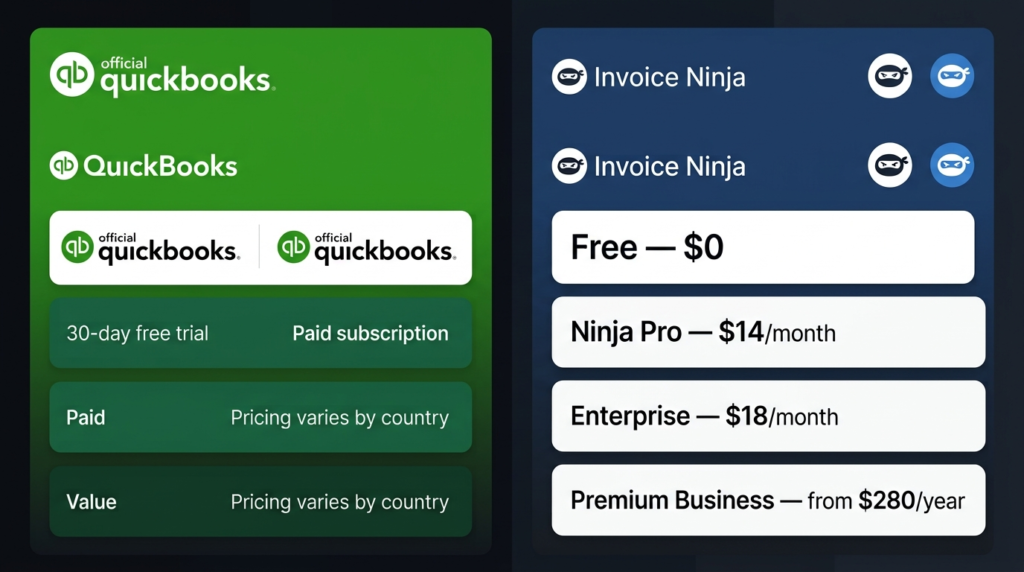
    Invoice Ninja has a permanent free plan. Its current pricing page lists Free at $0, Ninja Pro at $14 per month, Enterprise from $18 per month, and Premium Business from $280 per year.

    PricingQuickBooksInvoice Ninja
    Free planNo permanent free plan$0 forever
    Free trial30-day trial30-day money-back guarantee on paid plans
    Entry optionVaries by countryFree, up to 5 clients
    Paid planVaries by country and planNinja Pro: $14/month
    Annual ProVaries by country and plan$140/year
    EnterpriseHigher plans availableFrom $18/month
    Premium BusinessHigher plans availableFrom $280/year
    Best for budgetBusinesses needing accountingFreelancers and small businesses

    Invoice Ninja’s free plan includes up to five clients and unlimited invoicing. Its Pro plan provides unlimited clients and invoices, while Enterprise adds features such as additional users, permissions, bank account syncing, and electronic invoicing.

    For the latest QuickBooks prices, check the official QuickBooks pricing page before subscribing because prices and offers can vary by market.

    For Invoice Ninja, you can check the official Invoice Ninja pricing page for the current plan details.

    QuickBooks vs Invoice Ninja: Accounting Features

    For accounting, QuickBooks vs Invoice Ninja gives QuickBooks the stronger position. QuickBooks is designed to give businesses a wider view of their finances. Depending on the plan, users can track income and expenses, connect banks, manage bills, monitor taxes, manage inventory, and create financial reports. QuickBooks also supports professional invoices and payment reminders. Invoice Ninja can track expenses and vendors and provides financial reports. Its Pro plan includes invoice, expense, and profit-and-loss reports. Enterprise users can also connect bank accounts. For someone who needs full accounting records, QuickBooks is therefore the more suitable choice. For someone who mainly needs billing with some financial tracking, Invoice Ninja can be enough.

    QuickBooks vs Invoice Ninja: Invoicing and Payments

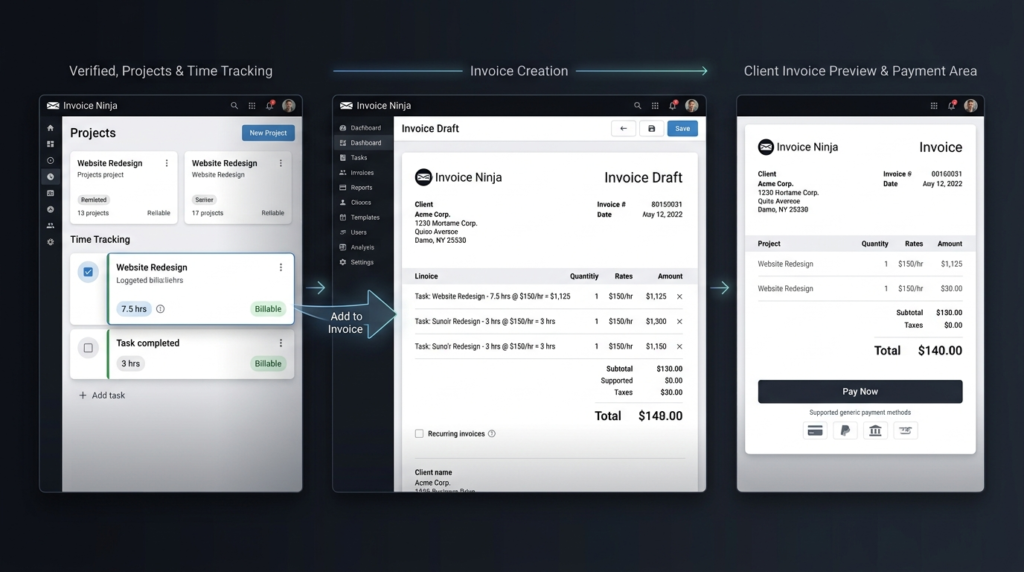
    When comparing QuickBooks vs Invoice Ninja for invoicing, the difference is smaller. Both platforms let users create and send professional invoices, manage recurring invoices, and accept online payments. QuickBooks can also match payments to invoices and send payment reminders. Invoice Ninja places even more attention on invoicing. It supports customizable invoice templates, online payment gateways, recurring billing, deposits, partial payments, payment reminders, and client payment portals. For freelancers and agencies, Invoice Ninja can be particularly useful because tracked project time can be converted directly into invoices.

    QuickBooks vs Invoice Ninja: Ease of Use

    Ease of use in QuickBooks vs Invoice Ninja depends on what you want to accomplish. Invoice Ninja can feel simpler when your regular tasks involve creating invoices, sending quotes, tracking expenses, recording billable time, and managing clients. Its workflow is centered around these activities. QuickBooks offers more financial functions, so there can be more to learn. That added depth becomes useful when your business needs detailed financial reports, bank feeds, tax tracking, bills, or inventory. If you only need billing software, paying for and learning a complete accounting system may not be necessary.

    QuickBooks vs Invoice Ninja: Which Is Better for Freelancers?

    For freelancers, QuickBooks vs Invoice Ninja often comes down to simplicity and accounting depth. Invoice Ninja is a strong option for freelancers who need invoices, quotes, online payments, expenses, projects, and time tracking. Its free plan can also be useful for someone with a small client base. QuickBooks is better suited to freelancers with more complicated finances who want their invoicing connected with broader accounting records.

    QuickBooks vs Invoice Ninja: Which Is Better for Small Businesses?

    For small businesses, QuickBooks vs Invoice Ninja depends on how much accounting work the company needs. A small agency, consultant, or service provider that mainly bills clients may find Invoice Ninja sufficient. A growing company that needs bank connections, detailed reports, bills, inventory, and broader financial management may get more value from QuickBooks. The best choice is the one that matches the actual workflow of the business rather than simply choosing the platform with the longest feature list.

    QuickBooks vs Invoice Ninja: Pros and Cons

    QuickBooks Pros

    • Broad accounting features
    • Detailed financial reports
    • Bank feeds on supported plans
    • Tax and expense tools
    • Inventory features on supported plans
    • Suitable for growing businesses

    QuickBooks Cons

    • No permanent free plan
    • Pricing varies by market
    • More features can mean a longer learning process
    • May be more than a freelancer needs

    Invoice Ninja Pros

    • Free plan available
    • Affordable paid plans
    • Strong invoicing features
    • Online payment support
    • Client payment portals
    • Project and time tracking
    • Self-hosting option
    • Unlimited clients on the Pro plan

    Invoice Ninja Cons

    • Not as deep as QuickBooks for complete accounting
    • Some advanced features require paid plans
    • Bank account syncing is available on Enterprise rather than the Free or Pro plans

    QuickBooks vs Invoice Ninja: Which One Should You Choose?

    Choose QuickBooks if your main priority is full accounting. It is better suited to businesses that need detailed financial records, bank connections, financial reports, tax features, bills, and inventory on supported plans.

    Choose Invoice Ninja if your main priority is affordable invoicing and client billing. It works especially well for freelancers, consultants, agencies, and small service businesses that need invoices, payments, expenses, projects, and time tracking.

    If you are comparing business software beyond accounting and invoicing, the OlaReviews software reviews section can also help you explore other software options before making a decision. 

    Final Thoughts on QuickBooks vs Invoice Ninja

    The QuickBooks vs Invoice Ninja decision comes down to breadth versus focus. QuickBooks is the stronger choice for businesses that need a wider accounting system with financial records, bank connections, reports, tax tools, bills, and inventory features. Invoice Ninja is a strong alternative for users who mainly need affordable invoicing, payments, expenses, projects, and time tracking. If your business mainly needs to send invoices and collect payments, Invoice Ninja can provide the tools you need at a lower starting cost. If accounting is a central part of your business, QuickBooks is the more complete option.

    QuickBooks vs Invoice Ninja: FAQs

    Is Invoice Ninja cheaper than QuickBooks?

    Yes. In QuickBooks vs Invoice Ninja, Invoice Ninja has the lower starting cost because it offers a free plan. Its current Pro plan is $14 per month or $140 per year.

    Is QuickBooks better for accounting than Invoice Ninja?

    Yes. QuickBooks vs Invoice Ninja favors QuickBooks when complete accounting is the priority. QuickBooks provides broader tools for income, expenses, bank feeds, tax tracking, reports, bills, and inventory on supported plans.

    Can Invoice Ninja be used for free?

    Yes. Invoice Ninja’s Free plan costs $0 and includes up to five clients with unlimited invoicing.

    Which is better for freelancers: QuickBooks or Invoice Ninja?

    If a freelancer mainly needs invoices, payments, expenses, projects, and time tracking, Invoice Ninja can be the better-value option. If the freelancer needs broader accounting and financial reporting, QuickBooks is likely the better choice.

  • TeamViewer vs RustDesk: Can This Open-Source Alternative Really Compete?

    TeamViewer vs RustDesk: Can This Open-Source Alternative Really Compete?

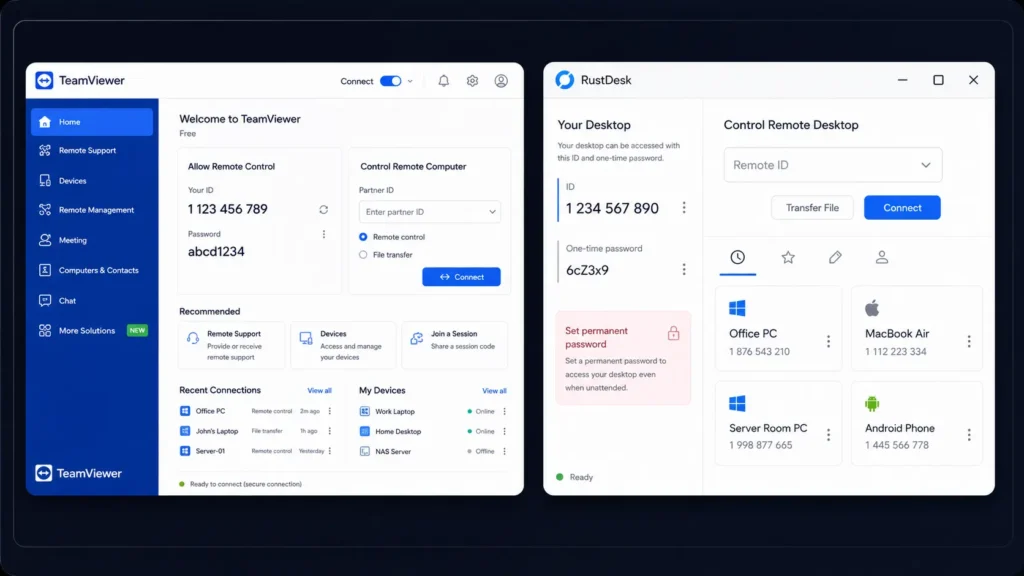
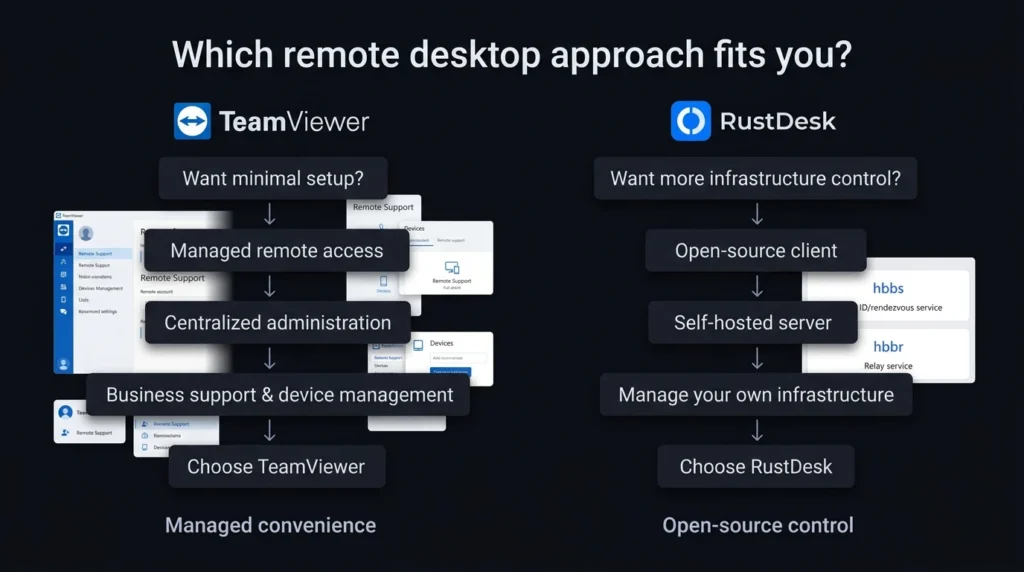
    Remote desktop software helps users access computers, provide support, transfer files, and manage devices from another location. But choosing the right platform can be difficult when cost, security, features, and control all matter. In TeamViewer vs RustDesk, the two platforms take different approaches. TeamViewer offers a mature managed service, while RustDesk focuses on open-source software and self-hosting. For personal users, IT professionals, and small businesses, the better choice depends on whether convenience or control is more important.

    TeamViewer vs RustDesk: What Is the Difference?

    TeamViewer vs RustDesk is mainly a comparison between a commercial remote access platform and an open-source alternative.

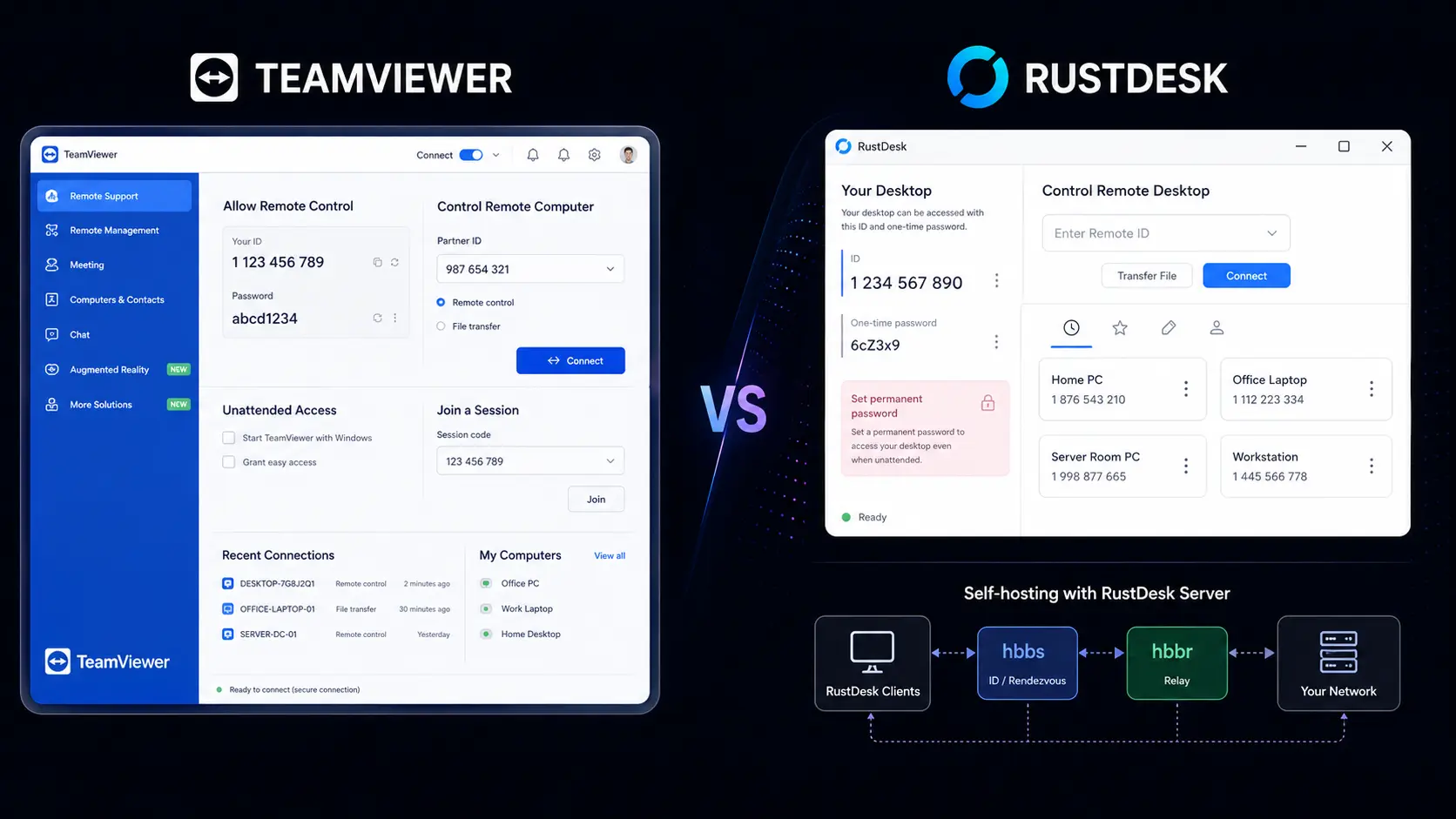
    TeamViewer provides remote access, remote support, unattended access, file transfers, multi-monitor support, remote printing, device management, and business administration tools. Its managed approach means users do not have to maintain their own remote access server.

    RustDesk provides many of the core remote desktop functions users expect, including remote control, file transfer, multiple operating system support, and unattended access. Its major difference is the ability to self-host the server, giving organizations more control over their remote access infrastructure.

    TeamViewer vs RustDesk Features Comparison

    FeatureTeamViewerRustDesk
    Remote desktopYesYes
    Remote supportYesYes
    Unattended accessYesYes
    File transferYesYes
    Multi-monitor supportYesYes
    Remote printingYesYes
    Session recordingYes, plan dependentAvailable
    Windows supportYesYes
    macOS supportYesYes
    Linux supportYesYes
    Android and iOSYesYes
    Web accessYesAvailable
    Self-hostingNot its main modelYes
    Open-source clientNoYes
    Two-factor authenticationYesAvailable with Pro
    Device managementAdvancedAvailable with Pro
    User managementAdvancedAvailable with Pro
    Central administrationYesAvailable with Pro
    Custom clientSelected plansAvailable with Pro
    Free optionPersonal useFree open-source self-hosting

    TeamViewer has the advantage in advanced business management. It is designed for companies that need centralized controls, reporting, device management, and a managed remote support environment.

    RustDesk focuses more on giving users control over their setup. Its open-source model and self-hosting option can be useful for organizations that prefer to manage their own infrastructure.

    TeamViewer vs RustDesk: Ease of Use

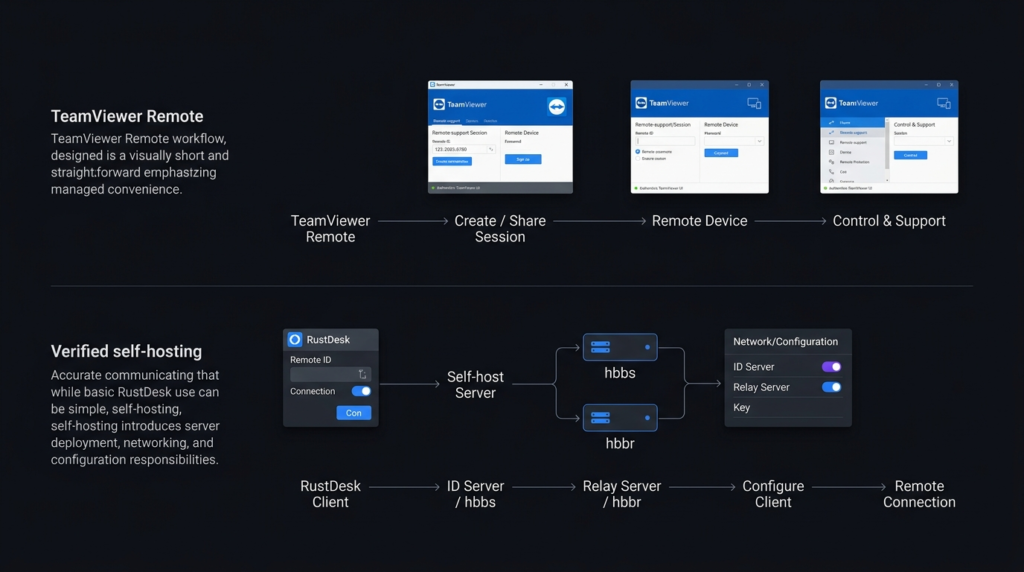
    Ease of use is another important part of TeamViewer vs RustDesk. TeamViewer is designed for users who want to install the software and start a remote session without dealing with server administration. Its interface and business tools are built around a managed experience. RustDesk is also relatively simple for normal remote connections. However, self-hosting requires additional work. Users may need to configure a server, network settings, security rules, and updates. For a beginner who wants the least amount of setup, TeamViewer is usually the easier option. For an experienced user who wants more control, RustDesk can be worth the additional setup.

    TeamViewer vs RustDesk: Security and Privacy

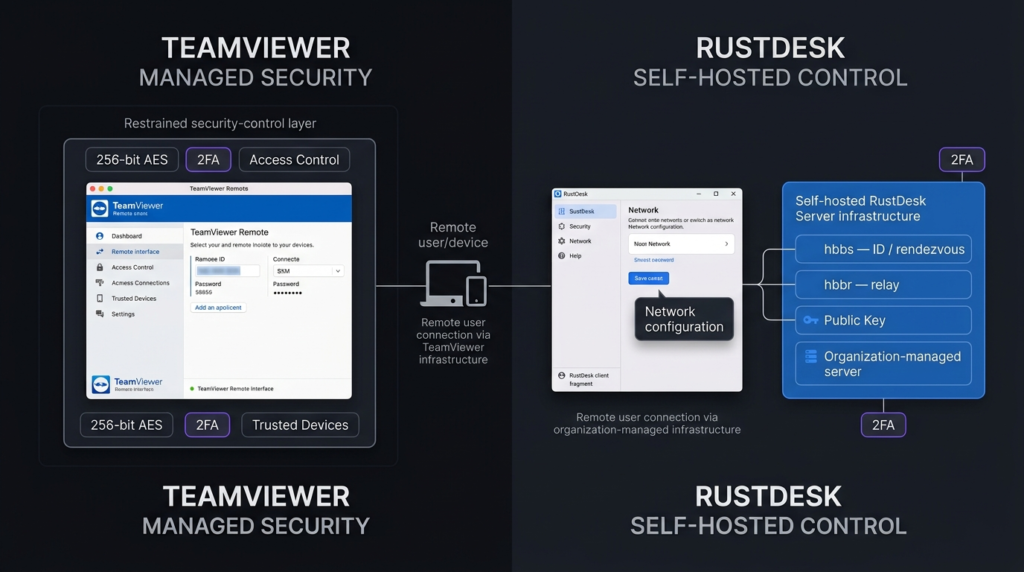
    Security can strongly influence the decision in TeamViewer vs RustDesk. TeamViewer provides encrypted connections, access controls, two-factor authentication, and business security features. Because TeamViewer manages much of the service infrastructure, users do not need to maintain their own remote access server. RustDesk also supports encrypted remote connections and allows users to host their own server. This can give businesses greater control over where their remote access system operates. However, self-hosting comes with responsibility. The organization must protect the server, apply updates, manage access, and configure the network correctly. This creates an important difference: TeamViewer provides more managed convenience, while RustDesk can provide more infrastructure control.

    TeamViewer vs RustDesk: Pricing Comparison

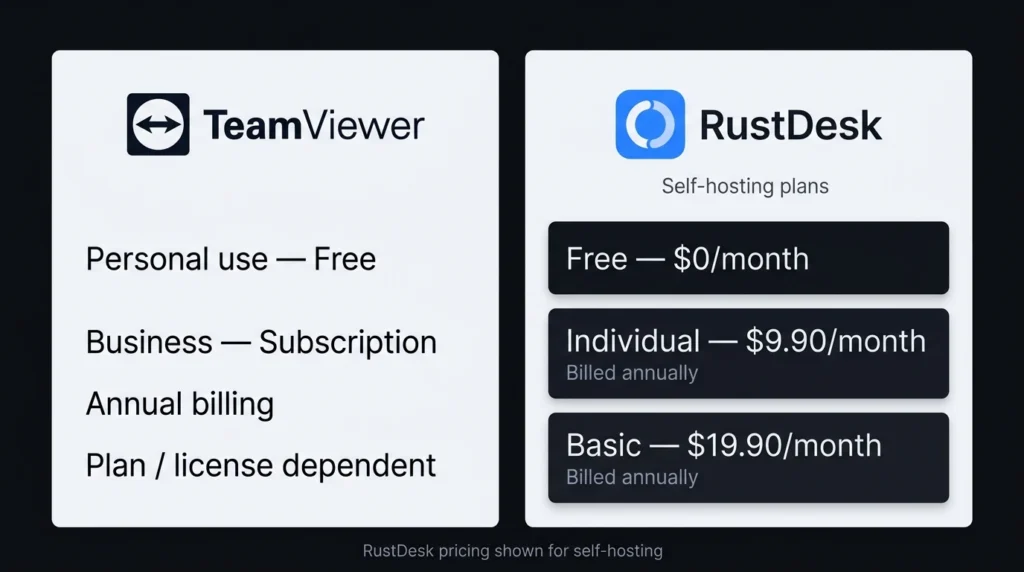
    Pricing is one of the biggest reasons users compare TeamViewer vs RustDesk. TeamViewer uses paid subscription plans for commercial use, while personal use has a free option under its terms. Business pricing varies according to the selected plan and requirements. RustDesk offers a free open-source self-hosting option. Its paid Server Pro plans add business and management features.

    Pricing AreaTeamViewerRustDesk
    Free optionPersonal useFree open-source self-hosting
    Paid modelSubscriptionPro subscription
    Entry paid optionPlan dependent$9.90/month billed annually
    Basic Pro optionPlan dependent$19.90/month billed annually
    Self-hostingNot its main modelYes
    Server managementManaged by providerUser managed for self-hosting
    Business controlsAdvancedAvailable with Pro
    Device managementAvailable on selected plansAvailable with Pro

    RustDesk’s Individual Pro plan starts at $9.90 per month when billed annually, while its Basic Pro plan starts at $19.90 per month when billed annually. The free open-source option can make RustDesk particularly appealing for technically confident users and small setups. Pricing can change, so users should check the official pricing pages before purchasing.

    TeamViewer vs RustDesk: Which Is Better for Businesses?

    For businesses, TeamViewer vs RustDesk depends on the company’s technical resources.

    TeamViewer is a strong option for organizations that want a ready-to-use service with centralized administration and business-focused features. It can reduce the amount of technical work needed to maintain remote access.

    RustDesk may be more attractive to businesses that already have technical staff and want greater control over their infrastructure. Self-hosting can also help organizations keep their remote access system within infrastructure they manage.

    The trade-off is simple: RustDesk gives more control, but that control requires more responsibility.

    TeamViewer vs RustDesk: Which Is Better for Personal Use?

    For personal remote access, TeamViewer vs RustDesk is more balanced.

    TeamViewer is convenient when you want a familiar service that requires little technical setup. It can be useful for helping family members, accessing another computer, or handling occasional remote support.

    RustDesk is appealing if you want an open-source option and are comfortable with self-hosting. Its free option can reduce software costs, especially when advanced business administration is not required.

    TeamViewer vs RustDesk: Pros and Cons

    TeamViewer Pros

    • Easy to set up
    • Strong remote support features
    • Advanced business administration
    • Wide device support
    • Managed service
    • Strong security controls

    TeamViewer Cons

    • Commercial plans can become expensive
    • Less control over the underlying infrastructure
    • Advanced features depend on the selected plan

    RustDesk Pros

    • Open-source client
    • Free self-hosting option
    • Greater infrastructure control
    • Cross-platform support
    • Lower software costs
    • Useful for technically experienced users

    RustDesk Cons

    • Self-hosting requires technical knowledge
    • Server maintenance becomes the user’s responsibility
    • Some business features require Pro plans
    • Less suitable for users who want zero administration

    TeamViewer vs RustDesk: Which One Should You Choose?

    User TypeRecommended ChoiceWhy
    BeginnerTeamViewerEasier setup
    Personal userRustDeskFree self-hosting option
    Small businessDependsCost and management needs vary
    IT professionalRustDeskMore infrastructure control
    Large businessTeamViewerMature management features
    Self-hosting userRustDeskBuilt around self-hosting
    User wanting minimal maintenanceTeamViewerManaged service
    Open-source supporterRustDeskOpen-source approach

    TeamViewer vs RustDesk: Final Verdict

    The TeamViewer vs RustDesk comparison does not have one answer for everyone. TeamViewer is the better fit for users who value convenience, mature business tools, centralized management, and minimal server administration. RustDesk is a strong alternative for users who want open-source software, self-hosting, greater infrastructure control, and lower software costs. RustDesk can compete with TeamViewer, but it competes in a different way. It does not simply copy the commercial model. Instead, it gives users more responsibility and more control. If you want remote access that is ready to use with little technical maintenance, choose TeamViewer. If you are comfortable managing your own infrastructure and want greater control, RustDesk is worth considering.

    FAQs About TeamViewer vs RustDesk

    Is RustDesk better than TeamViewer?

    RustDesk can be better for users who value open-source software, self-hosting, and infrastructure control. TeamViewer is generally better for users who want a managed service with advanced business features and less technical administration.

    Is RustDesk really free?

    Yes. RustDesk provides an open-source self-hosting option at no software subscription cost. Paid Pro plans add features designed for business management and centralized administration.

    Is RustDesk safe?

    RustDesk supports encrypted remote connections and allows users to self-host their server. With self-hosting, however, users are responsible for server security, updates, access settings, and network configuration.

    Which is easier to use, TeamViewer or RustDesk?

    TeamViewer is generally easier for beginners because it provides a managed service that does not require users to maintain their own remote access server. RustDesk is straightforward for basic use but can require more technical work when self-hosting.

  • Looker vs Metabase: Enterprise BI Power or Open-Source Simplicity?

    Looker vs Metabase: Enterprise BI Power or Open-Source Simplicity?

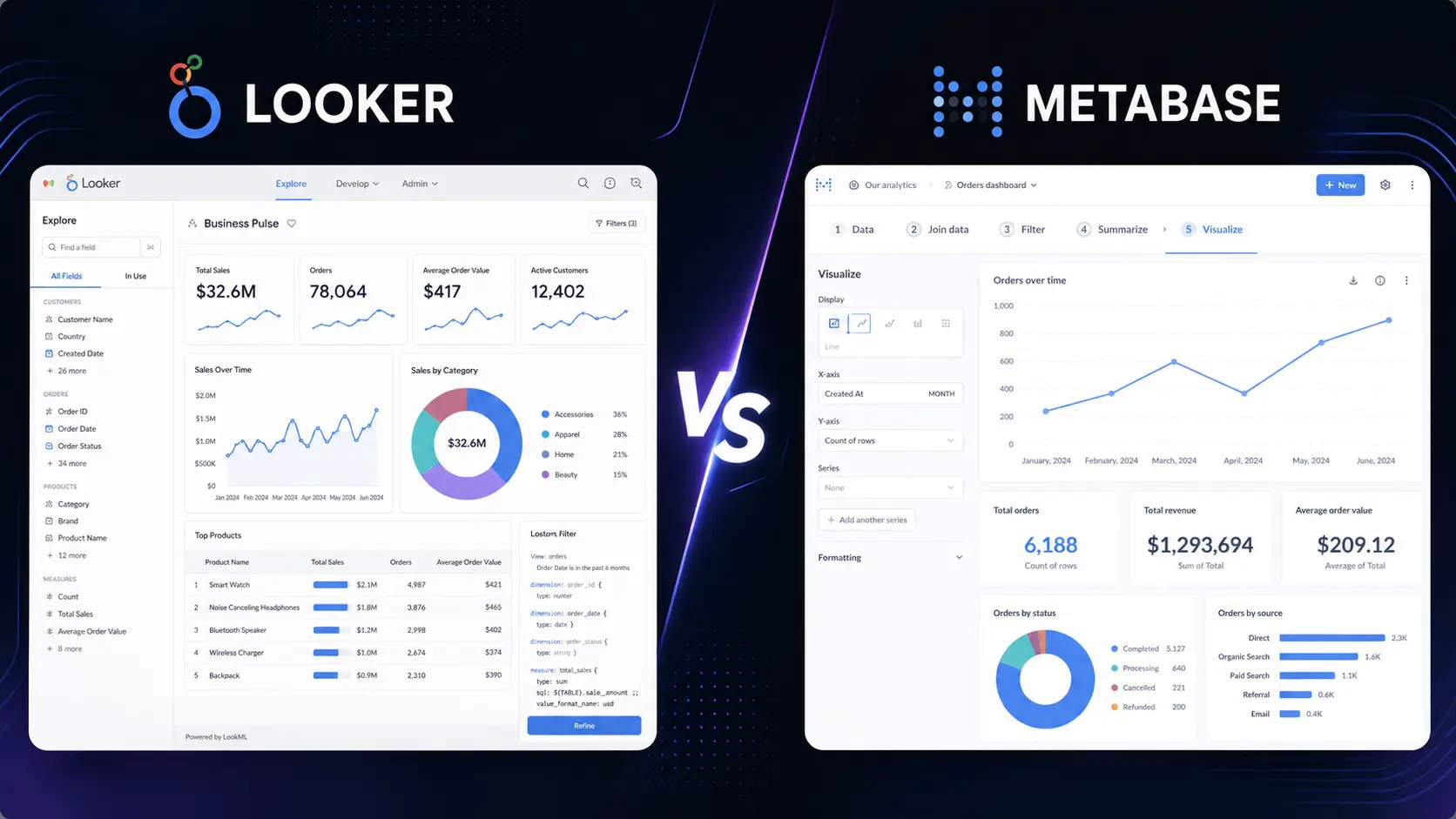
    Choosing the right business intelligence platform can affect how easily a company can understand data, create reports, and keep business numbers consistent. Looker vs Metabase is an important comparison because both tools help teams explore data and build dashboards, but they follow very different approaches. Looker focuses on governed analytics and enterprise control, while Metabase focuses on simplicity, open-source access, and quick data exploration.

    Looker vs Metabase: Key Features Compared

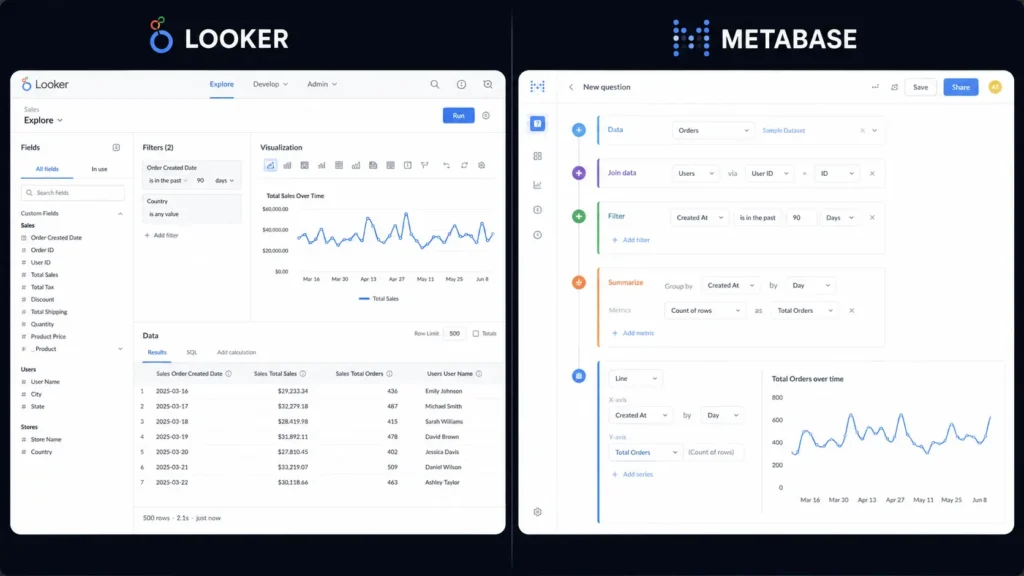
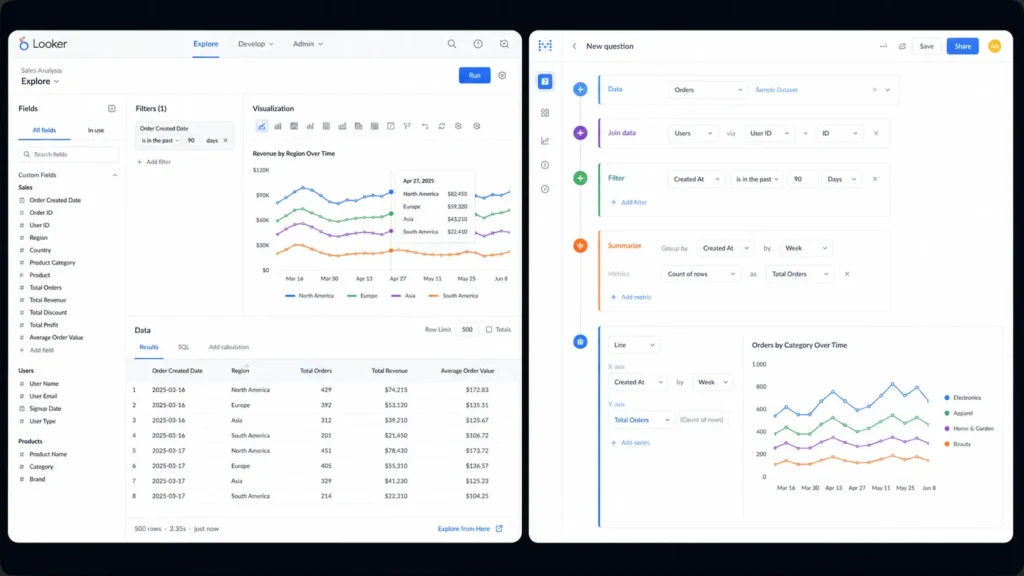
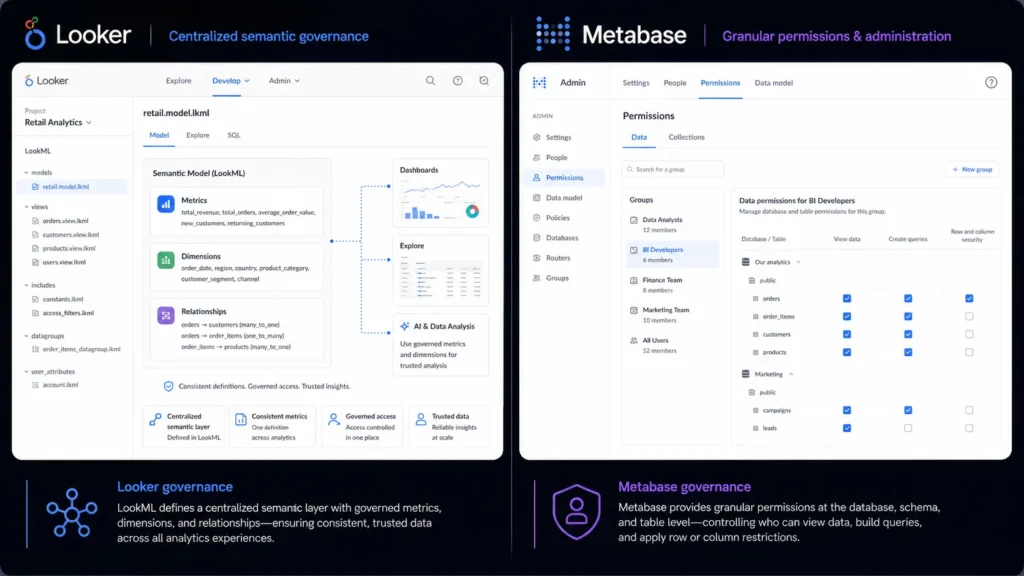
    The biggest difference in Looker vs Metabase is the level of control each platform provides. Looker uses a central modeling system that helps teams define business metrics and relationships consistently. This is useful when many departments need to work with the same numbers. Metabase takes a more direct approach. Users can connect databases, explore information with a visual query builder, write SQL when needed, and create dashboards. Its Open Source Edition is available under the AGPL license.

    FeatureLookerMetabase
    Data explorationAdvancedEasy and accessible
    Data modelingExcellentGood
    Visual query builderYesYes
    SQL editorYesYes
    DashboardsAdvancedAdvanced
    Business metric governanceExcellentGood
    User permissionsAdvancedAdvanced on paid plans
    Data visualizationExcellentExcellent
    Scheduled reportsYesYes
    AlertsYesYes
    Embedded analyticsExcellentYes
    Open-source editionNoYes
    Self-hostingAvailable through supported optionsYes
    AI featuresAvailableAvailable
    Best forLarge and data-heavy organizationsStartups and growing teams
    Ease of useModerateEasy

    *Feature comparison reflects current product documentation and plan information from Google Cloud and Metabase. *

    Looker vs Metabase: Pricing Comparison

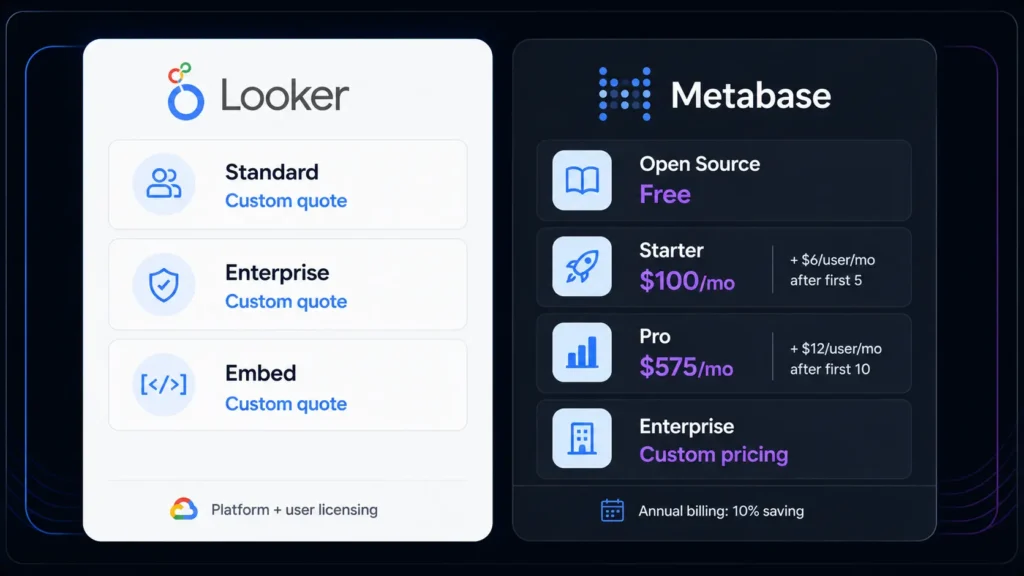
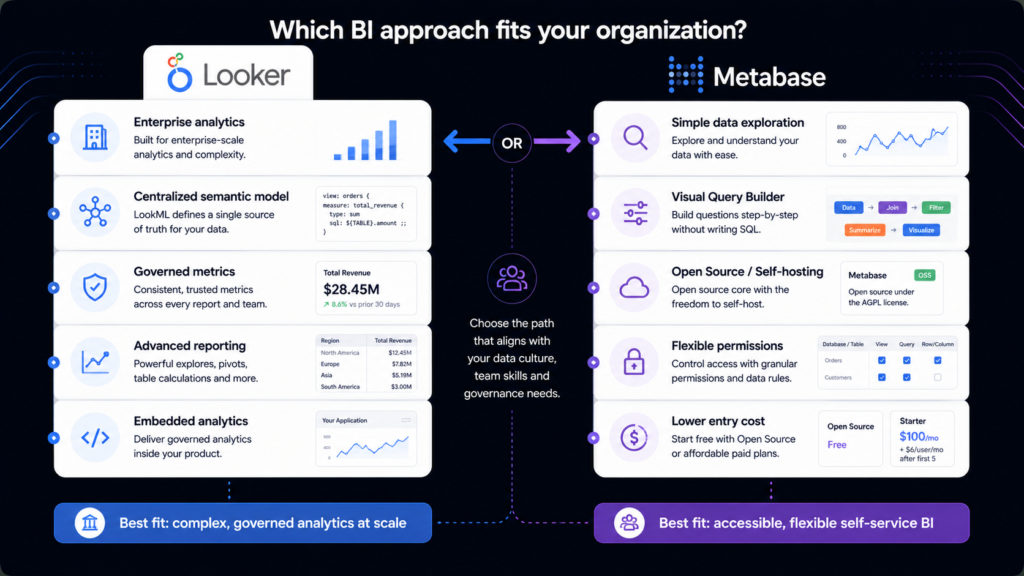
    Pricing is one of the most important parts of Looker vs Metabase. Looker does not publish a simple fixed monthly price for its Google Cloud Core editions. Its pricing combines platform costs with user licensing, and Google directs customers to sales for a custom quote. The Standard, Enterprise, and Embed editions include different levels of features and usage. Metabase has a more transparent pricing structure. Its Open Source Edition is free to use, while its current Starter plan begins at $100 per month plus $6 per additional user, with the first five users included. The Pro plan starts at $575 per month plus $12 per additional user, with the first ten users included. Annual billing provides a 10% saving according to Metabase’s billing documentation.

    Pricing OptionLookerMetabase
    Free optionNo standard free editionOpen Source Edition
    Entry paid planCustom quoteStarter: $100/month + $6/user
    Mid-level planCustom quotePro: $575/month + $12/user
    EnterpriseCustom quoteContact sales
    Annual pricingCustom quote10% annual billing discount
    Self-hostingAvailable depending on product setupOpen Source and paid options
    User-based pricingYesYes on paid plans
    Best pricing advantageEnterprise customizationLower entry cost and open-source option

    *Prices shown are based on official pricing pages available in August 2026 and may change. *

    Looker vs Metabase: Which Has Better Data Analysis?

    For advanced data analysis, Looker vs Metabase gives Looker an advantage. Its modeling approach helps organizations create shared definitions for important business metrics. This can reduce confusion when sales, finance, marketing, and management teams use the same data. Metabase is easier for everyday exploration. Users can ask questions through its query builder or use the SQL editor for more control. This makes it useful for teams that want quick answers without building a complex modeling layer.

    Looker vs Metabase: Which Is Easier to Use?

    When comparing ease of use in Looker vs Metabase, Metabase is the simpler option for most new users. Metabase is designed to let people explore data without requiring deep technical knowledge. Its visual tools can help business users create questions and dashboards without writing SQL for every task. Looker offers more control, but that control can require more training. Teams working with LookML and centralized data models may need technical users to manage the setup.

    Looker vs Metabase: Enterprise Security and Governance

    Enterprise governance is a major strength of Looker vs Metabase. Looker is designed for organizations that need centralized control over business definitions, permissions, reporting, and analytics. Metabase also provides advanced permissions on paid plans. Its Pro plan includes database-, row-, and column-level permissions along with single sign-on options. Enterprise customers can also receive stronger support and customized commercial terms. For companies with complex reporting structures, Looker may provide a more suitable foundation. For teams that need strong controls without the same level of complexity, Metabase can be a practical alternative.

    Looker vs Metabase: Which Is Better for Small Businesses?

    For small businesses, Looker vs Metabase often favors Metabase. The free Open Source Edition gives smaller teams a way to start without paying for a commercial BI platform. Metabase also offers a managed Starter plan for companies that do not want to maintain the software themselves. Looker can make more sense when a small company already has complex data requirements or expects to build a larger analytics operation.

    Looker vs Metabase: Which Is Better for Enterprise Companies?

    For large organizations, Looker vs Metabase becomes more balanced. Looker is a strong choice when centralized data definitions, advanced governance, detailed analytics, and embedded reporting are key requirements. Metabase can still work well for larger companies, particularly those that value self-hosting, open-source flexibility, and a simpler interface. Its Pro and Enterprise offerings add stronger permissions, support, and embedding options.

    Looker vs Metabase: Final Verdict

    The best choice in Looker vs Metabase depends on the size and needs of your organization. Looker is better suited to businesses that need advanced governance, centralized data models, complex reporting, and enterprise analytics. Metabase is more attractive to teams that want simple data exploration, open-source flexibility, self-hosting, and clearer starting prices. If simplicity and cost control are your main priorities, Metabase is worth considering. If your organization needs deeper control over data and reporting at scale, Looker may be the stronger long-term choice.

    FAQs About Looker vs Metabase

    Is Metabase cheaper than Looker?

    Metabase has a clear cost advantage for smaller teams because its Open Source Edition is free. Its paid Starter plan begins at $100 per month plus $6 per additional user. Looker uses custom pricing, so the final cost depends on the platform edition and user requirements.

    Is Metabase easier to use than Looker?

    Yes. Metabase generally has a simpler interface and is designed for quick data exploration. Looker offers deeper control but usually requires more technical knowledge.

    Is Looker better for enterprise reporting?

    Looker can be a better fit for enterprise reporting when an organization needs centralized business definitions, advanced governance, detailed permissions, and complex analytics.

    Can Metabase be self-hosted?

    Yes. Metabase offers an Open Source Edition for self-hosting, while paid plans also provide self-hosting options. Self-hosting gives teams more control but also means they are responsible for infrastructure, upgrades, backups, and monitoring.

  • Asana vs Trello: Which Project Management Tool Wins in 2026?

    Asana vs Trello: Which Project Management Tool Wins in 2026?

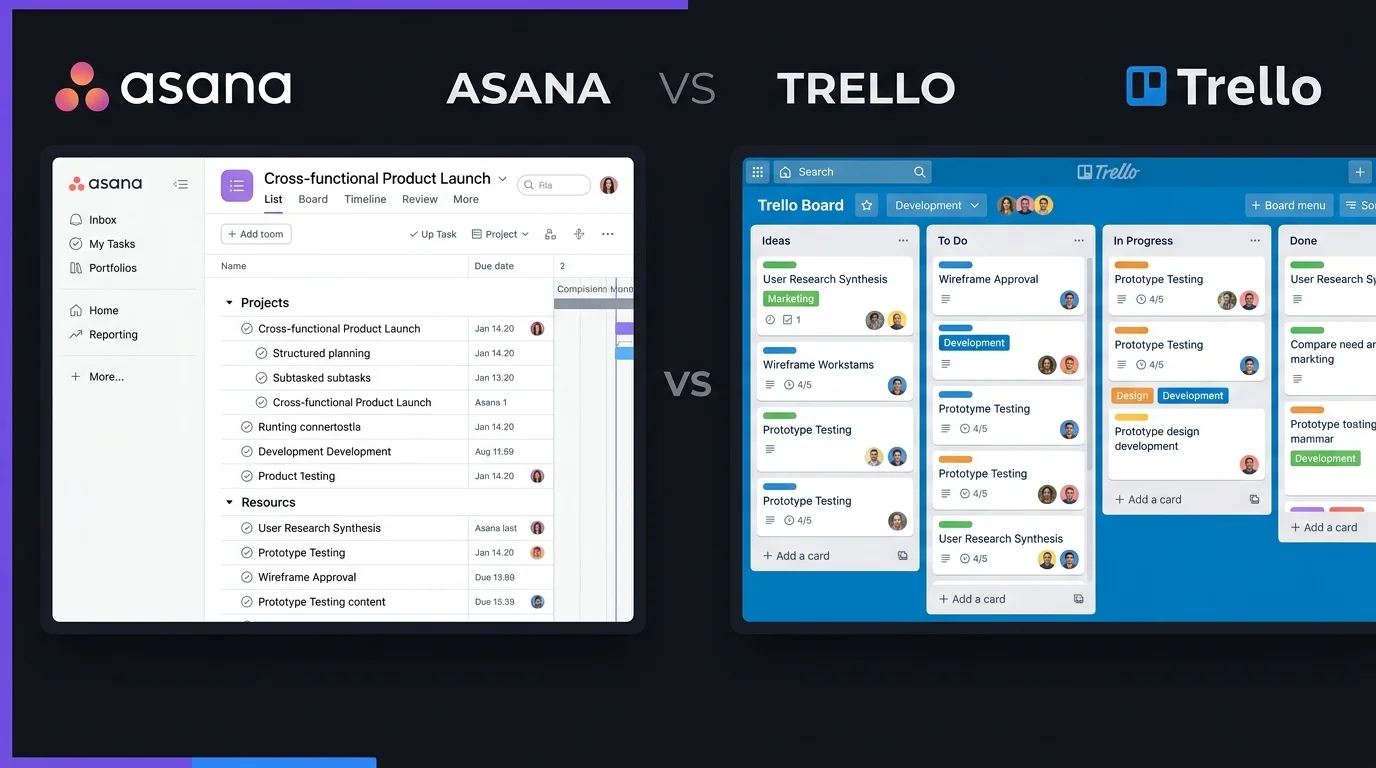
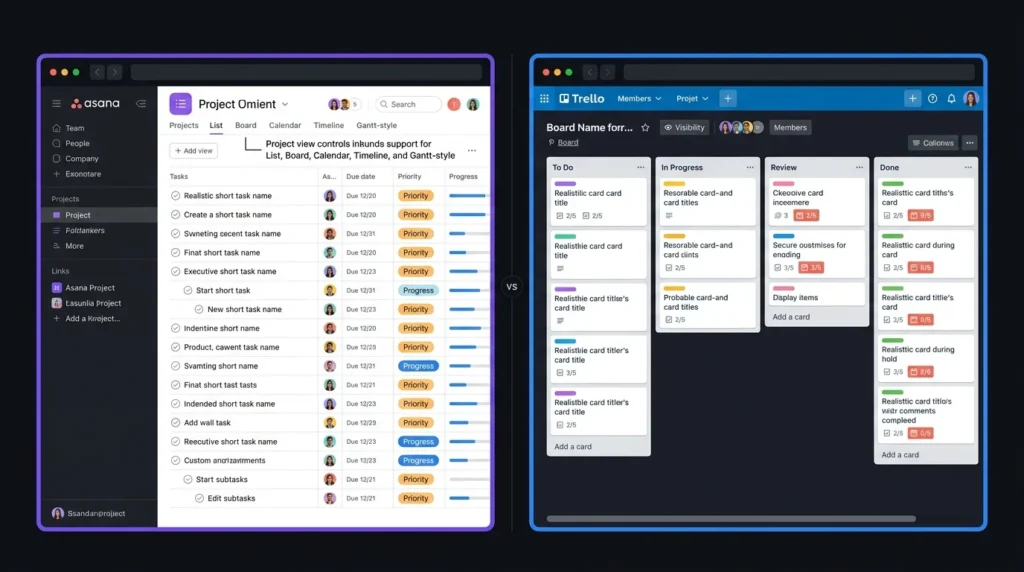
    Choosing the right project management tool can make daily work easier to organize. Asana vs Trello is a popular comparison because both tools help users manage tasks, projects, deadlines, and team work, but they take different approaches. Asana offers a more structured system for detailed project planning, while Trello uses simple boards and cards to keep work visual. The right choice depends on your team size, project complexity, budget, and preferred way of working.

    Asana vs Trello: Complete Comparison

    FeatureAsanaTrello
    Overall Rating4.7/54.5/5
    Ease of Use4.6/54.8/5
    Task Management4.8/54.5/5
    Project Planning4.8/54.2/5
    Kanban BoardsYesYes
    List ViewYesNo
    Calendar ViewYesYes
    Timeline ViewYesLimited
    Task DependenciesYesLimited
    SubtasksYesChecklists
    Custom FieldsYesYes
    AutomationYesYes
    ReportingYesLimited
    Workload ManagementYesLimited
    TemplatesYesYes
    Integrations100+ free integrationsPower-Ups and integrations
    Mobile AppsYesYes
    Free PlanYesYes
    Best ForDetailed projects and growing teamsSimple visual workflows

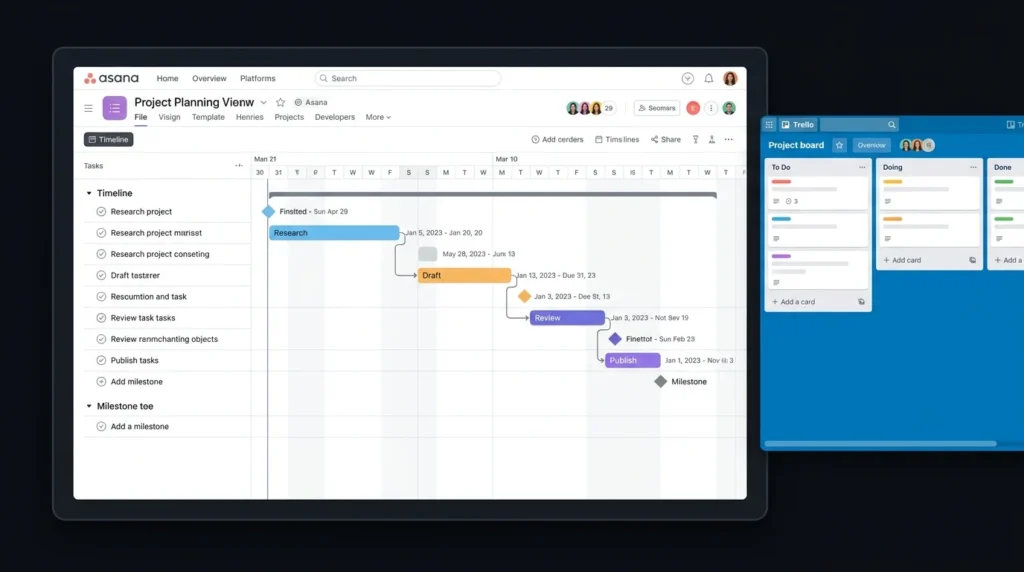
    Asana currently provides list, board, calendar, timeline, and Gantt-style views, along with task dependencies, custom fields, forms, workload tools, and workflow features. Trello focuses more strongly on its visual board system and also supports automation and additional Power-Ups.

    Asana vs Trello: Task Management

    How Asana Handles Tasks

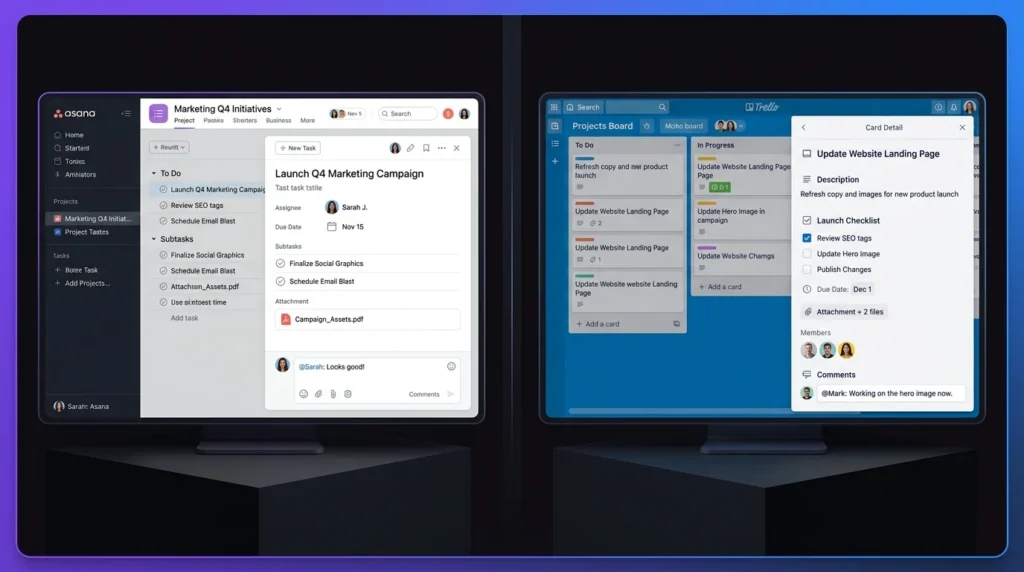
    Asana gives teams several ways to organize tasks. Users can assign work, add due dates, create subtasks, set dependencies, and organize tasks inside projects. This makes Asana useful when one project contains many connected tasks. Teams can see what needs to happen first and which tasks depend on other work.

    How Trello Handles Tasks

    Trello uses boards, lists, and cards. A card can contain descriptions, checklists, due dates, files, comments, and other information. Moving cards between lists provides a simple visual way to track progress. For example, a team can create To Do, In Progress, Review, and Done lists. For straightforward workflows, Trello can be easier to understand than Asana.

    Asana vs Trello: Project Planning

    Project planning is one of the biggest differences in the Asana vs Trello comparison. Asana is better suited to projects that require detailed schedules and connected tasks. Its timeline and Gantt-style features can help teams plan deadlines, milestones, and task dependencies. Trello works well for projects that can be managed through a simple visual workflow. It is particularly useful for content planning, simple marketing tasks, personal projects, and smaller team workflows. If your projects regularly involve several stages and dependencies, Asana provides more planning options.

    Asana vs Trello: Collaboration Features

    Both platforms allow users to work together, assign tasks, leave comments, share files, and monitor project progress. Asana places more emphasis on structured project collaboration. Teams can connect individual tasks with larger projects and goals. Trello keeps collaboration closely connected to cards. Team members can discuss work directly inside the relevant card, which keeps the system simple. The better option depends on how your team prefers to organize information.

    Asana vs Trello: Automation and Integrations

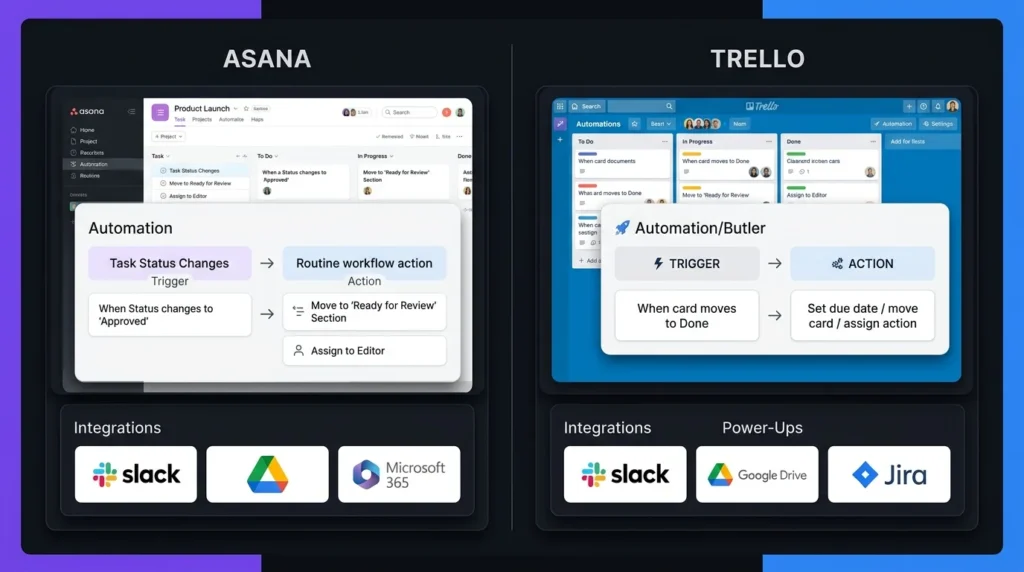
    Automation can handle repetitive actions in both tools. Trello includes built-in automation that can trigger actions based on activity on boards and cards. Trello also uses Power-Ups to add extra functions and connections with other services. Asana supports workflow automation and offers more than 100 free integrations on its current Personal plan, including connections with common work tools. For a simple workflow, Trello’s automation is easy to understand. Asana is more suitable when automation needs to fit into a larger project structure.

    Asana vs Trello: Pricing Comparison

    Pricing is an important part of the Asana vs Trello decision.

    Pricing FeatureAsanaTrello
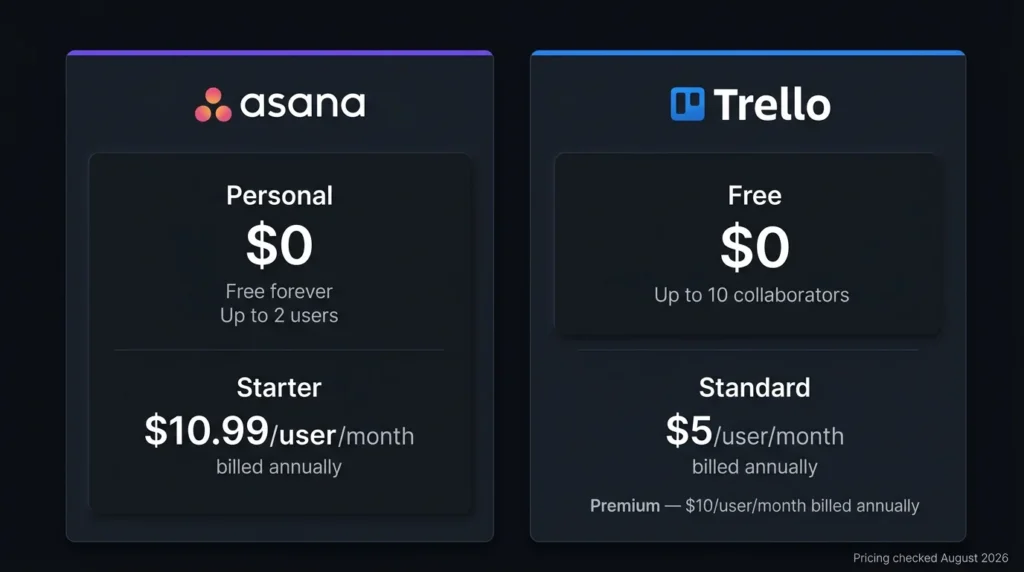
    Free Plan$0$0
    Free Plan UsersUp to 2 usersUp to 10 collaborators per Workspace
    Paid PlansStarter, Advanced, Enterprise, Enterprise+Standard, Premium, Enterprise
    Entry Paid PlanVaries by billing and planStandard starts at $5/user/month when billed annually
    Free FeaturesTasks, projects, list, board, calendar and moreUnlimited cards and up to 10 boards per Workspace
    Free TrialAvailable for paid plans14-day Premium trial
    Enterprise PricingCustomCustom

    Asana’s current pricing page lists Personal at $0 and includes unlimited tasks and projects, list, board, and calendar views. Trello’s official pricing page lists its Free plan at $0 and Standard at $5 per user per month when billed annually. Because software pricing can change, check the official pricing pages before making a purchase.

    Asana vs Trello: Ease of Use

    Trello has an advantage in simplicity. New users can usually understand its board, list, and card system without much training. Asana has more features and project views, so it may take longer to learn. However, those extra options can become useful as projects become more detailed. For a small team that wants a simple visual system, Trello can be a good fit. For teams that need more project controls, Asana offers greater depth.

    Asana vs Trello: Which Tool Should You Choose?

    Choose Asana if you need:

    • Detailed project planning
    • Task dependencies
    • Multiple project views
    • Workload management
    • Structured team workflows
    • Detailed project tracking

    Choose Trello if you need:

    • Simple visual boards
    • Easy task tracking
    • A short learning curve
    • Straightforward workflows
    • A generous free plan for small teams

    The Asana vs Trello choice should depend on how your team actually works. Choosing a tool with more features does not automatically make it better if your team only needs a simple task board.

    Final Thoughts on Asana vs Trello

    The Asana vs Trello comparison comes down to the type of workflow you need. Trello is a strong option for users who want simple boards, cards, and visual task tracking. Asana is better suited to users who need detailed project planning, dependencies, multiple views, and structured workflows. Before choosing, consider your team size, project complexity, required features, and budget. For simple work management, Trello can be enough. For more detailed project planning, Asana provides a wider set of tools.

    FAQs About Asana vs Trello

    Is Asana better than Trello for large teams?

    Asana can be a better choice for large teams handling complex projects, multiple deadlines, dependencies, and detailed workflows. Trello can work well for larger groups when their work follows a simple board-based process.

    Is Trello easier to use than Asana?

    Yes. Trello’s board-and-card structure is generally easier for beginners to understand. Asana offers more project planning options, which can require more time to learn.

    Which is cheaper, Asana or Trello?

    Trello has a lower starting paid price. Its Standard plan starts at $5 per user per month when billed annually, while Asana uses a different plan structure and pricing model. Both offer free plans.

    Can Asana and Trello manage personal projects?

    Yes. Both tools can be used for personal tasks, content planning, study projects, and other individual work. Trello is useful for simple visual planning, while Asana offers more ways to organize detailed projects.

  • Google Workspace vs LibreOffice: Which Productivity Suite Is Better?

    Google Workspace vs LibreOffice: Which Productivity Suite Is Better?

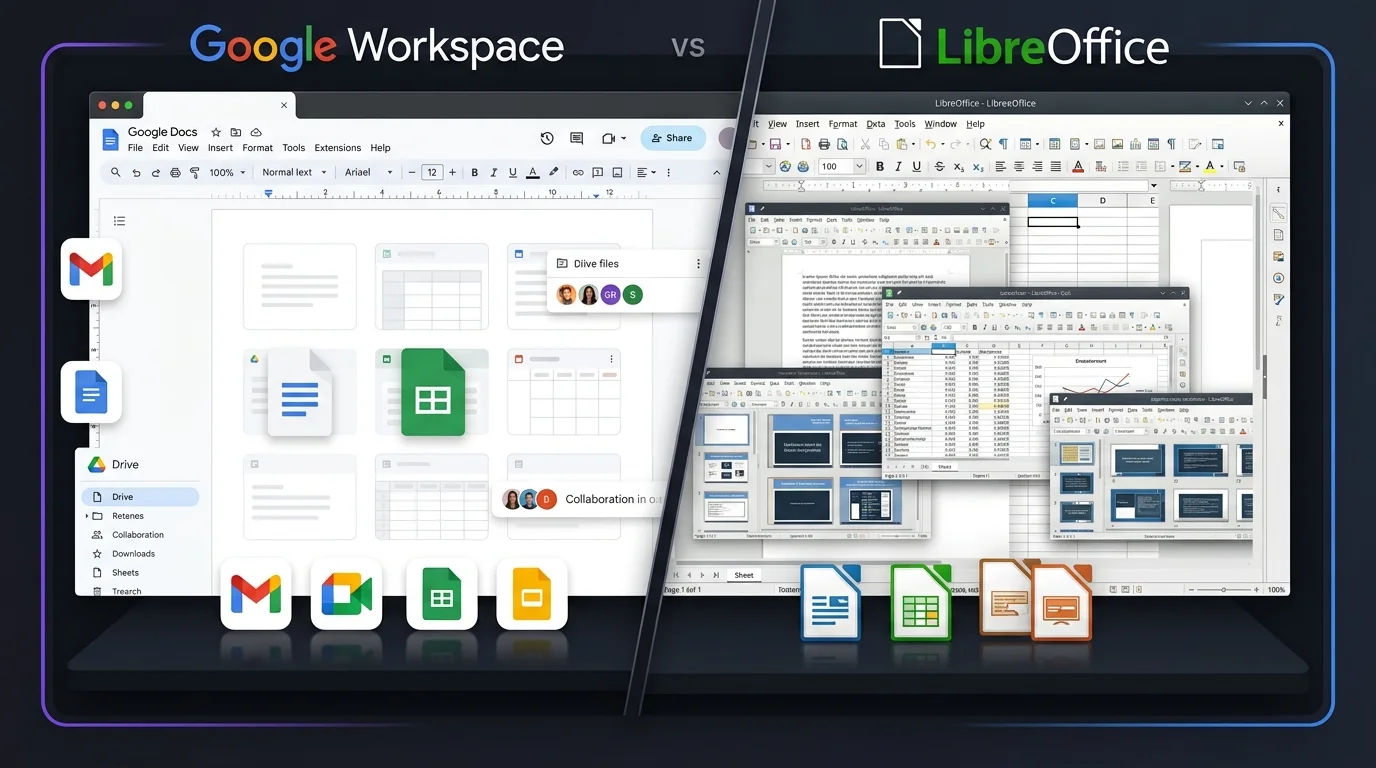
    Choosing the right productivity suite depends on how you work, what features you need, and whether you prefer cloud-based or desktop software. Google Workspace vs LibreOffice is a useful comparison for students, professionals, businesses, and personal users looking for reliable tools for documents, spreadsheets, and presentations. Google Workspace focuses on online collaboration, cloud storage, and connected work. LibreOffice takes a different approach with a free desktop suite that works well without an internet connection. The better option depends on your budget, workflow, and need for collaboration.

    Google Workspace vs LibreOffice: Comparison Table

    FeatureGoogle WorkspaceLibreOffice
    Word ProcessorGoogle DocsLibreOffice Writer
    SpreadsheetGoogle SheetsLibreOffice Calc
    PresentationGoogle SlidesLibreOffice Impress
    EmailGmail includedNot included
    Cloud StorageGoogle Drive includedNo built-in cloud storage
    Real-Time CollaborationYesLimited
    Offline WorkSupported with setupExcellent
    Desktop AppsLimitedFull desktop suite
    Mobile AccessAndroid and iOS appsLimited mobile options
    File SharingBuilt inUsually requires another service
    Microsoft Office File SupportYesYes
    Video MeetingsGoogle MeetNot included
    TemplatesLarge selectionAvailable
    Document CommentsYesYes
    Version HistoryYesAvailable through file management features
    User ManagementAvailable on business plansNot designed for centralized business management
    Internet RequiredMainly for cloud featuresNo
    Best ForTeams, businesses, students, remote workPersonal users, offline work, budget users

    Google Workspace vs LibreOffice: Pricing Comparison

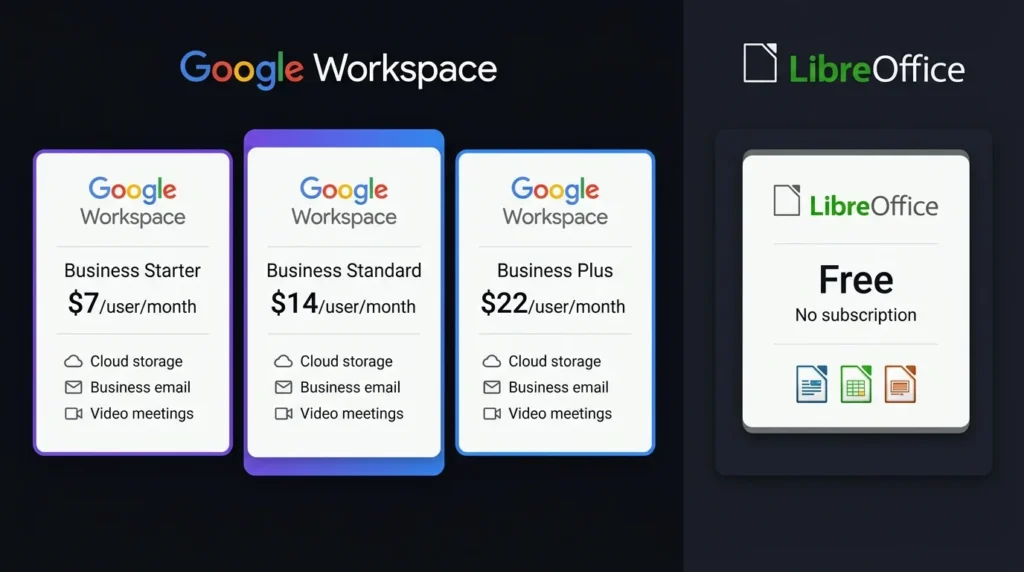
    Pricing is one of the biggest differences between the two options. LibreOffice is free to download and use, while Google Workspace uses paid plans for business and professional users. Google also provides free personal access to individual applications such as Docs, Sheets, and Slides with a Google account, although storage and business features differ.

    Pricing FactorGoogle WorkspaceLibreOffice
    Basic CostFree personal tools available; business plans are paidFree
    SubscriptionYes for business plansNo
    Cloud StorageIncluded with Google Workspace plansNot included
    Business EmailIncluded with eligible plansNot included
    Video MeetingsIncluded with Workspace plansNot included
    Desktop Office AppsWeb-focusedIncluded
    Long-Term CostDepends on selected planNo software subscription
    Best Value ForBusinesses and teamsUsers wanting free desktop software

    For users who only need word processing, spreadsheets, and presentations, LibreOffice can reduce software costs because there is no subscription. Google Workspace can offer better value for businesses that also need professional email, cloud storage, meetings, and shared workspaces.

    Google Workspace vs LibreOffice: Features

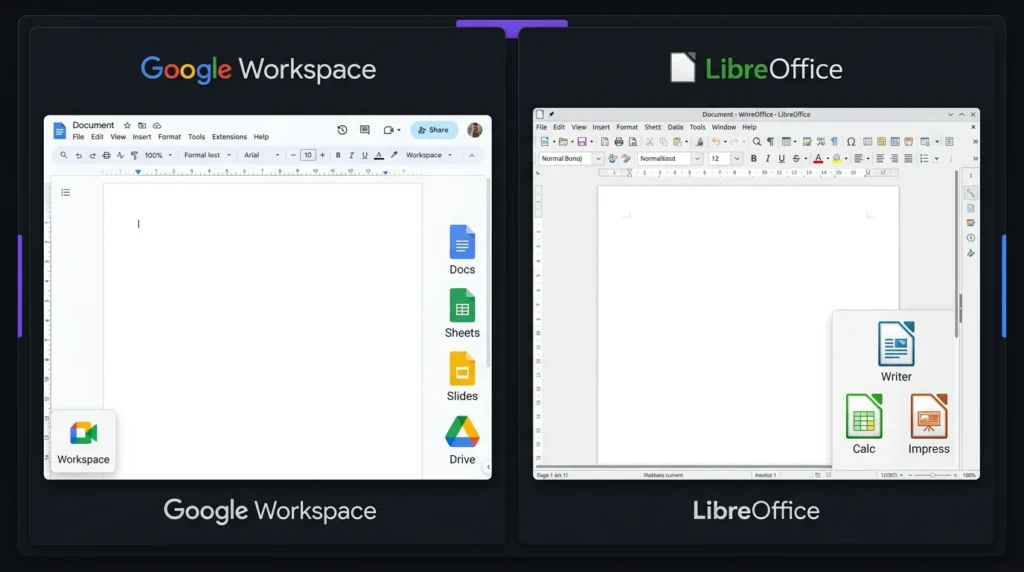
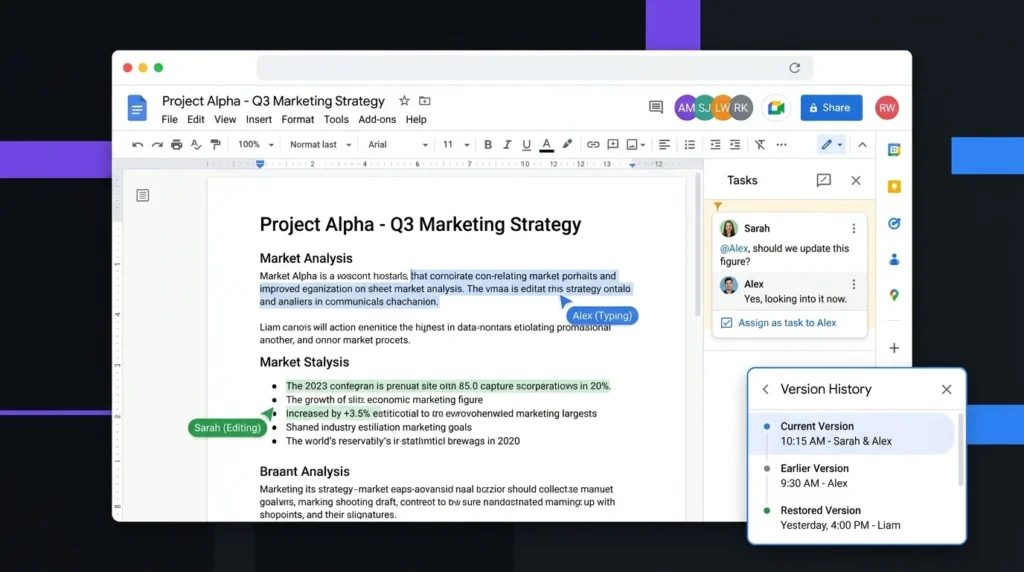
    Google Workspace provides a connected set of online tools. Google Docs handles documents, Google Sheets manages spreadsheets, and Google Slides is designed for presentations. Google Drive provides cloud storage, while Gmail and Google Meet support communication.

    LibreOffice includes Writer, Calc, Impress, Draw, Base, and Math. This gives users a broad collection of desktop applications without requiring a paid account.

    For basic office work, both suites provide the main tools most users need. The biggest difference in Google Workspace vs LibreOffice is the way those tools are delivered.

    Google Workspace vs LibreOffice: Collaboration

    Google Workspace has a strong advantage for collaboration. Multiple people can work on the same document at the same time, add comments, suggest changes, and share files through links or permissions.

    LibreOffice is primarily designed for individual desktop work. Documents can still be shared through email, cloud storage, or other services, but the collaboration experience is not as integrated.

    For remote teams, group assignments, and businesses, Google Workspace is generally the more practical choice.

    Google Workspace vs LibreOffice: Offline Use

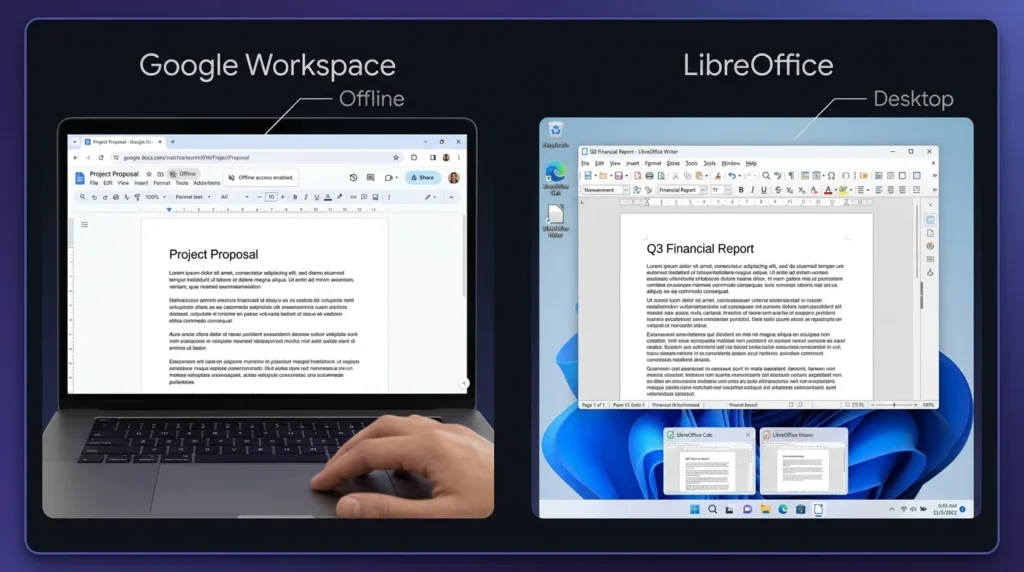
    LibreOffice is an excellent option for offline work. Once installed on a computer, Writer, Calc, and Impress can be used without an internet connection.

    Google Workspace also supports offline access for certain applications, but users need to configure offline functionality. Its main strength remains cloud-based work.

    If internet access is unreliable or you prefer keeping files directly on your computer, LibreOffice has an advantage.

    Google Workspace vs LibreOffice: File Compatibility

    Both suites can work with popular office file formats. LibreOffice supports formats commonly associated with Microsoft Office, while Google Workspace can import and export several common formats. However, complex documents can sometimes experience formatting changes when moved between different office programs. Users working with advanced layouts, spreadsheets, or presentation designs should test important files before switching platforms.

    Google Workspace vs LibreOffice: Ease of Use

    Google Workspace is easy to access because most tools work directly through a web browser. Users can sign in and continue working from another supported device.

    LibreOffice feels more like a traditional desktop office suite. Its applications offer many settings and tools, which can be useful for experienced users but may take some time for beginners to learn.
    For simple online work, Google Workspace may feel easier. For traditional desktop productivity, LibreOffice remains a strong option.

    Google Workspace vs LibreOffice: Which Productivity Suite Is Better?

    The answer depends on your needs.

    Google Workspace is better for:

    • Online collaboration
    • Remote teams
    • Cloud storage
    • Business email
    • Video meetings
    • Working across multiple devices

    LibreOffice is better for:

    • Free office software
    • Offline work
    • Local file storage
    • Desktop productivity
    • Users who want to avoid subscriptions

    Google Workspace is the stronger choice when collaboration and cloud services are important. LibreOffice is the better fit for users who mainly need free desktop applications without a recurring software cost.

    Final Verdict on Google Workspace vs LibreOffice

    Google Workspace vs LibreOffice comes down to cloud convenience versus desktop freedom. Google Workspace provides a connected working environment with collaboration, storage, email, and meetings. LibreOffice provides a capable free office suite with strong offline functionality and local file control. For businesses and teams, Google Workspace offers a more complete collaboration experience. For individuals who want free desktop productivity tools, LibreOffice provides excellent value. Your ideal choice should depend on how you work, your budget, and whether you need online collaboration.

  • Hotjar vs Matomo: Better User Insights or More Control Over Your Data?

    Hotjar vs Matomo: Better User Insights or More Control Over Your Data?

    Choosing the right analytics platform can help you understand visitors, improve website performance, and make better decisions. Hotjar vs Matomo is a common comparison because both tools provide website insights but take different approaches. Hotjar focuses heavily on visual user behavior, feedback, heatmaps, and session recordings. Matomo provides broader website analytics with stronger options for data ownership and control. The right choice depends on whether you care more about understanding how visitors use your website or having greater control over your analytics data.

    Hotjar vs Matomo: Quick Comparison

    FeatureHotjarMatomo
    Website analyticsYesYes
    HeatmapsYesYes
    Session recordingsYesYes
    Visitor feedbackYesYes
    SurveysYesYes
    Conversion trackingYesYes
    Traffic reportsBasic to moderateAdvanced
    Campaign trackingYesYes
    FunnelsYesYes
    User flowLimitedYes
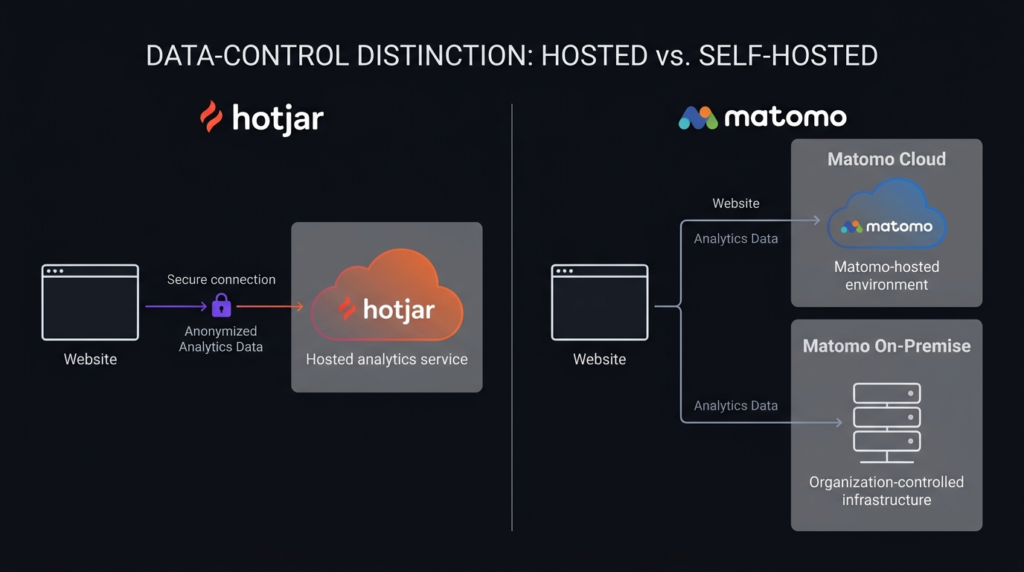
    Data ownershipLimited compared with self-hosted analyticsStrong
    Self-hostingNoYes
    Privacy controlsStrongExtensive
    Real-time analyticsLimitedYes
    E-commerce trackingAvailableYes
    Ease of useVery easyModerate
    Best forUser behavior researchFull website analytics and data control

    This Hotjar vs Matomo comparison shows that both platforms cover important analytics needs, but their strengths are different.

    Features Comparison

    Hotjar Features

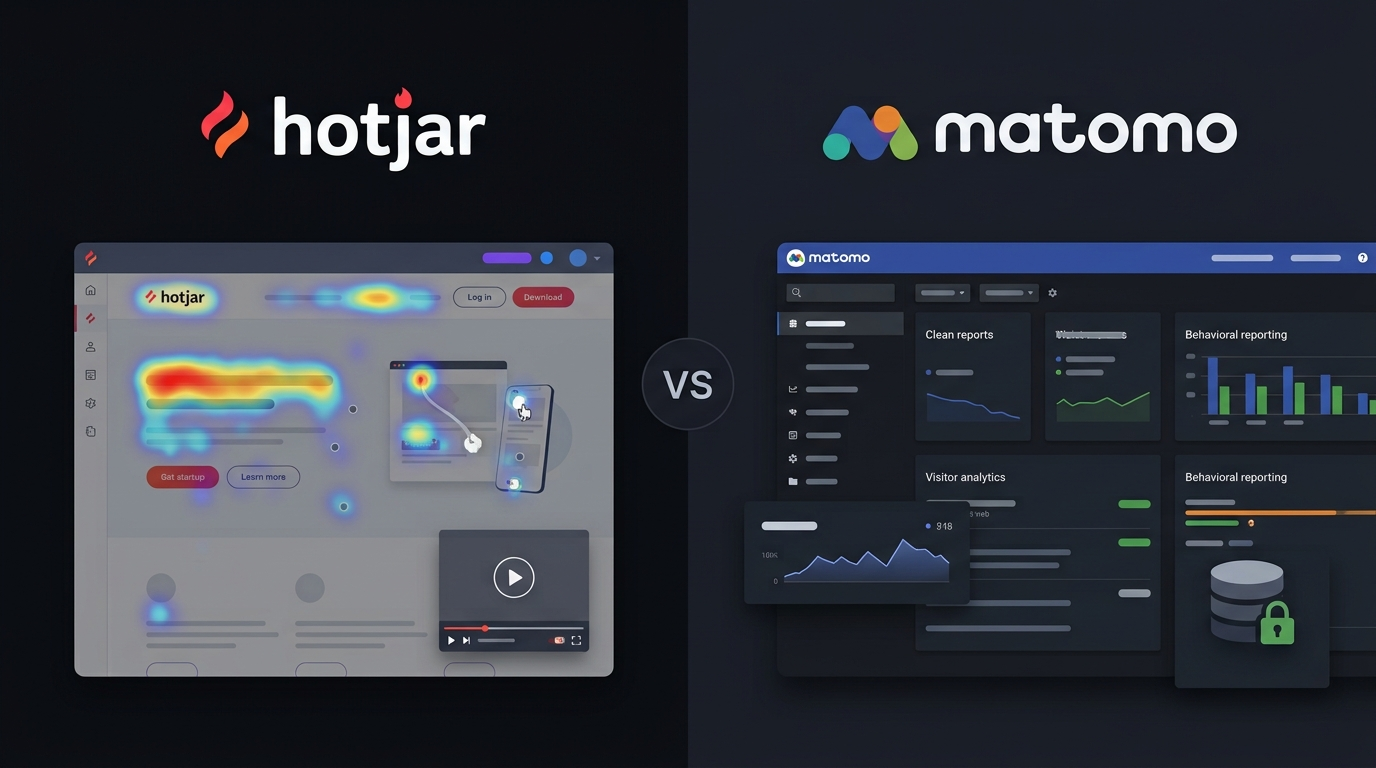
    Hotjar is built around understanding visitor behavior. Its heatmaps help you see where people click, move, and scroll on pages. Session recordings provide a visual view of individual website visits. Hotjar also offers feedback and survey features, allowing businesses to collect direct opinions from visitors. These tools can help identify confusing pages, navigation problems, and areas where users may stop interacting with a website.
    Key Hotjar features include:

    • Heatmaps
    • Session recordings
    • Surveys
    • Feedback tools
    • User behavior insights
    • Website experience research
    • Conversion-related insights
    • Privacy controls

    Hotjar also states that its platform is designed around anonymous insights and includes privacy measures such as data suppression options.

    Matomo Features

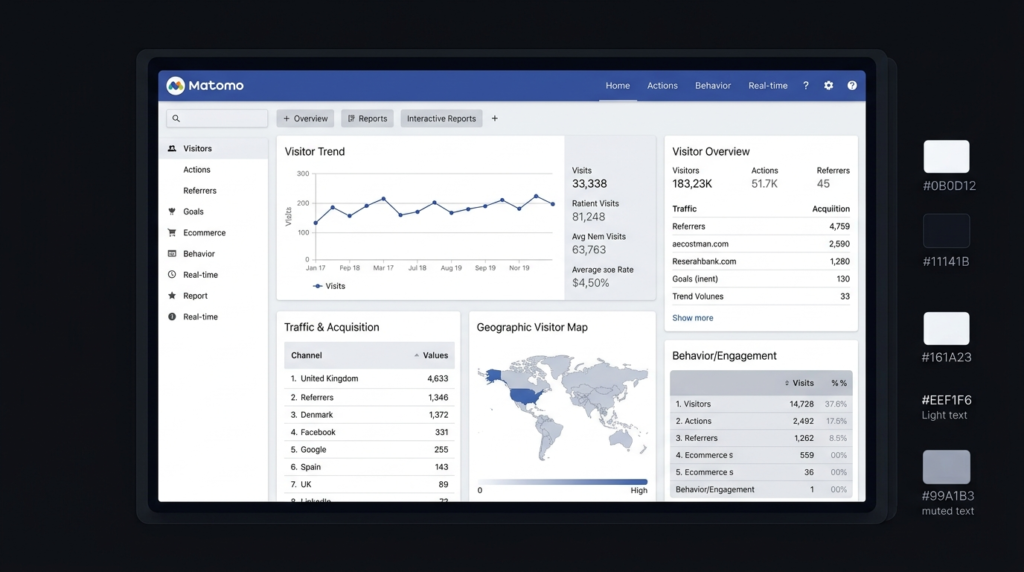
    Matomo takes a wider analytics approach. It can track website traffic, visitor activity, campaigns, goals, e-commerce activity, events, site searches, and other website data. Its feature set also includes funnels, user flows, custom reports, form analytics, heatmaps, session recordings, and search engine keyword reporting on eligible plans.

    Important Matomo features include:

    • Real-time analytics
    • Visitor tracking
    • Campaign tracking
    • Goal tracking
    • E-commerce analytics
    • Funnels
    • User flows
    • Heatmaps
    • Session recordings
    • Custom reports
    • Form analytics
    • Privacy controls
    • Data export options
    • Self-hosting

    For Hotjar vs Matomo, Matomo has an advantage when a business wants one platform for broader website measurement.

    Hotjar vs Matomo: Pricing Comparison

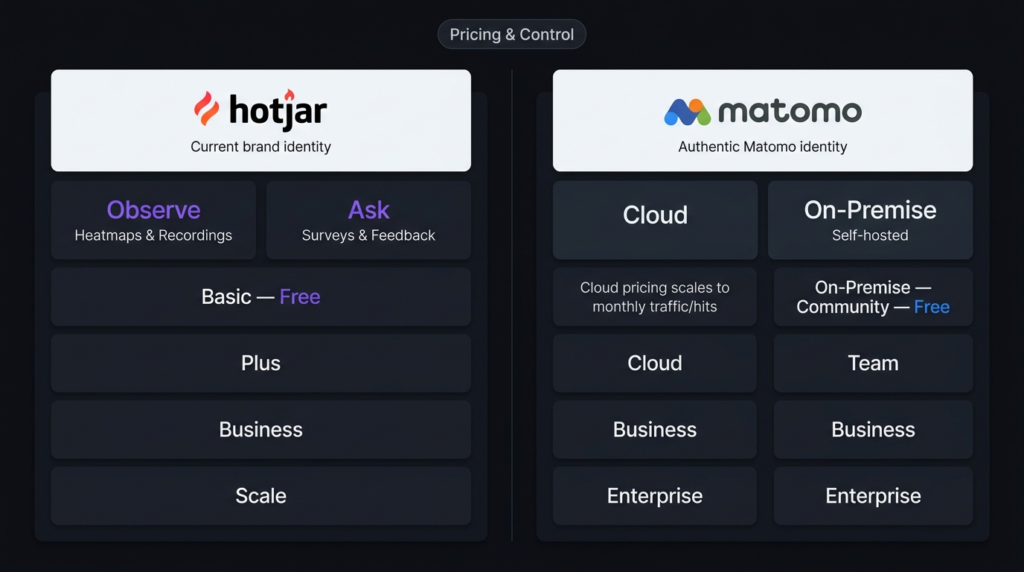
    Pricing is an important part of the Hotjar vs Matomo decision. Hotjar offers a basic version for free, while paid plans depend on the features and usage required. Hotjar also allows customers to change plans without a long-term contract. Matomo has both Cloud and On-Premise options. Its On-Premise software is free to download and use, although businesses may need to pay for hosting, maintenance, and optional premium features.

    Pricing AreaHotjarMatomo
    Free optionYesYes, On-Premise
    Cloud hostingYesYes
    Self-hostingNoYes
    Pricing modelPlan and usage basedTraffic, plan, and hosting based
    Paid featuresAvailable on paid plansAvailable depending on Cloud or On-Premise setup
    Free trialAvailable depending on plan21-day Cloud trial
    Data storage controlLowerHigher with On-Premise
    Best pricing advantageEasy starting pointFree self-hosted option

    Matomo Cloud pricing varies according to monthly traffic. Its official pricing page currently lists Cloud plans based on the number of monthly hits, while higher traffic levels require a larger plan or contact with sales. Matomo also provides a free trial without requiring a credit card. Because pricing can change, businesses should check the current plan before making a purchase decision.

    Hotjar vs Matomo: Which Gives Better User Insights?

    Hotjar is usually the stronger option when your main goal is to understand how visitors behave on specific pages. For example, a designer can use heatmaps to see whether visitors notice an important button. A product team can watch session recordings to identify confusing navigation. A marketing team can use feedback tools to learn why visitors may not complete an action. Matomo can also provide behavioral information, but it puts more emphasis on detailed website analytics and reporting. For Hotjar vs Matomo, Hotjar is a strong choice for teams that want simple visual insights into user behavior.

    Hotjar vs Matomo: Which Gives More Data Control?

    Matomo has a clear advantage when data ownership is a major concern. Matomo On-Premise allows organizations to install the platform on their own servers. This gives them more control over where analytics data is stored and how the system is managed. Matomo says its On-Premise version gives users control over data location, while its Cloud service hosts data on its servers. Hotjar offers privacy controls, but it is primarily a hosted service. Therefore, Hotjar vs Matomo favors Matomo for organizations with strict data management requirements.

    Hotjar vs Matomo: Which Is Easier to Use?

    Hotjar is generally easier for beginners because its main features are visual and straightforward. Users can quickly understand heatmaps, recordings, and feedback without building complex reports. Matomo provides more depth, but its wider feature set can take longer to learn. Teams that need detailed reporting may find this extra complexity useful. If ease of use is your priority in Hotjar vs Matomo, Hotjar is likely the simpler starting point.

    Hotjar vs Matomo: Which Tool Should You Choose?

    Choose Hotjar if you need:

    • Simple user behavior research
    • Heatmaps and recordings
    • Visitor feedback
    • Website experience insights
    • An easy interface

    Choose Matomo if you need:

    • Detailed website analytics
    • Greater data ownership
    • Self-hosting
    • E-commerce and campaign tracking
    • Broader reporting
    • Strong privacy and data control

    The best option in Hotjar vs Matomo depends on the type of information your team needs. Hotjar works well when visual user behavior is the main priority, while Matomo is better suited to businesses that want broad analytics and more control over their data.

    Final Thoughts on Hotjar vs Matomo

    Hotjar vs Matomo is not simply a choice between two analytics platforms. It is a choice between two different priorities. Hotjar focuses on helping teams understand visitor behavior through visual tools and feedback. Matomo combines website analytics with stronger data ownership and self-hosting options. If your main need is simple user behavior research, Hotjar is a practical choice. If you need detailed analytics and greater control over your data, Matomo deserves closer consideration.

    FAQs About Hotjar vs Matomo

    Is Hotjar better than Matomo?

    Hotjar can be better for heatmaps, session recordings, and visitor feedback. Matomo can be better for detailed website analytics, data ownership, and self-hosting.

    Is Matomo free?

    Matomo On-Premise is free to download and use. However, hosting and some premium features can create additional costs. Matomo Cloud is a paid service based on traffic levels.

    Can I use Hotjar and Matomo together?

    Yes. Using both can make sense when you need Matomo for broader website analytics and Hotjar for visual behavior research and visitor feedback.

    Which is more private, Hotjar or Matomo?

    Both offer privacy features, but Matomo provides more control through its self-hosted option. With On-Premise, an organization can choose where its analytics data is stored and manage the hosting environment itself.

  • Zoom vs Jitsi: Which Video Conferencing Tool Is Better in 2026?

    Zoom vs Jitsi: Which Video Conferencing Tool Is Better in 2026?

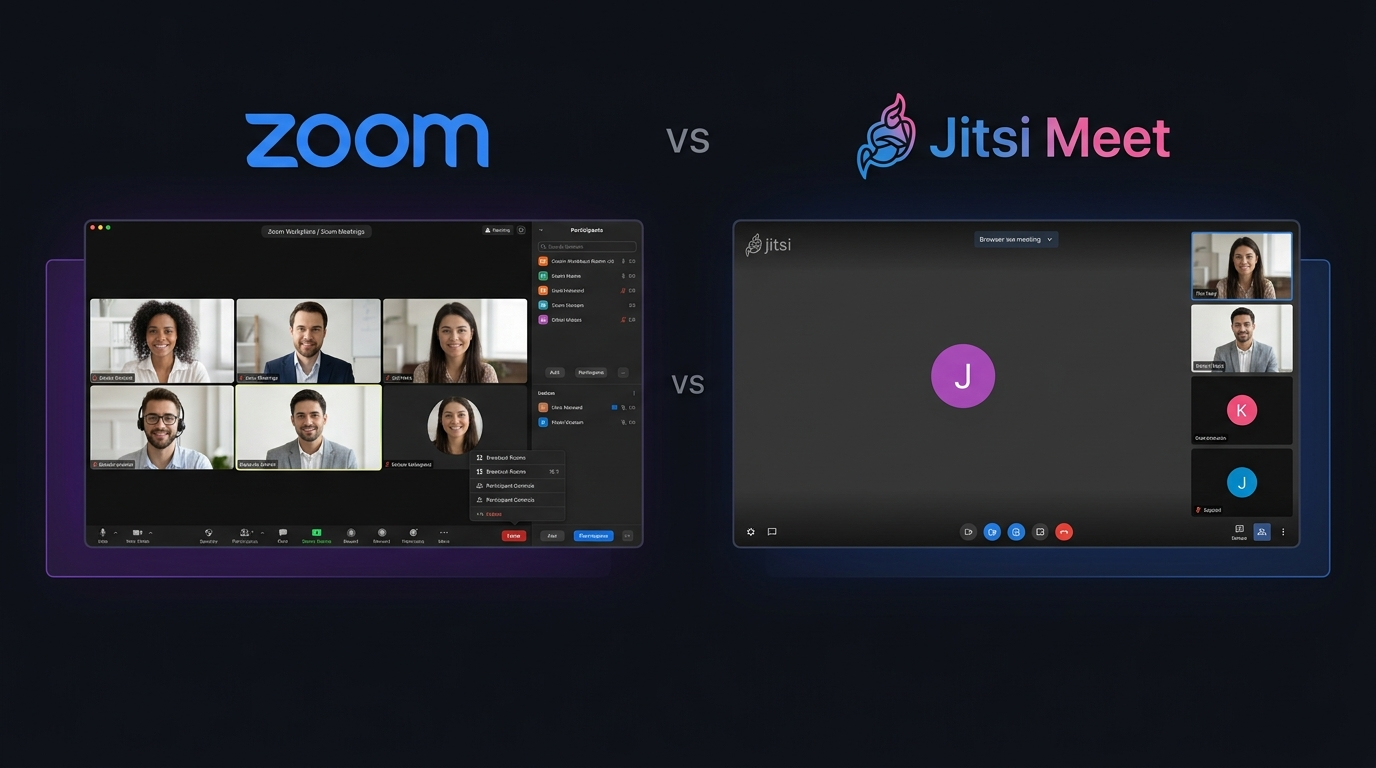
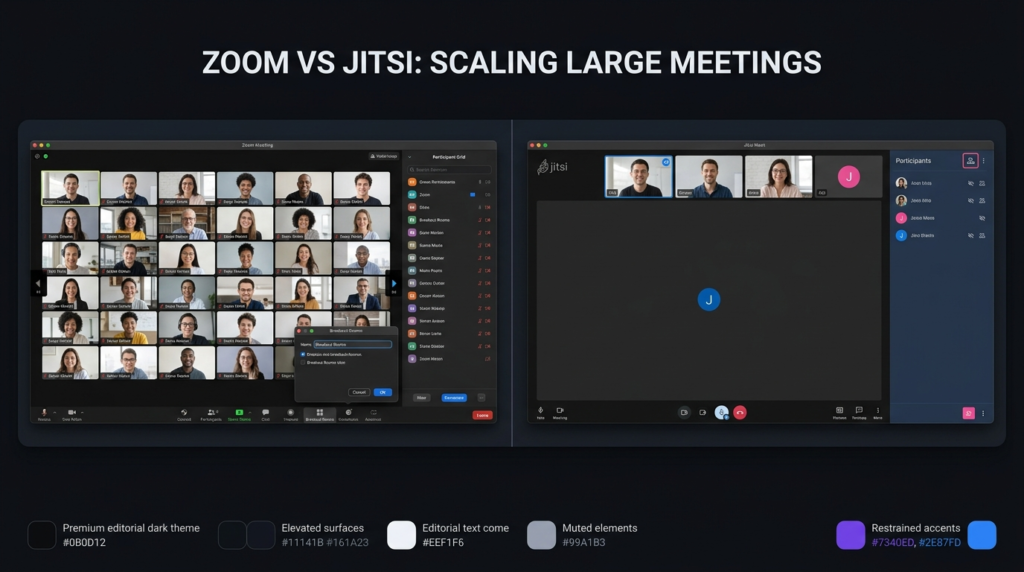
    Choosing between Zoom vs Jitsi depends on what you need from a video conferencing platform. Zoom is built for professional meetings, businesses, schools, online events, and team communication. Jitsi focuses on simple video calls and provides an open-source option. Both platforms support video calls, screen sharing, chat, and browser-based meetings. However, their meeting features are quite different. Zoom provides a wider range of tools, while Jitsi focuses on the essential features needed for online communication.

    Zoom vs Jitsi: Quick Comparison

    The main difference in Zoom vs Jitsi is the depth of features. Zoom offers more tools for professional users, while Jitsi keeps the experience simple.

    FeatureZoomJitsi
    Ease of Use4.8/54.7/5
    Video & Audio Quality4.8/54.5/5
    Meeting Features4.9/54.2/5
    Screen Sharing4.9/54.6/5
    Privacy & Security4.6/54.8/5
    Free Plan4.4/55.0/5
    Business Features4.9/54.0/5
    Large Meetings4.9/54.1/5
    Open-Source Support2.5/55.0/5
    Customization4.3/54.8/5
    Overall Value4.7/54.6/5

    Zoom vs Jitsi: Meeting Features

    Meeting features are one of the most important parts of the Zoom vs Jitsi comparison. Both platforms cover the basic needs of an online meeting, but Zoom provides a larger selection of tools for hosts and participants.

    Meeting FeatureZoomJitsi
    Video MeetingsYesYes
    Audio MeetingsYesYes
    Screen SharingYesYes
    Meeting ChatYesYes
    Participant ControlsAdvancedBasic
    Waiting RoomYesLimited
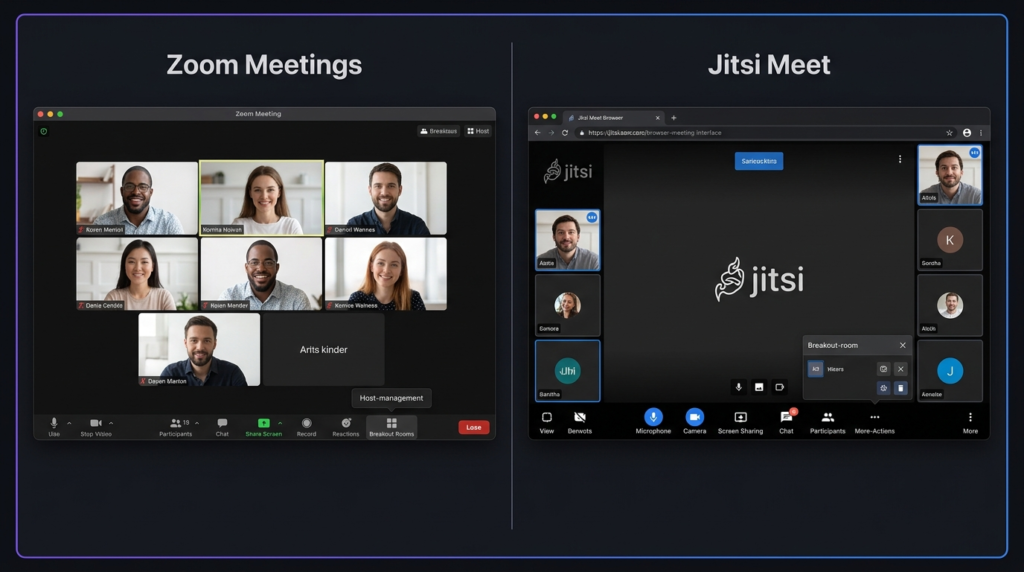
    Breakout RoomsYesLimited
    Meeting RecordingAvailableDepends on setup
    PollsYesNo
    Virtual BackgroundsYesYes
    Hand RaisingYesYes
    Large Meeting SupportStrongMore limited
    Webinar ToolsYesNo
    Meeting ReactionsYesYes
    Screen Sharing ControlsAdvancedBasic

    Zoom receives a higher rating because it gives hosts more ways to manage meetings. Features such as breakout rooms, polls, recording, participant controls, and webinar support can be useful for businesses, teachers, and professional event organizers. Jitsi focuses on the core meeting experience. It provides video, audio, chat, screen sharing, and several participant controls without trying to match the full feature set of Zoom. For simple calls, Jitsi has enough tools for many users. For structured professional meetings, Zoom offers more flexibility.

    Zoom vs Jitsi: Ease of Use

    When it comes to ease of use, Zoom vs Jitsi is fairly close. Jitsi is attractive for users who want to start a meeting quickly. The browser-based experience keeps the setup simple, making it useful for casual calls and small groups. Zoom also offers an accessible interface, but its larger collection of features means there are more settings to learn. Once users become familiar with the platform, these additional controls can make meetings easier to manage.

    Zoom vs Jitsi: Video and Audio Quality

    Video and audio quality depend on factors such as internet speed, device hardware, browser performance, and network conditions. Zoom is designed for professional communication and provides a range of settings for meeting quality and participant management. Jitsi can also deliver good video and audio for regular meetings, although performance can vary depending on the server and setup.

    Zoom vs Jitsi: Privacy and Security

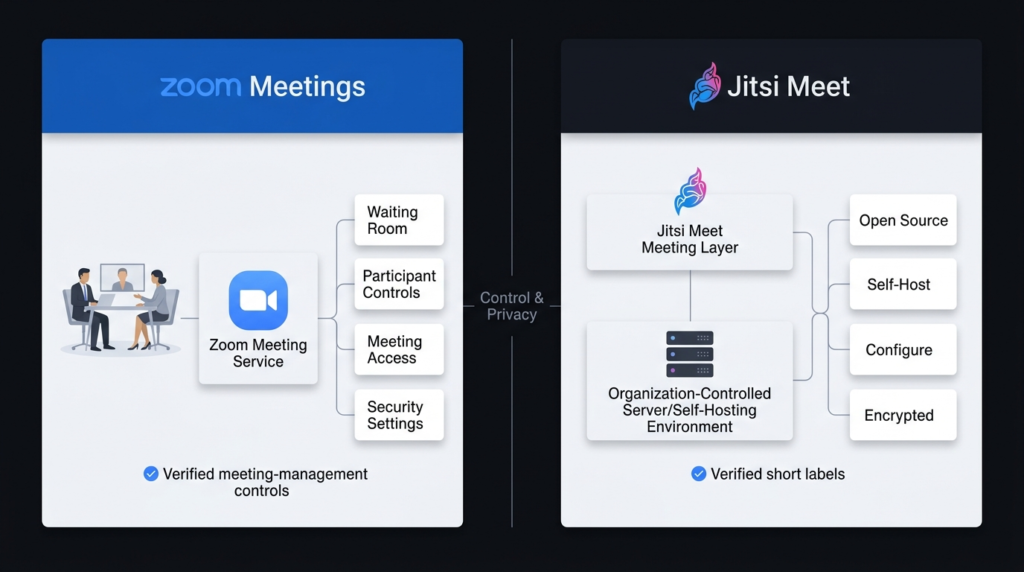
    Privacy is another important factor in Zoom vs Jitsi. Jitsi has a strong appeal for users who prefer open-source software. Organizations can also host their own Jitsi environment, giving them more control over the service and its data. Zoom provides several security and meeting-access controls. These can include passwords, participant management, waiting rooms, and other settings depending on the account and plan. Users who prioritize open-source software and self-hosting may prefer Jitsi, while businesses that want managed meeting controls may prefer Zoom.

    Zoom vs Jitsi: Free Plan

    The free options are another major difference between Zoom vs Jitsi. Jitsi Meet provides a free public service for video meetings, making it appealing to users who want basic communication without paying for a subscription. Zoom also offers a free plan, but some advanced features and higher usage limits require a paid plan. For users who mainly want free video calls, Jitsi provides strong value.

    Zoom vs Jitsi for Business

    For businesses, Zoom generally has the stronger feature set. Zoom supports professional meetings, team communication, presentations, training, webinars, and other workplace uses. Its additional controls can also help organizations manage meetings with larger groups. Jitsi can work well for small teams that need basic video communication. Its open-source nature may also appeal to organizations that want greater control over their meeting infrastructure.

    Zoom vs Jitsi for Large Meetings

    Large meetings are another area where Zoom has an advantage. Zoom provides tools designed for larger meetings and online events. Hosts get more options for managing participants and organizing sessions. Jitsi is better suited to smaller meetings and straightforward group calls. Its capabilities can depend on the server configuration when it is self-hosted.

    Zoom vs Jitsi: Which One Should You Choose?

    The right choice depends on your requirements.

    Choose Zoom if you need:

    • Professional meetings
    • Large group sessions
    • Advanced meeting controls
    • Breakout rooms and polls
    • Recording options
    • Webinar and business tools

    Choose Jitsi if you need:

    • Free video meetings
    • Simple browser-based calls
    • Open-source software
    • Self-hosting options
    • Basic meeting features

    Final Verdict on Zoom vs Jitsi

    The comparison shows that both platforms have a clear purpose. Zoom is the more complete option for businesses, professional meetings, large groups, and users who need advanced meeting tools. Jitsi is a strong alternative for people who want simple video conferencing with free access and an open-source foundation.

    Overall Ratings

    Zoom: 4.7/5

    Jitsi: 4.6/5

    For most professional users, Zoom vs Jitsi favors Zoom because of its wider feature set. For users who value simplicity, free access, and open-source software, Jitsi remains an excellent option.

    FAQs About Zoom vs Jitsi

    Is Jitsi better than Zoom?

    Jitsi can be better for users who want simple and free video meetings. Zoom is generally better for professional users who need advanced meeting features.

    Does Jitsi have breakout rooms?

    Jitsi has fewer advanced meeting-management features than Zoom. Users looking for a dedicated breakout-room experience may find Zoom more suitable.

    Which is better for business, Zoom or Jitsi?

    Zoom is generally better for businesses because it offers more meeting controls, collaboration features, and tools for larger professional meetings.

    Can Zoom and Jitsi be used in a browser?

    Yes. Both platforms support browser-based meetings, although available features can vary depending on the browser, device, and meeting setup.

  • DeepMotion vs Ardy: AI Motion Capture Compared for Quality, Speed & Control

    DeepMotion vs Ardy: AI Motion Capture Compared for Quality, Speed & Control

    AI motion capture has changed how creators turn human movement into digital animation. Instead of relying only on expensive studio equipment, creators can now use AI-based tools to create character movement from video or other inputs. DeepMotion vs Ardy is an important comparison for animators, game developers, and digital creators who want quality motion without a traditional capture setup. The two options take different approaches. DeepMotion focuses on an easy-to-use motion capture workflow, while ARDY is a motion-generation model designed for more flexible, technical use. The right choice depends on motion quality, speed, control, pricing, and how much technical work you want to handle.

    DeepMotion vs Ardy: How Do These AI Motion Tools Work?

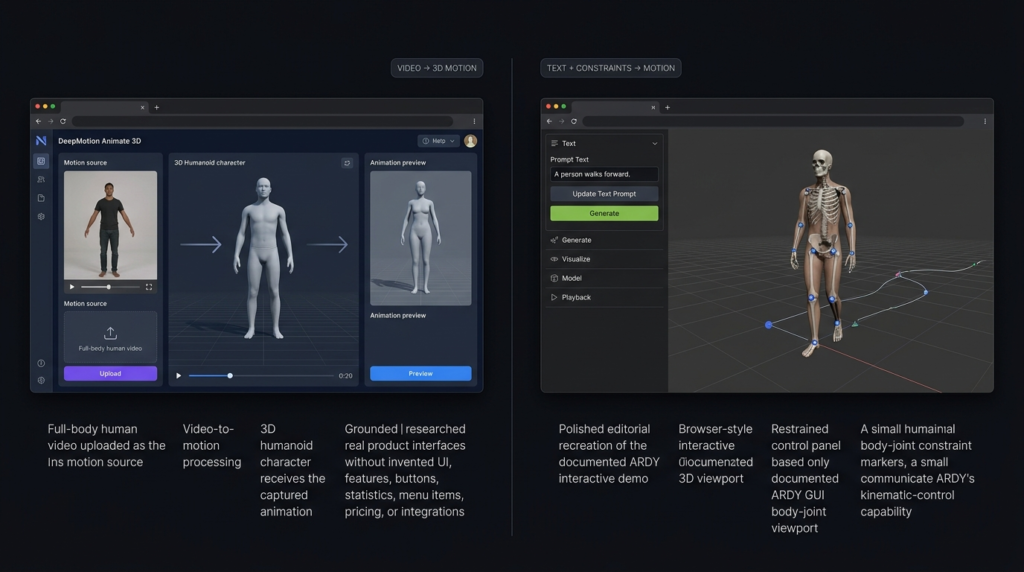
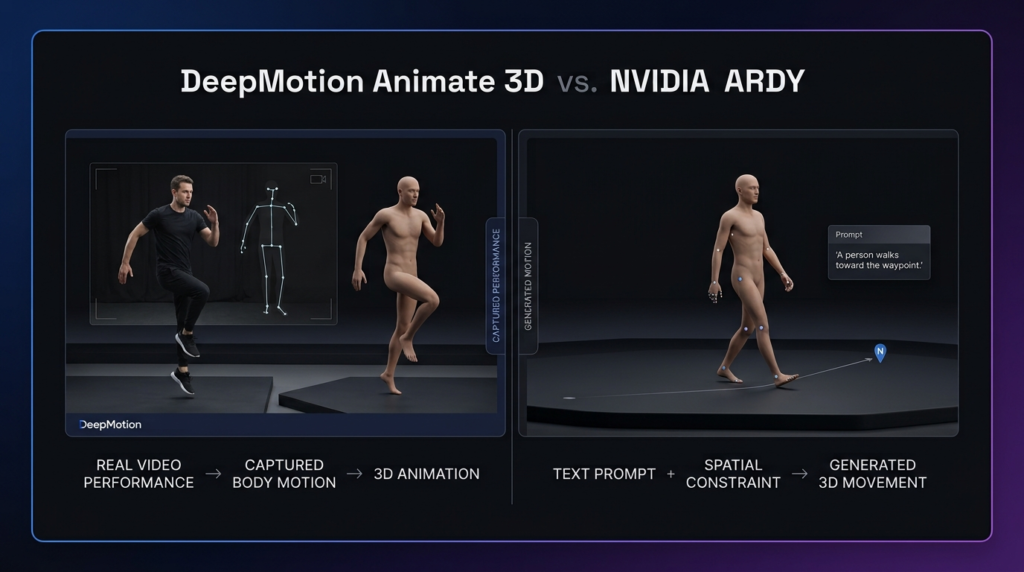
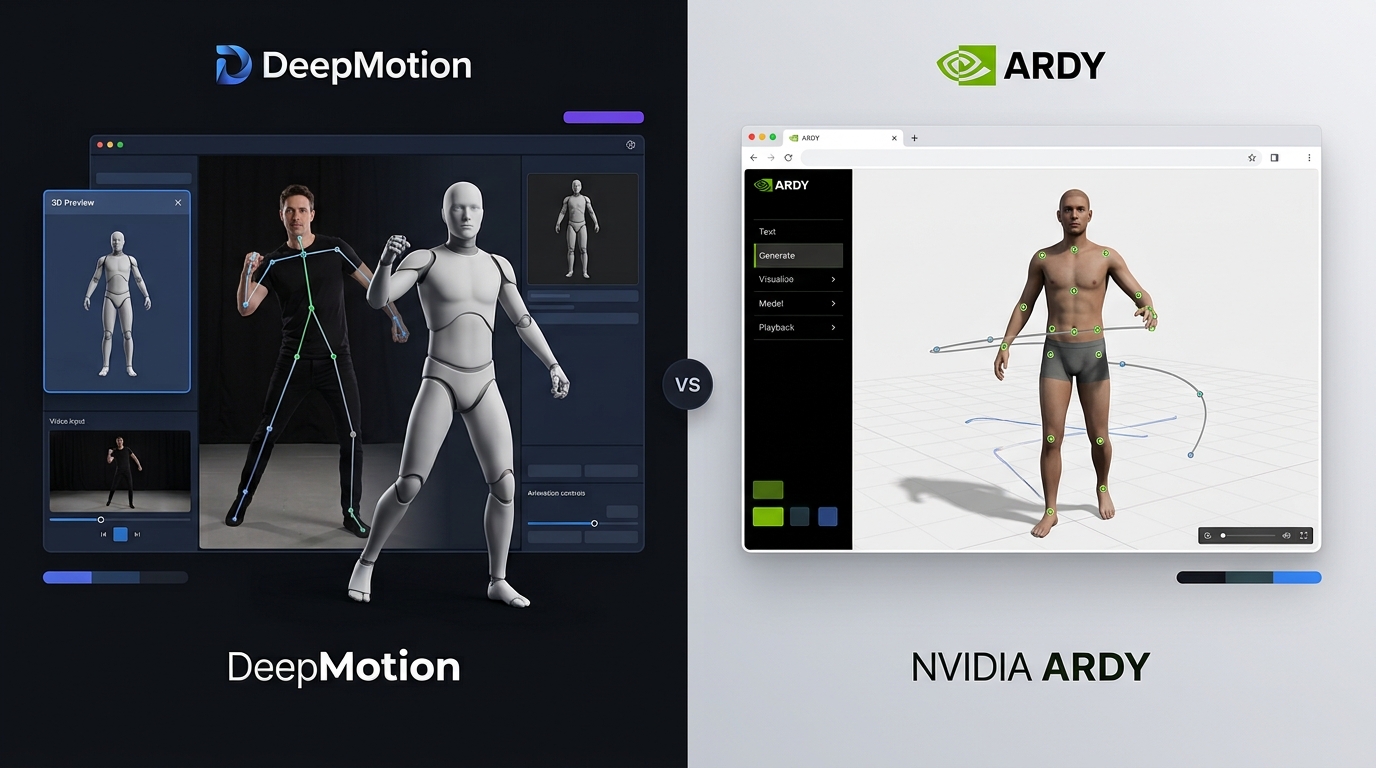
    DeepMotion Animate 3D turns video into 3D character animation. Users can upload or record movement and apply the generated motion to digital characters. It is designed to make motion capture accessible without specialized hardware.

    ARDY takes a different route. It is a motion-generation model from NVIDIA that can create 3D human movement from text and support movement control. This makes it interesting for developers and creators who want to experiment with AI-generated motion rather than only capture movement from a person.

    In the DeepMotion vs Ardy comparison, DeepMotion is easier to approach as a complete online service, while ARDY is more suited to users comfortable with model-based workflows.

    DeepMotion vs Ardy: Motion Quality

    Motion quality is one of the most important factors when choosing an AI animation tool.

    DeepMotion can capture common movements such as walking, running, jumping, dancing, and other full-body actions from video. Results depend on the quality of the source footage, camera angle, lighting, and visibility of the person.

    ARDY focuses on generating motion based on prompts and controls. This can give creators a different way to produce movement without recording every action themselves.

    For users who want to capture their own performance, DeepMotion vs Ardy generally favors DeepMotion. For users interested in generating motion from instructions, ARDY offers a more interesting approach.

    Which Produces More Natural Movement?

    Neither tool can guarantee perfect movement in every situation. Complex actions, unusual poses, fast motion, and unclear source material can affect the result. DeepMotion has an advantage when the goal is to reproduce a real person’s movement. ARDY can be useful when the creator wants to generate a specific motion without first recording it.

    DeepMotion vs Ardy: Speed and Ease of Use

    Speed matters when creators need several animations for a project.

    DeepMotion provides a structured online workflow. A user can provide video, process the movement, and work with the resulting animation without building a complete AI pipeline.
    ARDY can be powerful, but its model-based approach may require more technical knowledge depending on how it is used. Hosted versions can reduce some of that work, while local or developer workflows may require additional setup.
    For beginners, DeepMotion vs Ardy leans toward DeepMotion because the workflow is easier to understand and use.

    DeepMotion vs Ardy: Control and Editing

    Control becomes important when generated motion needs changes.

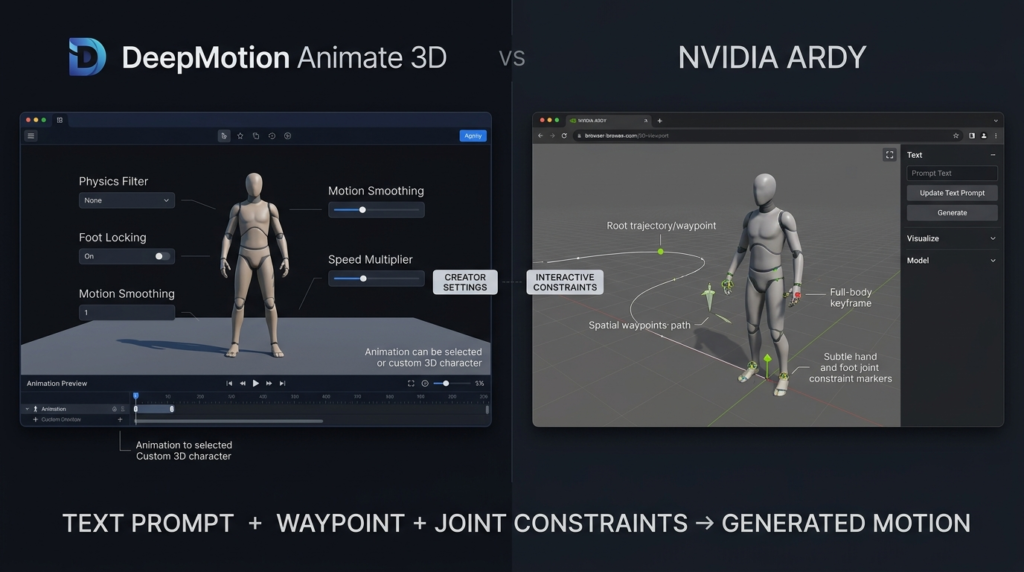
    DeepMotion provides tools and settings for working with captured animation and digital characters. This makes it useful for creators who want to take generated motion into a broader 3D workflow.

    ARDY is interesting for users who want to control generated movement through prompts and constraints. Its model-based design can provide creative flexibility, but getting the exact result may require more experimentation.

    DeepMotion vs Ardy: Features Comparison

    FeatureDeepMotionARDY
    AI motion creationYesYes
    Video-based motion captureYesNo, primarily model-based generation
    Text-based motion generationLimited compared with ARDYYes
    3D human movementYesYes
    Beginner-friendlyStrongModerate
    Professional animation workflowStrongDepends on setup
    Motion controlStrongStrong for model-based control
    Best forAnimators and creatorsDevelopers and technical creators

    DeepMotion vs Ardy: Pricing

    Pricing is another major difference between the two.

    DeepMotion Pricing

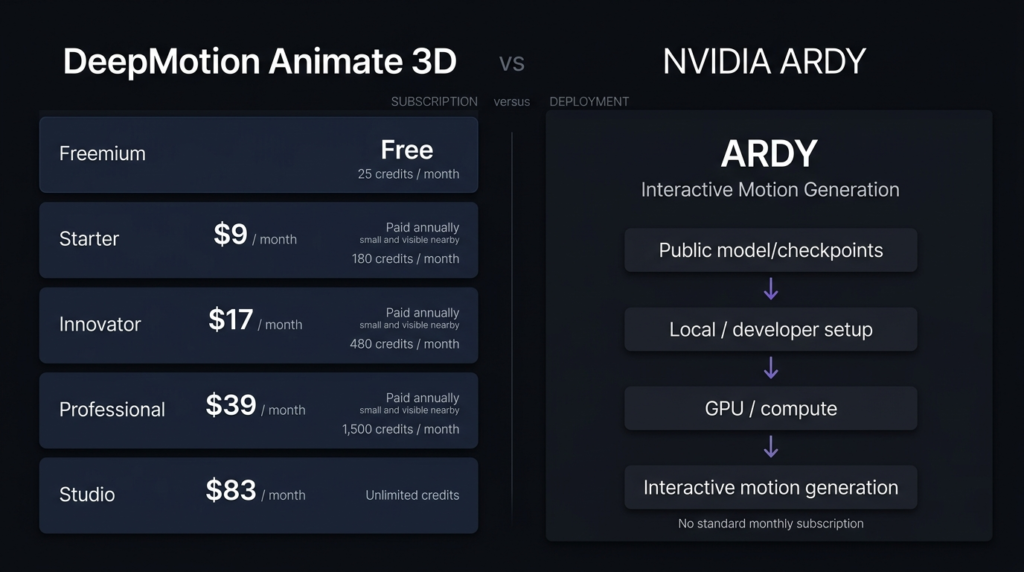
    DeepMotion Animate 3D has a free Freemium plan and several paid options. Its current pricing page lists the following prices when paid annually:

    DeepMotion PlanPriceMonthly CreditsBest For
    FreemiumFree25Testing and occasional use
    Starter$9/month*180Individual creators
    Innovator$17/month*480Regular users
    Professional$39/month*1,500Professional projects
    Studio$83/month*UnlimitedHigh-volume production

    Prices are based on annual billing. DeepMotion’s pricing and plan limits can change, so users should confirm the latest details before subscribing.

    The free plan is useful for testing the platform, while paid plans provide more capacity. Commercial projects may require a premium subscription depending on the applicable plan terms.

    ARDY Pricing

    ARDY does not follow the same subscription model as DeepMotion. It is an NVIDIA motion-generation model rather than a standard monthly animation service. That means there is no single official ARDY monthly subscription price that can be directly compared with DeepMotion. Costs can depend on how the model is accessed, including hosted services, cloud computing, or a user’s own technical setup.

    Pricing FactorDeepMotionARDY
    Free optionYesPublic model availability
    Fixed monthly plansYesNo standard monthly subscription
    Starting priceFree / $9 paid plan*Depends on deployment
    Commercial useDepends on planCheck applicable license
    Best pricing modelSubscriptionUsage or deployment based

    This makes DeepMotion vs Ardy different from a normal SaaS price comparison. DeepMotion is easier to budget because users can select a monthly plan, while ARDY costs depend more on the way the model is used.

    DeepMotion vs Ardy: Which Is Easier for Beginners?

    DeepMotion is the easier choice for most beginners. Its web-based workflow reduces the amount of technical setup required to create character movement.

    ARDY is more appealing to users who understand AI models, development tools, or custom animation workflows. It can provide more freedom, but that freedom can also mean more setup and testing.

    If your main goal is to create an animation rather than manage an AI model, DeepMotion is likely the more convenient option.

    DeepMotion vs Ardy: Which Should You Choose?

    Choose DeepMotion if you need:

    • Video-based motion capture
    • A simple online workflow
    • 3D character animation
    • A clear subscription structure
    • Tools designed for creators and animators

    Choose ARDY if you want:

    • Text-driven motion generation
    • More experimentation with AI-generated movement
    • A model-based workflow
    • Greater flexibility for development
    • A solution that can fit into a custom technical pipeline

    The best option in DeepMotion vs Ardy depends on your project rather than simply the number of features each platform offers.

    DeepMotion vs Ardy: Final Verdict

    DeepMotion vs Ardy comes down to two different approaches to AI motion creation. DeepMotion is a stronger option for creators who want video-based motion capture through an accessible platform. Its free plan and paid options also make budgeting easier. ARDY is more interesting for developers and technical creators who want AI-generated motion based on text and controls. It can provide flexibility, but the overall cost and difficulty depend on how the model is deployed. For most beginners, animators, and creators who want to turn real movement into 3D animation, DeepMotion is the more practical choice. For developers exploring custom AI motion generation, ARDY may be worth testing.

    FAQs About DeepMotion vs Ardy

    Is DeepMotion better than ARDY?

    DeepMotion is generally better for straightforward video-based motion capture and creator-friendly animation workflows. ARDY may be better for developers interested in generating motion from text and controls.

    How much does DeepMotion cost?

    DeepMotion offers a free plan. Its paid plans currently start at about $9 per month with annual billing, followed by plans at $17, $39, and $83 per month.

    Does ARDY have a monthly subscription?

    ARDY does not have the same type of standard monthly subscription as DeepMotion. Costs depend on how and where the model is used.

    Which is better for beginners, DeepMotion or ARDY?

    DeepMotion is generally the better starting point for beginners because it provides a more direct workflow. ARDY is more suitable for users comfortable with technical AI and development workflows.

  • Magnific AI vs Finegrain Enhancer: Image Quality, Upscaling & Key Differences

    Magnific AI vs Finegrain Enhancer: Image Quality, Upscaling & Key Differences

    Choosing between Magnific AI vs Finegrain depends on what you expect from an image enhancer. Magnific AI is built for creative upscaling, where the system can create new-looking texture and detail. Finegrain Image Enhancer takes a more natural approach, focusing on clearer images while trying to keep the original appearance. For AI art, portraits, product photos, and everyday images, the better choice can be very different.

    Magnific AI vs Finegrain: Key Differences Explained

    It is mainly a comparison between creative detail generation and natural image enhancement.

    Magnific can add noticeable detail to low-resolution images and gives users controls for creativity, resemblance, and image detail. Its current platform also includes an image upscaler designed to increase resolution while adding detail.

    Finegrain Image Enhancer is more focused on straightforward enhancement. Its website offers several models for different image types and claims support for images such as portraits, products, landscapes, and AI-generated artwork.

    Magnific AI vs Finegrain: Comparing Image Quality and Results

    When comparing Magnific AI vs Finegrain, Magnific has an advantage when the original image is extremely soft or lacks visible detail. Its creative approach can reconstruct textures that are difficult to recover from the source.

    The trade-off is that generated detail may change small parts of an image. This can be useful for fantasy artwork, game assets, illustrations, and AI-generated images, but it may be less desirable when an exact photo likeness matters.

    Finegrain takes a more restrained approach. Its image enhancer is designed to improve clarity while keeping the image natural. This makes it a practical choice for product pictures, regular photographs, and images where preserving the original appearance is important.

    Magnific AI vs Finegrain: Features

    FeatureMagnific AIFinegrain Enhancer
    Main focusCreative image upscalingNatural image enhancement
    AI detail generationStrongMore restrained
    PortraitsVery good, but can alter detailsGood for natural results
    Product imagesGoodVery good
    AI artworkExcellentGood
    Creative controlsExtensiveSimpler
    Browser-basedYesYes
    Free optionCheck current plan3 free enhancements daily
    Maximum outputUp to 10K on current platformUp to 4K advertised
    Best forAI art and creative workPhotos and everyday images

    Magnific’s current platform lists an image upscaler capable of output up to 10K. Finegrain’s enhancer advertises output up to 4K and several models for different uses.

    Magnific AI vs Finegrain: Pricing

    Pricing is another important difference in Magnific AI vs Finegrain. Magnific’s standalone pricing has changed as its services have become part of a larger creative platform, so users should check the official pricing page before subscribing. Third-party 2026 sources still report the older standalone structure at about $39 per month for Pro, $99 for Premium, and $299 for Business.

    Finegrain Image Enhancer currently lists a free option with three enhancements per day. Its paid plans shown on the site include Pro at $7.99/month, Max at $14.99/month, and Ultra at $24.99/month. Annual billing is cheaper.

    ToolStarting price shown/reportedFree option
    Magnific AIAround $39/month for older standalone Pro pricingCheck current offer
    Finegrain Enhancer$0; paid from $7.99/month3 images/day

    Because Magnific’s product and pricing structure is changing, its official site is the safer source for the latest subscription details.

    Magnific AI vs Finegrain: Which Tool Is Best for AI-Generated Art?

    For AI-generated artwork, Magnific AI vs Finegrain is easier to decide. Magnific is usually the stronger option when you want richer textures, sharper surfaces, and more creative detail. Finegrain can still work well for AI art when the goal is to improve clarity without changing the visual character too much. If you want the upscaled version to look more dramatic, Magnific is the better fit.

    Magnific AI vs Finegrain: Which Tool Is Best for Photo Enhancement? 

    For normal photographs, Finegrain can be the safer choice. Its stated goal is to preserve natural quality, while its models are designed for different image types. Magnific can produce excellent results on photographs, but its creative processing can sometimes invent or alter small details. For personal photos or product images where accuracy matters, a more restrained enhancer may be preferable.

    Magnific AI vs Finegrain: User Experience and Ease of Use

    Both tools are accessible through a browser, so there is no need for complex desktop software. Magnific offers more control, which is useful for experienced creators but can require more adjustment. Finegrain is simpler for users who want to upload an image, select an enhancement option, and get a cleaner result. Its website also states that images are automatically deleted after 24 hours.

    Magnific AI vs Finegrain: Final Verdict

    The winner in Magnific AI vs Finegrain depends on the image you are processing. Choose Magnific AI if you create AI artwork, illustrations, fantasy scenes, game assets, or other creative visuals where adding new detail is valuable. Choose Finegrain if you mainly enhance photographs, product images, or other visuals where keeping the original look matters more. For creative image quality, Magnific is the stronger choice. For affordable and natural enhancement, Finegrain offers better value.

    FAQs About Magnific AI vs Finegrain

    Is Magnific AI better than Finegrain?

    For creative upscaling, Magnific AI is generally the stronger option. Finegrain is more suitable when you want natural enhancement and lower-cost access.

    Is Finegrain free?

    Yes. Finegrain Image Enhancer currently offers three free enhancements per day, while paid plans provide more credits and remove the watermark.

    Which is better for AI-generated images?

    Magnific AI is usually better for AI-generated images because it can create additional texture and visual detail. Finegrain is better when you want to preserve the original appearance.

    Which should photographers choose?

    Photographers who care most about natural-looking results may prefer Finegrain. Magnific is worth considering when the image needs stronger reconstruction or creative detail.