Microsoft Declares a Code Red Over Outages: What That Actually Means
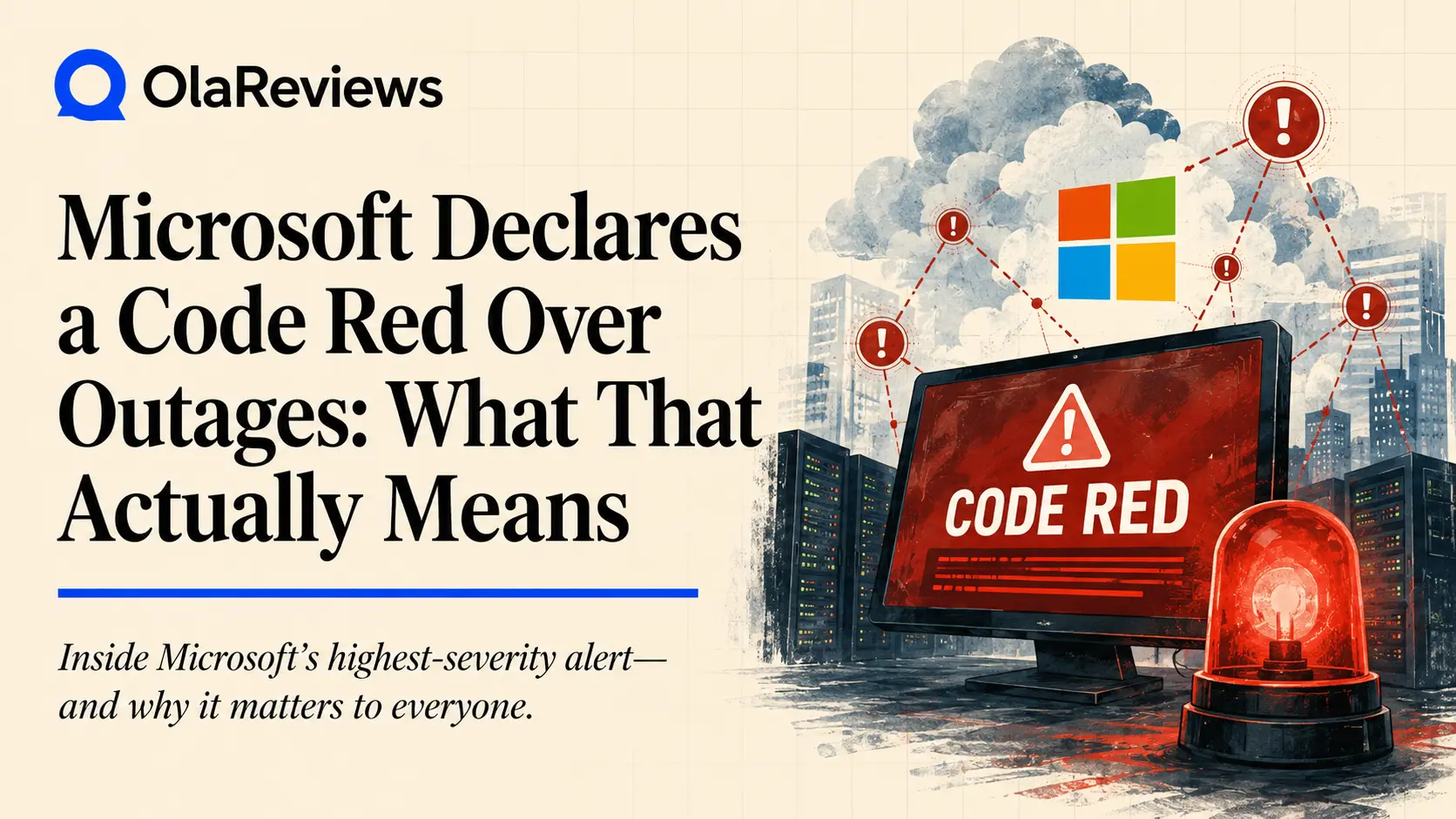
Two weeks after the outage that took Outlook offline across 74 countries, Microsoft has reached for its most serious internal designation. The company declared a Code Red on Tuesday, its highest-priority alert, and set about rebuilding how it prevents and responds to large failures. The decision was communicated in internal memos rather than announced publicly. Here is what Microsoft’s Code Red actually covers, what the memos reveal about the November outage, and why this is a bigger admission than the apology that preceded it.
What Code Red Means
Internal memos dated 20 and 23 November, reported by Reuters, show Microsoft declaring Code Red status for Microsoft 365 core service health. The declaration became public on 24 November.
Code Red is Microsoft’s most urgent internal classification. Inside a company of its size, the label is less about any single fix than about priority: it reassigns engineers, clears competing work, and puts reliability ahead of feature delivery.
The scope is how Microsoft prevents and handles major outages, not the November incident alone. That is the significant part. A post-incident report explains one failure. A Code Red concedes the process that allowed it needs rebuilding.
What Triggered It
The outage began on the afternoon of 12 November and ran for more than 12 hours, with full restoration not confirmed until 14 November.
The damage reached well beyond inconvenience:
- Disruption reached 74 countries and territories
- Banking, government and court systems all affected
- Some businesses reverted to fax machines to confirm trades
- In Brazil, court deadlines were paused by judicial authorities
Microsoft issued a preliminary incident report on 16 November, which the later memos build on.
The cause, as described so far
According to reporting, the root of it lay in work done earlier to expand network capacity. That groundwork carried a problem which stayed hidden until a subsequent change to the network brought it out.
That matches what chief executive Satya Nadella later told CNBC, which we covered in our report on his explanation: a latent bug introduced months earlier, exposed by a traffic surge, in a system lacking sufficient isolation between components.
Microsoft has consistently ruled out a cyberattack.
Why This Was Not an Isolated Event
The Code Red makes more sense against the year as a whole. The November failure was not Microsoft’s first major 365 outage of 2026:
- January 2026: an outage lasting nearly ten hours
- 23 July 2026: a regional failure, blamed on a defect in the automated system Microsoft uses to maintain its network
- 12 November 2026: the global outage
Three significant incidents in eleven months, two of them caused by Microsoft’s own network changes, is a pattern rather than misfortune. That is the context a Code Red responds to.
What Customers Can Actually Do
The practical question for businesses is compensation, and the answer is less generous than many expect.
What customers are entitled to is set by Microsoft’s service level agreement covering its online services, in the version dated 1 November 2026. Key points:
- Credits are not automatic. You must claim them.
- Terms vary by service, so Exchange Online and Teams may be treated differently.
- Credits apply against future invoices rather than being paid out.
- Claim windows are limited, typically shortly after the affected month.
If your organisation was affected:
- Document the impact now, including dates, times, affected users and services.
- Keep the incident reference numbers from Microsoft’s status communications.
- Read your specific agreement, since enterprise and smaller-business terms differ.
- Submit through your admin portal or reseller, not through general support.
We covered the mechanics in more detail in our analysis of the outage itself.
Is a Code Red Meaningful?
Worth being even-handed here.
In Microsoft’s favour: declaring an internal emergency over reliability, two weeks after the event and without external pressure to do so, is not nothing. Many companies publish a post-incident report and move on. The memos suggest genuine internal alarm.
Against: a Code Red is an internal designation with no external accountability attached. There is no published timeline, no commitment customers can hold the company to, and no mechanism for verifying what changes. Nor is there anything stopping the designation being quietly retired once attention moves on.
The test will be whether 2027 looks different, not whether the memo sounded serious.
For the wider pattern of November failures, see our reports on the NSA network outage, the Apple outage and the Chase banking failure.
A Serious Label, an Unproven Promise
Declaring a Code Red is a real admission that something structural went wrong, and Microsoft deserves some credit for making it rather than closing the file after a post-incident report. Whether it changes anything is unknowable from a memo. Document your losses and claim SLA credits if you were affected, and judge Microsoft on next year’s uptime rather than this month’s language.
Frequently Asked Questions
What is Microsoft’s Code Red?
Microsoft’s most urgent internal alert status, declared on 24 November 2026 for Microsoft 365 core service health, covering how the company prevents and handles major outages.
What caused the November Microsoft outage?
Earlier capacity-expansion work left a latent problem, which a later network change brought to the surface. Microsoft ruled out a cyberattack.
How many countries were affected?
The outage disrupted services across 74 countries and territories, including banks, governments and courts.
Can businesses claim compensation?
Possibly, through SLA service credits. These are not automatic, vary by service, and are usually applied against future invoices.