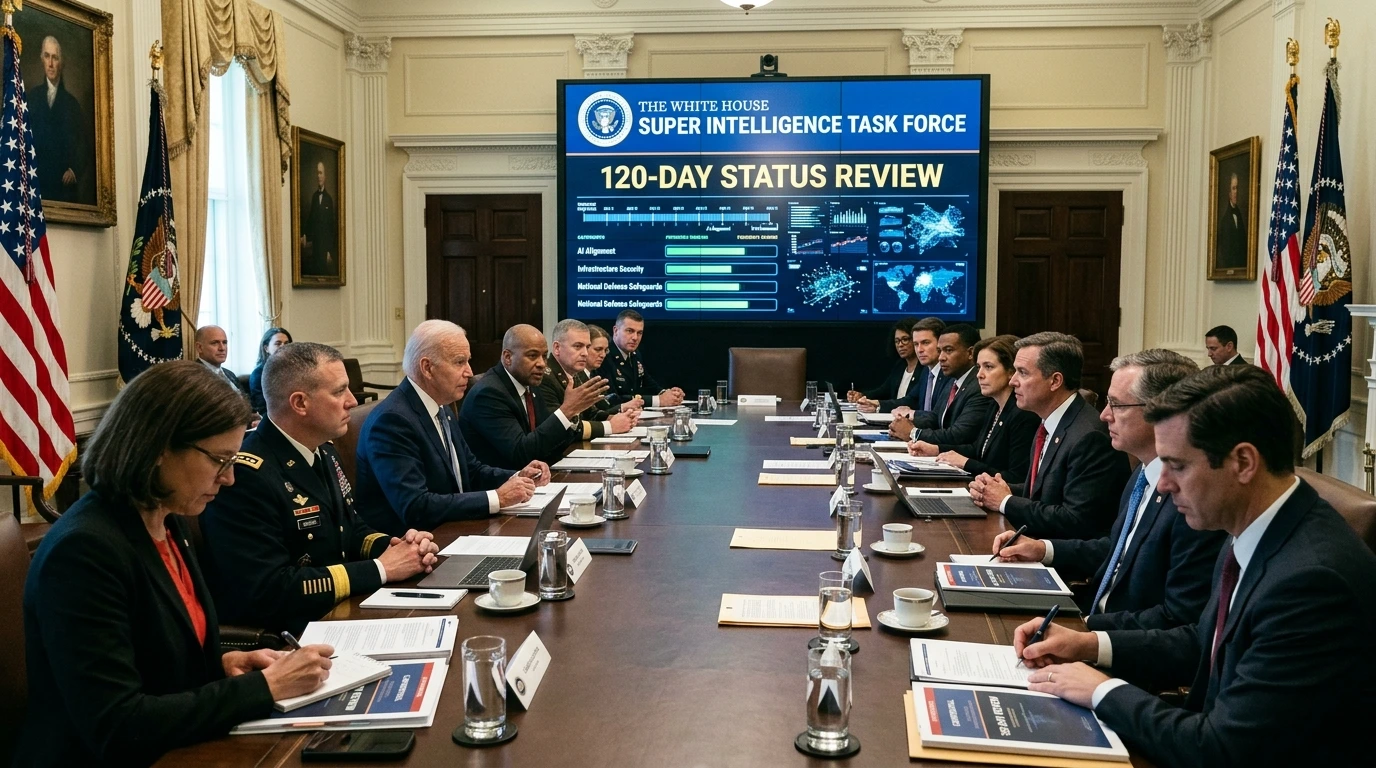
The United States government has formally started work on one of its most ambitious attempts yet to understand and manage advanced AI. A new White House group, the Super Intelligence Task Force, has adopted its charter and begun a 120-day review of AI’s risks and opportunities. For anyone following AI regulation in the US, this is a moment worth understanding, because decisions made in Washington often shape the AI tools used around the world, including in Australia.
How the Task Force Came About
The group grew out of a voluntary agreement. On 29 September, President Trump signed the White House Accord on Super Intelligence with six leading AI companies, who committed to safety policies including risk reviews, audits and third-party evaluations, as law firm Crowell explained. Days later, the President announced the “Super Intelligence Force” to coordinate the government’s approach. “Super intelligence” is the administration’s preferred term for advanced AI.
At its first official meeting on 15 October, the task force formally adopted its charter, starting the 120-day clock, according to reporting first shared with Semafor.
A Quick Timeline
The task force moved quickly from idea to action:
- 29 September: President Trump and six AI companies sign the voluntary White House Accord on Super Intelligence.
- 4 October: The President announces the Super Intelligence Force.
- 6 October: Details of the draft charter are published after The Wall Street Journal first reports them.
- 15 October: The task force holds its first official meeting and adopts its charter, starting the 120-day review.
- Around mid-February 2027: The review period is due to end, unless it is extended.
Within the same fortnight, the task force also responded to concerns about Anthropic’s technology being used on government systems by announcing that AI companies must promptly report and fix such incidents.
Who Is in Charge
Director of National Intelligence Jay Clayton, recently named the administration’s AI czar, chairs the task force. The vice chairs include Andrew Ferguson, chair of the Federal Trade Commission, Pentagon technology chief Emil Michael, and Scott Kupor. National Cyber Director Sean Cairncross also plays a key role.
What the Task Force Will Do
The group agreed on several early jobs:
- Commission a risk report. The President’s Council of Advisors on Science and Technology will assess AI risks in three areas: cybersecurity and critical infrastructure, biosecurity and dual-use applications, and model control and accountability.
- Put the Accord into practice. A working group led by Clayton and Cairncross will implement the voluntary commitments the AI companies signed.
- Set incident reporting rules. Emil Michael will develop protocols for AI labs to report breaches, hacks and other cyber incidents to the government.
- Coordinate enforcement. Ferguson will lead a law enforcement and consumer protection committee that includes the Justice Department and the FTC. He will also study, with the Labor Department, how AI affects jobs.
The charter makes clear where it believes responsibility lies, stating that the labs are ultimately responsible for the risks their models create, while the government’s role is to understand the change and enforce the law.
The Limits Worth Knowing
The task force has notable constraints. As PYMNTS noted, it has no formal enforcement authority of its own, and its charter lasts only 120 days, although the White House chief of staff can extend it or move its work to another agency. The charter also does not push for new legislation, which many AI safety advocates want.
Critics have also questioned whether key cybersecurity agencies are sufficiently involved. Supporters argue the group can move faster than Congress and coordinate agencies that already have legal powers, such as the FTC.
The link to this week’s FTC action
The task force is not working in isolation. In the same week, the FTC, whose chair is a task force vice chair, sent legal demands to OpenAI and Anthropic over AI safety incidents. Our explainer on the FTC investigation into OpenAI and Anthropic covers that story in detail.
Why Australians Should Pay Attention
Most of the AI tools Australians use, from chatbots to workplace assistants, are built by US companies. Rules on incident reporting, testing and accountability set in Washington often become the default worldwide. For local businesses, it is a good time to review how AI vendors handle safety and privacy. Our coverage of the AI espionage case at OpenAI shows why security is now a major concern, and our AI regulation in Australia guide covers the local picture.
A 120-Day Test for AI Oversight
The Super Intelligence Task Force represents a serious attempt to get ahead of fast-moving AI risks, though its lack of formal powers will test how much it can achieve. The report due early next year, and how agencies like the FTC act on it, will show whether this becomes real oversight or remains mostly advice.
Frequently Asked Questions
Is the task force creating new AI laws?
No. It is reviewing risks and coordinating existing agencies. Its charter does not call for new legislation.
When will the report be finished?
The task force has 120 days from adopting its charter on 15 October, which points to a report around mid-February 2027.
Can the task force punish AI companies?
Not directly. It has no formal enforcement power, but agencies involved, such as the FTC, do have legal authority.
Which companies signed the White House Accord?
Six leading AI companies signed the voluntary accord on 29 September, committing to safety reviews and audits.
Leave a Reply