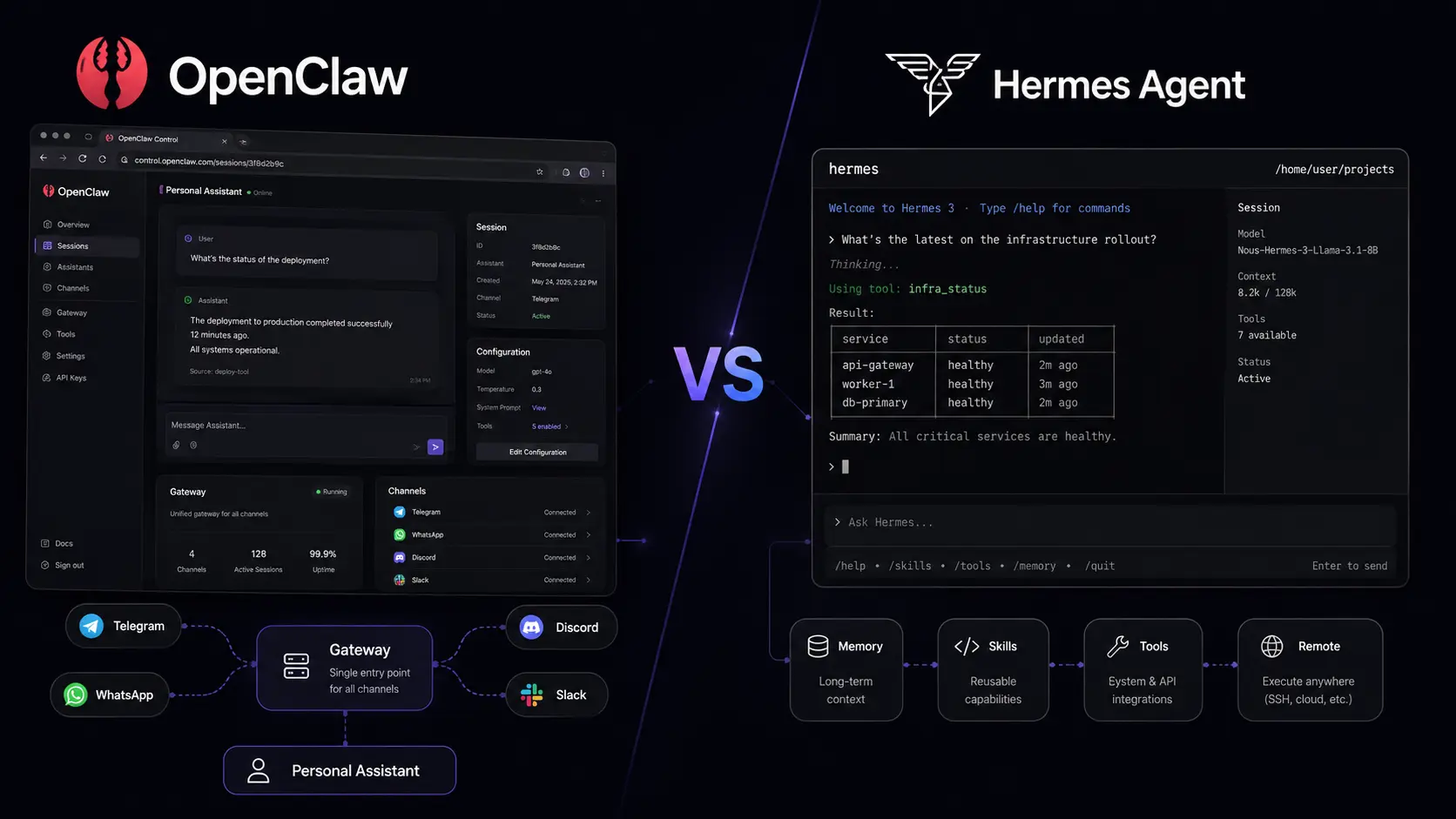
AI Agent Platforms are becoming one of the most interesting ways to automate digital work in 2026. Instead of using AI only to answer questions, you can use an agent to browse the web, work with files, interact with apps, remember information, and complete multi-step tasks. Two open-source options that stand out are OpenClaw and Hermes Agent. Both give developers and automation users more control than a typical chatbot, but their approaches are different. OpenClaw focuses strongly on personal AI assistance and connected services, while Hermes Agent puts more emphasis on persistent knowledge, reusable skills, and self-improving workflows. Which one is better in 2026? This comparison looks at their features, automation capabilities, setup, developer experience, pricing, and best use cases.
How We Compared OpenClaw and Hermes Agent
We compared these two AI Agent Platforms across practical areas that matter when choosing an agent: setup, automation, memory, integrations, messaging support, model flexibility, developer control, and deployment options.
Rather than simply counting features, we focused on what each platform is designed to do. OpenClaw uses a Gateway architecture that connects the agent with channels and tools, while Hermes Agent focuses on an agent that can learn from previous work and develop reusable skills. Both projects are open source, making them interesting for developers who want to customize their environment or run an AI agent on their own hardware or infrastructure.
AI Agent Platforms at a Glance
| Tool | Best For | Starting Price |
| OpenClaw | Personal AI automation and connected services | Free |
| Hermes Agent | Self-improving agents and advanced workflows | Free |
The core software for both projects is open source. However, your actual costs can include model usage, API charges, VPS hosting, GPU resources, and third-party services.
OpenClaw Review
Best AI Agent Platform for Personal Automation
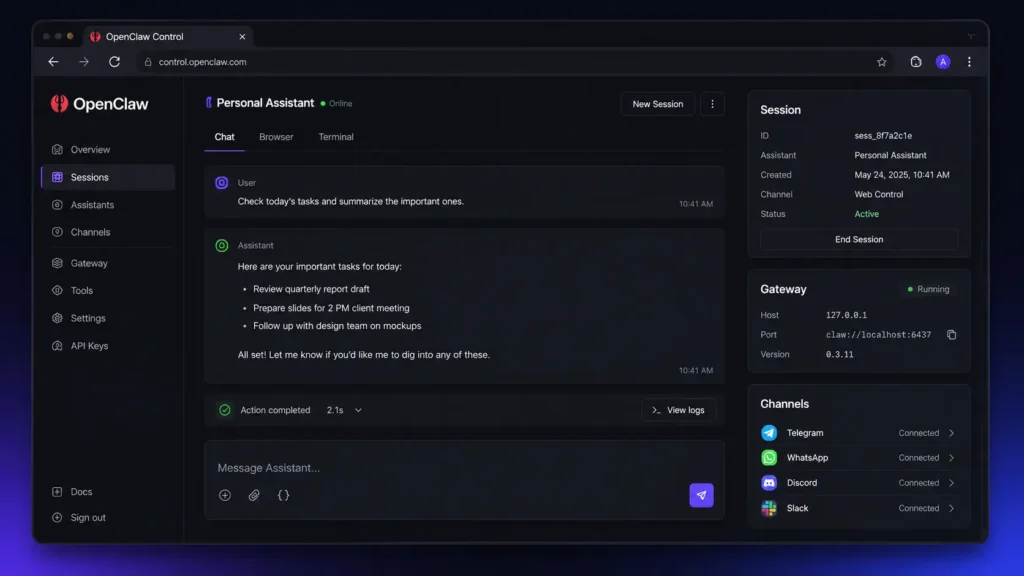
OpenClaw Official Website presents the project as an open-source personal AI assistant designed to work across your devices and communication channels. It is aimed at users who want an AI agent that can do more than generate text.
OpenClaw can connect with messaging platforms and other services, while its Gateway provides a central layer for managing the agent. If you want to inspect the project, its OpenClaw GitHub Repository provides access to the source code and project development.
The setup is designed with developers in mind. You can use its onboarding workflow to configure AI access and start the Gateway, while the platform also provides a web dashboard for managing the running agent. For installation details and supported environments, the OpenClaw Official Documentation provides the relevant setup information.
Pros:
- Strong personal-assistant and multi-channel approach
- Open source and highly customizable
Cons:
- Initial configuration can feel technical
- Broad system access requires careful security settings
Hermes Agent Review
Best AI Agent Platform for Self-Improving Workflows
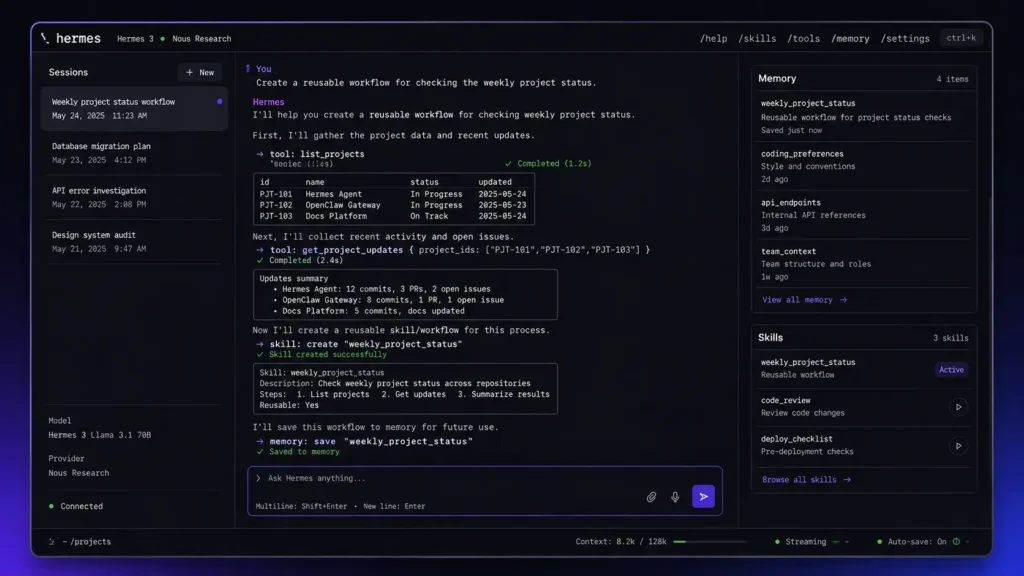
Hermes Agent Official Website describes Hermes as a self-improving AI agent created by Nous Research. Its main attraction is the focus on learning, persistent knowledge, reusable skills, and longer-term agent workflows.
Hermes Agent is designed to remember useful information between sessions and improve skills through experience. Developers can also explore the Hermes Agent GitHub Repository to examine its source code, tools, skills, gateway functionality, and development.
The platform supports different deployment environments and model providers, making it flexible for technical users. It also provides messaging integrations, browser control, scheduled tasks, subagents, and other capabilities. For the complete feature and setup information, the Hermes Agent Official Documentation is the best place to start.
Pros:
- Strong persistent knowledge and self-improvement capabilities
- Flexible tools and automation options
Cons:
- Large feature set may take time to learn
- Advanced workflows can require technical configuration
OpenClaw vs Hermes Agent: Key Feature Differences
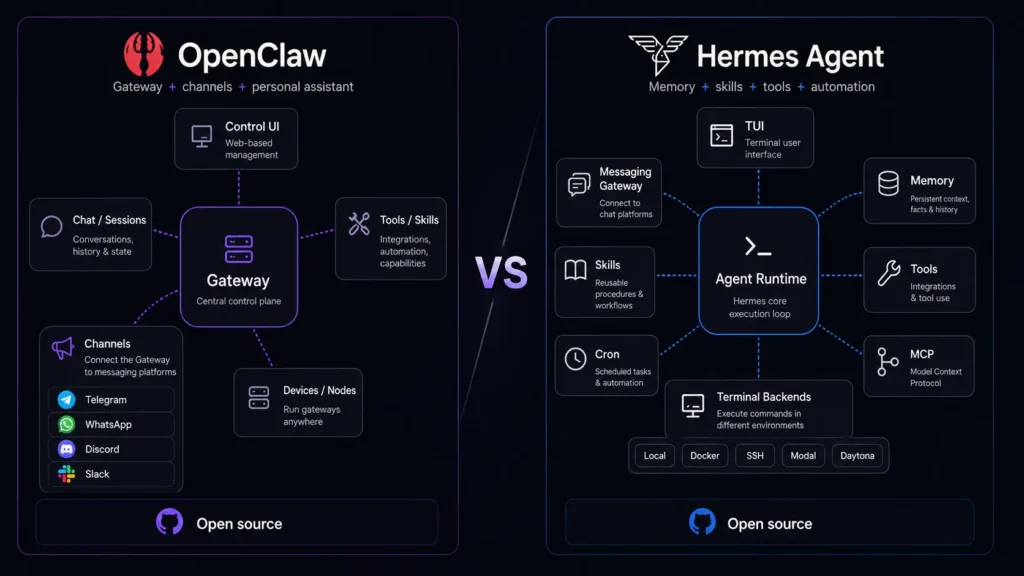
The biggest difference between these AI agent tools is their philosophy.
OpenClaw feels particularly focused on becoming a personal AI assistant that can work across your digital environment. Its strength comes from connecting the agent with communication channels, devices, tools, and services.
Hermes Agent takes a more agent-development-oriented approach. Its learning loop, skills, persistent knowledge, and automation features make it attractive for users who want an agent that can become more capable over time.
| Feature | OpenClaw | Hermes Agent |
| Open Source | Yes | Yes |
| Personal Assistant | Strong | Strong |
| Persistent Memory | Yes | Yes |
| Self-Improving Skills | Extensible | Core Focus |
| Messaging Integrations | Extensive | Extensive |
| Browser Automation | Yes | Yes |
| Model Flexibility | High | High |
| Subagents | Available | Available |
| Scheduled Automation | Yes | Yes |
| Local Deployment | Yes | Yes |
| Best For | Personal automation | Advanced agent workflows |
If you are also interested in AI-powered developer software, you can read our AI Code Editors in 2026 comparison.
Which Is Easier to Set Up?
OpenClaw provides a guided onboarding workflow that helps users configure AI access and get the Gateway running. Its command-line approach will feel familiar to developers, although beginners may need some time to understand the architecture. Hermes Agent also offers dedicated setup commands and configuration tools. Users can configure models, tools, gateways, and other parts of the system from its command-line environment. If you are already comfortable with terminals, both platforms are manageable. Neither is quite as simple as opening a traditional chatbot and immediately typing a prompt, though.
Which Has Better Automation?
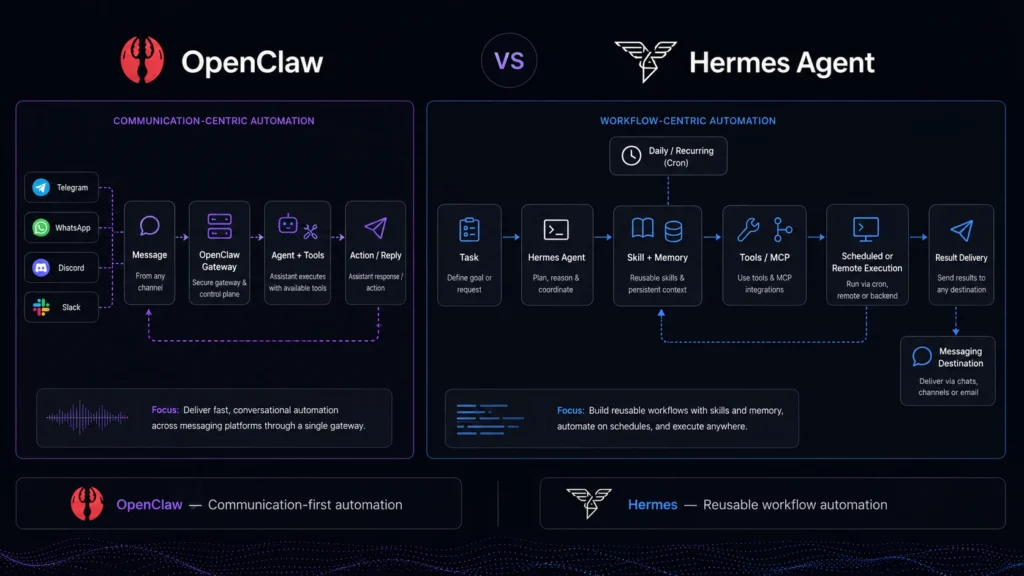
Both platforms can automate multi-step tasks, but Hermes Agent has a particularly strong case for advanced workflows.
OpenClaw works well for personal productivity tasks involving connected services, messaging platforms, browsers, and other digital tools. It is a good choice when you want an assistant that can interact with your digital environment.
Hermes Agent focuses more heavily on autonomous workflows. Its persistent knowledge, skills, subagents, scheduled tasks, and tool ecosystem make it appealing for developers building more complex automation. For example, you could use an agent to perform recurring research, maintain useful knowledge from previous work, and reuse skills across future tasks.
Which Is Better for Developers?
Developers can get significant flexibility from both platforms.
OpenClaw is a strong option if you want to build a personal automation system around a central Gateway. Its open-source nature also allows developers to inspect and customize the project.
Hermes Agent is particularly appealing if you are interested in experimenting with agent architecture. Its model-provider flexibility, tools, skills, memory, subagents, and automation features provide plenty of room for customization. This means there is no clear technical winner for every developer..
Security and Control
Security is important when working with both AI Agent Platforms. An agent can potentially access files, execute commands, browse websites, interact with accounts, and send messages. That makes these systems powerful, but it also means you should avoid giving them unnecessary permissions.
Start with limited access and test workflows before connecting sensitive accounts or business information. For production environments, developers and businesses should also review authentication, permissions, isolation, and data-handling requirements. The more control you give an AI agent, the more important it becomes to understand exactly what that agent can access.
OpenClaw vs Hermes Agent Pricing
Both OpenClaw and Hermes Agent are open-source projects, so the core software does not require a traditional SaaS subscription.
However, free software can still have operating costs. Depending on your setup, you may pay for:
- AI model API usage
- VPS or cloud hosting
- GPU resources
- Third-party APIs
- Optional hosted services
Hermes Agent can also be used with the Nous Portal for users who want a more convenient model-access experience.
OpenClaw can similarly be deployed on your own infrastructure, meaning your final cost depends largely on the models, hardware, and services you choose. For developers who already have suitable hardware or affordable model access, both can be considerably cheaper than some enterprise automation platforms.
Which One Should You Choose?
The right choice depends on what you expect from your AI agent.
Choose OpenClaw if:
- You want a personal AI assistant
- You need strong messaging integration
- You want connected service automation
- You prefer a Gateway-based architecture
- You want an open-source assistant you can customize
Choose Hermes Agent if:
- You want persistent knowledge
- You are interested in self-improving agents
- You want reusable skills
- You need advanced automation
- You want flexible model-provider options
For everyday personal automation, OpenClaw is probably the easier recommendation. For experimental, autonomous, and learning-focused workflows, Hermes Agent is the more interesting choice.
Final Verdict: OpenClaw or Hermes Agent?
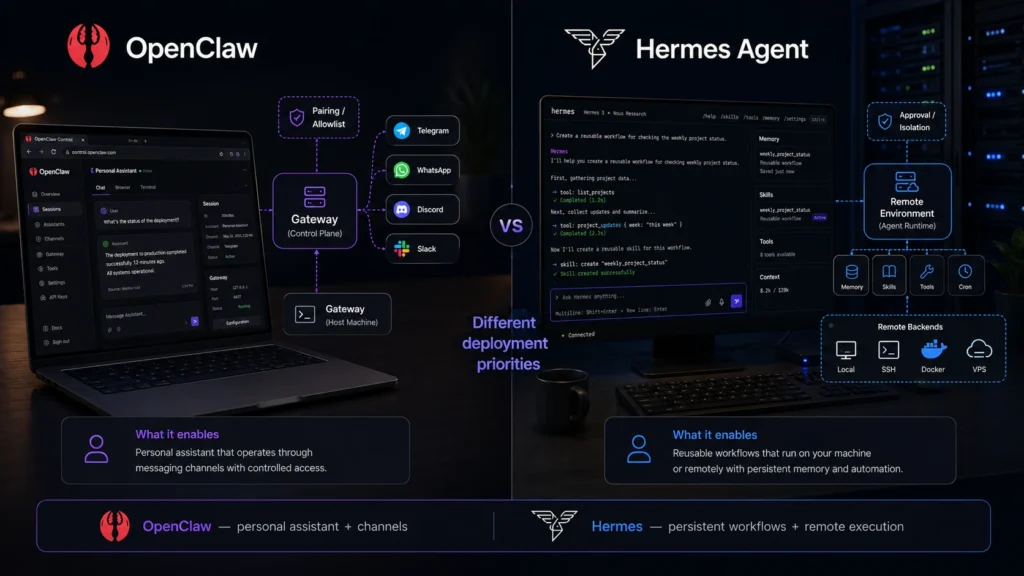
So, which of these AI Agent Platforms is better in 2026? If you want a flexible personal AI assistant that connects with your devices, messaging channels, and digital services, OpenClaw is the better starting point. If your priority is persistent knowledge, reusable skills, and an agent that can improve through experience, Hermes Agent is the stronger choice. Both projects are evolving quickly, so the best option may change as new models, tools, integrations, and agent capabilities appear throughout 2026. Before making your decision, you can compare the latest OpenClaw GitHub Repository and explore the latest Hermes Agent Documentation to see which platform fits your workflow. The future of AI Agent Platforms is not just about getting better answers. It is about getting AI systems that can actually do the work.
FAQ
Is OpenClaw better than Hermes Agent?
Not for everyone. OpenClaw is especially strong as a personal AI assistant with connected services and communication channels. Hermes Agent stands out with its focus on persistent knowledge, skills, and self-improvement.
Are OpenClaw and Hermes Agent free?
Both are open-source projects. However, users may still have costs related to AI models, hosting, APIs, or other external services.
Which AI agent tool is better for developers?
Both are strong options. OpenClaw is well suited to developers building connected personal automation, while Hermes Agent is attractive for developers experimenting with memory, skills, autonomous workflows, and self-improving agents.
Editorial Disclosure: This article is based on publicly available product information and official documentation. Features, integrations, and pricing may change as both projects continue to develop.
Leave a Reply