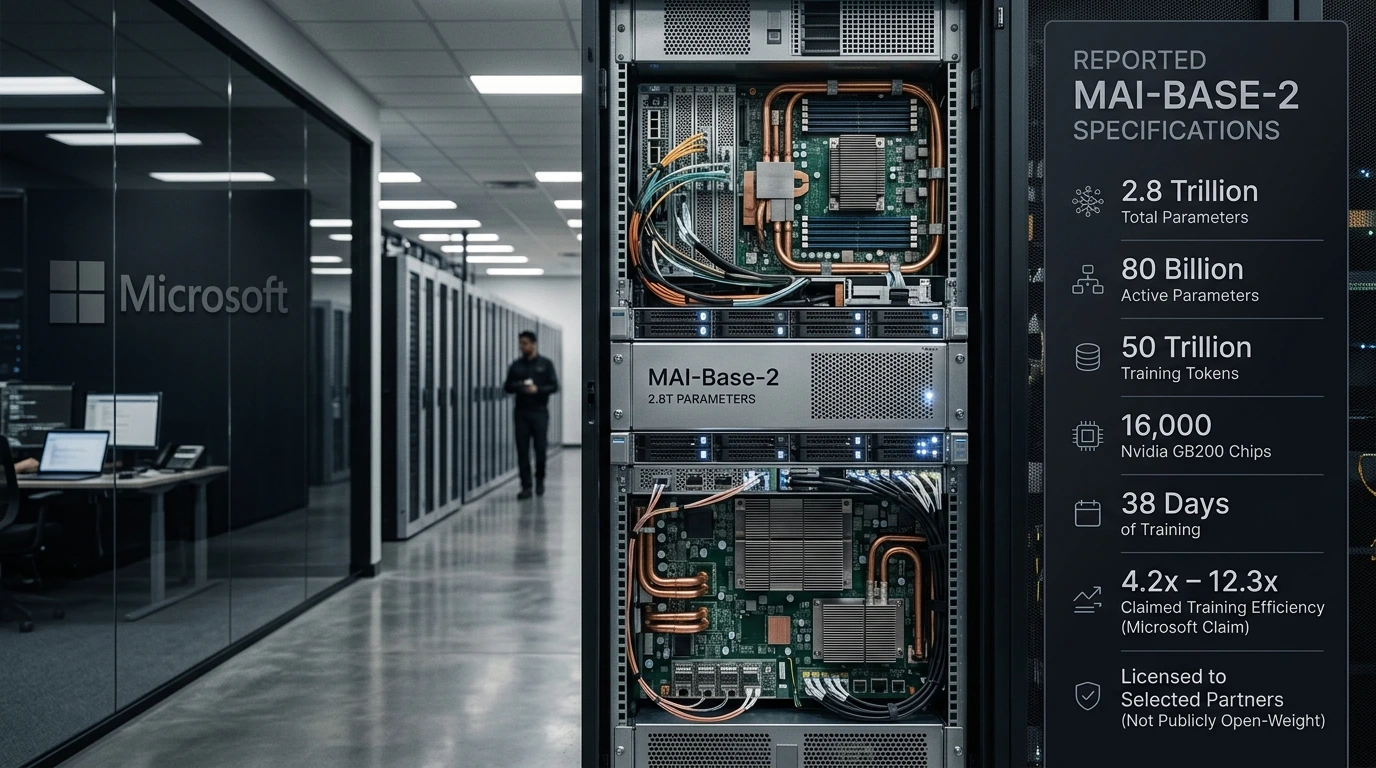
Microsoft has quietly built one of the largest AI models ever publicly confirmed. The company’s AI lab says it has finished the first major stage of training MAI-Base-2, a model with 2.8 trillion parameters. Numbers like that can feel meaningless without context, so here is a plain-English guide to what this Microsoft AI model is, how it was built, and why it matters even though you cannot use it yet.
What Microsoft Announced
On 15 October, Microsoft AI said it had completed pre-training MAI-Base-2, as Technology.org reported. Microsoft AI chief Mustafa Suleyman also shared the news on X, describing it as a model in the three trillion parameter class built entirely in-house.
Pre-training is the first big phase of building an AI model. The model identifies patterns by training on vast amounts of text and images. It then goes through post-training, where it is refined to follow instructions, behave safely and become genuinely useful. MAI-Base-2 is now in that second phase.
The Numbers, Translated
Microsoft shared unusually detailed figures:
- 2.8 trillion parameters in total. Parameters are the internal values a model adjusts during training. A higher number of parameters can help it learn and handle more complex information and tasks.
- 80 billion active parameters. The model uses a design called mixture of experts. Instead of using every parameter for every word, it sends each piece of input to a small group of specialised sub-networks. Only about 3% of the model works at any moment, which saves computing power.
- 50 trillion tokens of training data. Tokens are small chunks of text. About 18% of the mix was image and language data, so the model learned to understand pictures from the start.
- 16,000 Nvidia GB200 chips for 38 days. That is a vast amount of computing power, running through August and September 2026.
Microsoft’s Big Efficiency Claim
Microsoft says MAI-Base-2 beat every open-weight model it tested on its own held-out evaluations. It also claims its training method was 4.2 to 12.3 times more efficient than DeepSeek’s strongest open base model, meaning it reached similar results with far less computing power, as FourWeekMBA summarised. The company says it trained the model on original data and did not copy from other models through a technique called distillation.
These are Microsoft’s own figures, and some comparisons used different stages of rival models. Independent evaluation will tell a fuller story once the model is finished.
How It Compares in Size
To put 2.8 trillion parameters in perspective, consider this week’s other big releases. Meta’s new open-weight Muse Spark Open has about 816 billion parameters, while Nvidia’s Nemotron 3.5 Super VL has about 120 billion. By total size, MAI-Base-2 is far larger than both.
Size is not everything, though. Thanks to the mixture-of-experts design, MAI-Base-2 only uses around 80 billion parameters at any one time, which keeps running costs manageable. Many leading companies, including OpenAI and Google, do not publish full details of their models, so it is impossible to say for certain where MAI-Base-2 ranks overall. What is clear is that the industry is moving toward very large models that only switch on the parts they need, combining huge knowledge with practical speed.
Why This Matters for Microsoft and OpenAI
Microsoft is OpenAI’s biggest partner and investor, and it has relied heavily on OpenAI’s models for products such as Copilot. Building its own top-tier models gives Microsoft more independence and bargaining power. Reports say Suleyman claimed the new base model outperformed the base model behind one of OpenAI’s systems while using a fraction of the training compute.
Microsoft is not giving the model away. It plans to license the model’s weights to trusted partners through its Azure Foundry platform, rather than publishing them openly. That sets it apart from this week’s wave of open models from companies such as Meta and Nvidia.
Can You Use MAI-Base-2?
Not yet. It is a base model still in post-training, with no release date or named partners announced. For now, the closest Microsoft AI model people can try is MAI-Thinking-1, its reasoning model. Australian businesses already using Microsoft Azure may eventually see MAI models appear in Foundry, but Microsoft has not confirmed which customers will qualify.
To see how other new models compare, our guides to Google’s Gemini 4 Argon and Meta’s Muse Wonder cover the latest releases you can try today. Our what is an AI model explainer covers the basics.
A Giant Step Toward Independence
MAI-Base-2 shows Microsoft building serious AI capability of its own, with impressive scale and efficiency claims. It is not a product yet, but it signals where the company is heading. Watch for the finished model and its first partners, because that is when this giant number will start to matter in everyday tools.
Frequently Asked Questions
Is MAI-Base-2 the biggest AI model ever?
It is among the largest publicly confirmed by parameter count. Many companies do not publish exact sizes, so direct comparisons are difficult.
Is MAI-Base-2 open source?
No. Microsoft plans to license its weights to selected partners rather than release them publicly.
Will MAI-Base-2 power Copilot?
Microsoft has not said. It is still being trained, and no product plans have been announced.
What is the difference between pre-training and post-training?
Pre-training teaches the model general knowledge from huge datasets. Post-training refines it to follow instructions safely and helpfully.
Leave a Reply