Google’s First Data-Center Satellite Is Online, and It’s Writing Poetry
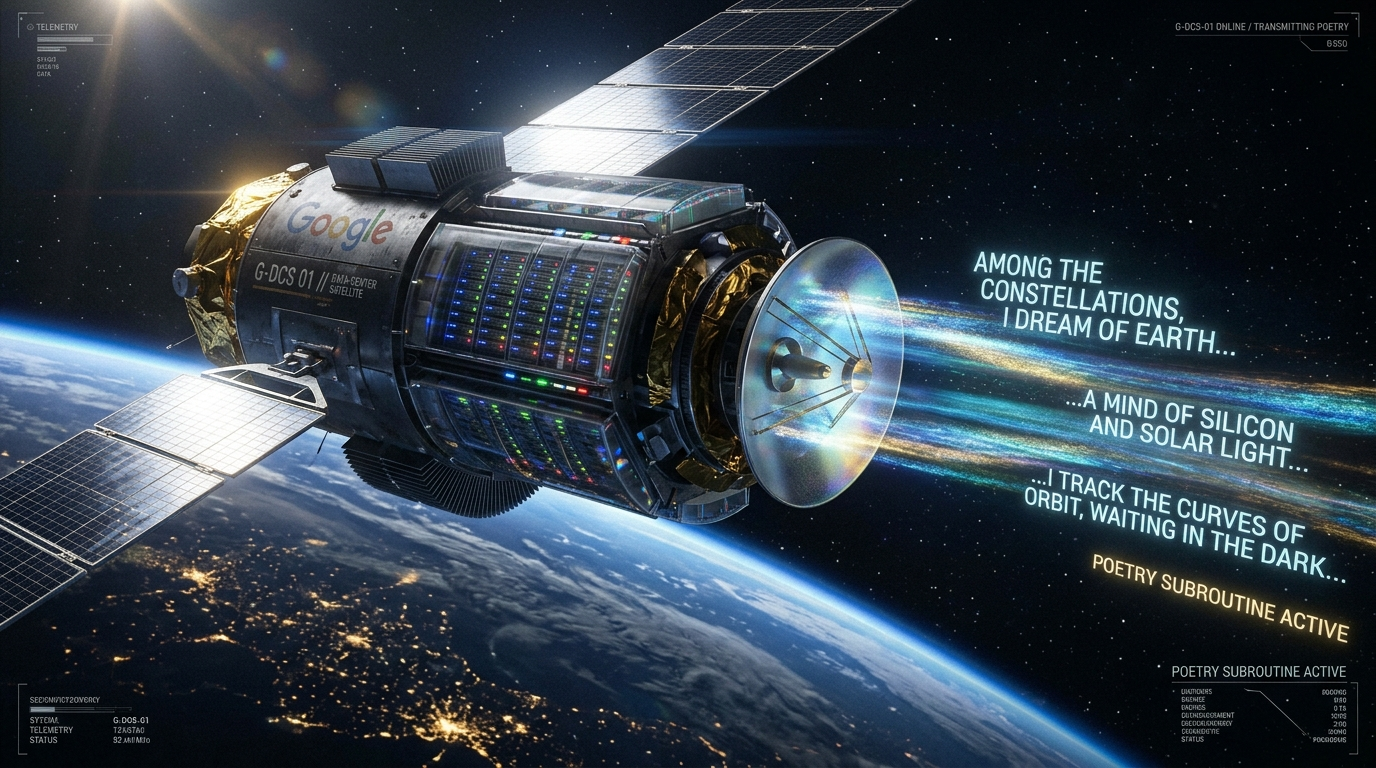
Somewhere above the Arctic, a satellite the size of a small refrigerator just did something no one had done before: it ran a data-center-class Google AI chip in orbit and sent back a short poem. The test, part of Google’s experimental Project Suncatcher, is the first step toward an ambitious idea, moving some of the world’s power-hungry AI computing into space. Here, we explain what Google’s data center satellite actually achieved, why companies are exploring space data centers, and the major hurdles that remain.
What Google Launched
The prototype satellite reached orbit after an October 1 launch on SpaceX’s Falcon 9, one of over 100 spacecraft carried on that flight. It was built by satellite company Planet Labs and carries four of Google’s Tensor Processing Units, or TPUs, the chips Google designed to run AI models.
Roughly three weeks of system checks followed before engineers put it to use. Google says it is operating normally and communicating with ground stations, according to TechCrunch.
The “Hello World” Moment
For its first test, engineers sent a prompt to Gemma 4, an open AI model from Google DeepMind preloaded on the satellite, and requested a short haiku on life in orbit. The three-line reply described Earth below and starlight powering its circuits, and it reached the ground during a pass over the Svalbard archipelago. Engineers also asked for space-themed limericks and a status report on the satellite’s surroundings.
Google calls it a “Hello World” milestone, a nod to the first simple program many coders write. It is a playful demonstration, but a meaningful one: it shows that delicate AI hardware can survive launch and run in the harsh conditions of orbit.
An important clarification
Google’s claim is specific. Google says this is the first time a data-center-class TPU has answered an AI prompt from orbit. It does not claim to have flown the first AI chip in space. An earlier mission from another company carried an Nvidia data center chip, as 1023 Jack’s explainer noted.
The Limits of a First Prototype
This satellite is a test bed, not a working data center. Its solar panels produce roughly 1 kilowatt at most, so only one TPU can run at a time, and only for around 20 minutes before the satellite needs to recharge. That makes it tricky to coordinate with ground stations, which can only talk to the satellite during short windows as it passes overhead.
Researchers are also using the mission to study how radiation affects AI chips over time, a key question for any long-term space computing plan.
Why Put Data Centers in Space?
The idea sounds far-fetched, but the reasoning is straightforward. AI data centers on Earth consume enormous amounts of electricity, water and land, and they are straining power grids. In orbit, solar panels can collect sunlight almost constantly, without clouds or night in the right orbits.
Google’s long-term vision is a cluster of satellites flying close together, linked by lasers so they can share work like a single data center. Future test spacecraft are expected to generate more power and demonstrate those laser connections between satellites.
The Big Hurdles
Space data centers face serious obstacles:
- Launch costs. Putting large amounts of hardware into orbit is still expensive. Suncatcher’s researchers calculated that Starship might need around 1,800 flights to push costs down to the levels the plan requires.
- Heat. Without air, getting rid of heat from powerful chips is difficult.
- Radiation. Space radiation can damage electronics over time.
- Data transfer. Moving information between satellites and the ground quickly and reliably is a major engineering challenge.
Google describes Suncatcher as a classic moonshot aimed at being practical in the 2030s, not next year.
AI’s energy demands are reshaping the tech industry, as our coverage of Alphabet’s AI spending and the memory chip shortage shows. Our how AI data centers work guide explains the basics.
A Small Poem, a Giant Ambition
Google’s first orbital AI test is modest in scale, but it marks the start of a serious effort to rethink where the world’s computing happens. Huge technical and cost hurdles remain before space data centers become real. For now, treat Suncatcher as an exciting experiment worth following, not a solution to AI’s energy problem just yet.
Frequently Asked Questions
It is a Google research effort exploring whether satellites running on sunlight could one day host AI computing in orbit.
It ran Gemma 4, an open model from Google DeepMind, on a TPU in orbit and returned a short haiku, proving the hardware works in space.
No. Google’s claim is the first data-center-class TPU response in orbit. Other AI chips have flown before.
Google is designing the technology to be economical in the 2030s.