Google’s Genie 4 Builds Explorable Worlds in Real Time: What It Can Do
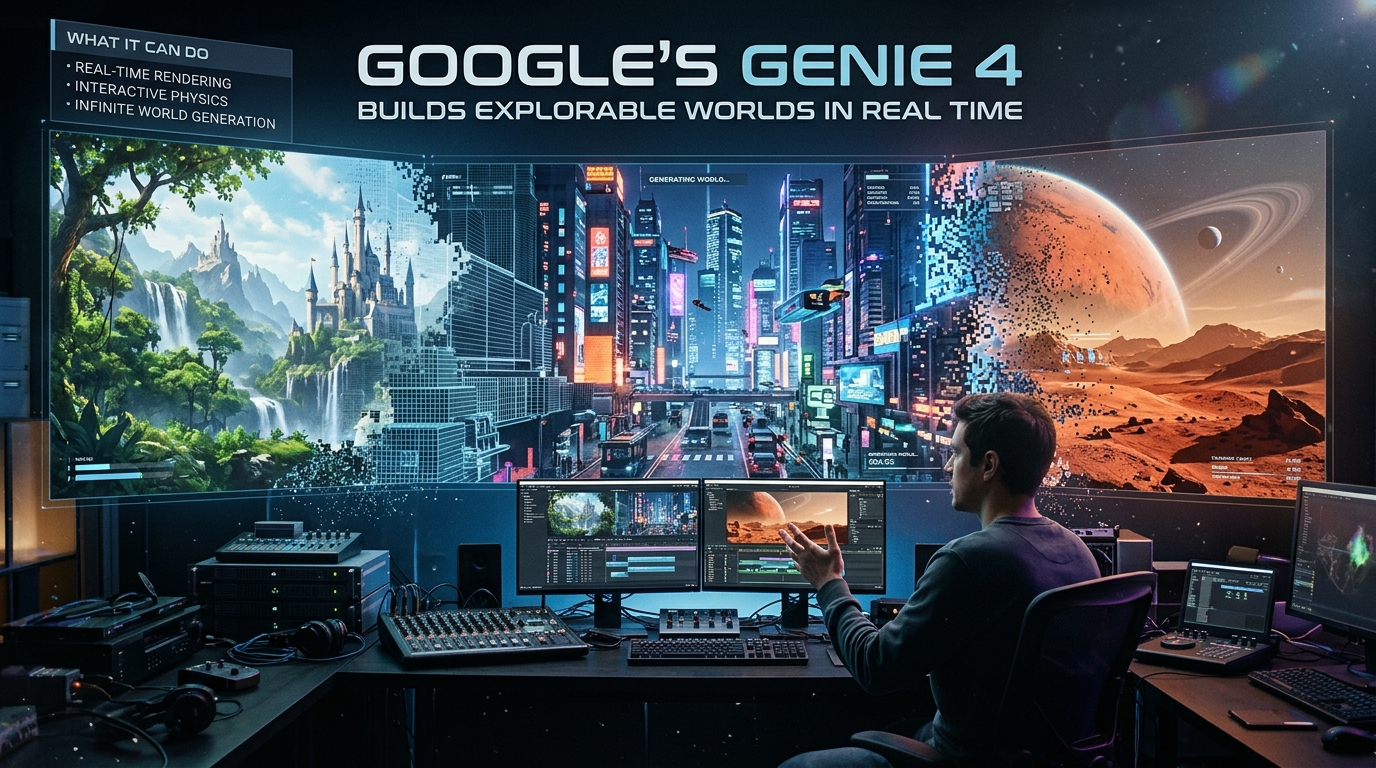
Type a sentence, press enter, and step into a beach at dusk where waves crash, gulls cry and a passing stranger stops to chat. That is the experience Google DeepMind is promising with Genie 4, the newest version of its interactive simulation system. Unlike a video, the scene keeps reacting as you wander through it, and you can rewrite it on the fly with another line of text. The announcement drew more than two million views on X within a day. For Australians curious about where this technology is heading, we look at what an AI world model actually is, what this release changes, and why it matters well beyond games.
Worlds That Are Generated, Not Built
Traditional video games rely on teams of artists and programmers who model every tree, wall and character by hand. A world model takes a very different route. It learns how places tend to look and behave from enormous amounts of footage, then produces each new moment on demand as you move around.
Genie 4 can start from a written prompt or a single picture. You then explore with your keyboard, and the system draws what should appear next, frame after frame. Nothing is stored in advance. The landscape exists only because the model predicts it as you arrive.
That idea is not entirely new. Google showed the first Genie in 2024 and a much sharper Genie 3 in August 2025. What makes this version notable is how much more it can now do inside a single scene.
Three Upgrades That Stand Out
Sound arrives for the first time
Earlier versions were silent. Genie 4 generates ambient noise, music and spoken dialogue alongside the pictures, and characters can respond to what you say or do, according to Google DeepMind’s announcement. A rainy street now sounds wet. A crowded market hums with voices.
You can direct the action live
The second change is live steering. While a world is running, a fresh instruction can shift the camera, change the weather or drop in a new character without starting again. Behind the scenes, Google’s Gemini models interpret those commands, keep track of what has already happened and plan multi-step events so the scene stays consistent.
Scenes last longer
Simulations can now run for up to two minutes, double the previous limit, as Quartz reported. Two minutes may sound short, but for a model inventing every frame in real time, holding a world together for that long is a significant technical step.
The Weak Spots Google Admits
Google has been unusually frank about the gaps. Scenery can slowly change as a session goes on, so a building glimpsed early on might look different when you return. The team says it has not yet solved accurate audio or readable text inside the worlds, which means street signs and book pages may appear garbled.
One research director told Bloomberg that keeping a scene fully consistent over two minutes would require a model that genuinely understands everyday physics. In other words, Genie 4 is impressive, but it is still an experiment rather than a finished product.
Why This Matters Beyond Gaming
Entertainment is the obvious use, but the more important applications may be practical:
- Training robots. In one experiment, a Gemini model broke a physical task into steps that Genie 4 then simulated, a possible way to rehearse robot behaviour safely before touching real hardware.
- Testing AI agents. Simulated environments give software agents a place to practise without causing real-world damage.
- Rapid prototyping. Designers and filmmakers could sketch an interactive scene in minutes instead of weeks.
- Education. Teachers might one day let students walk through a historical setting or a scientific process.
Early testers from fields as varied as film, newsrooms, classrooms, game studios and engineering firms are already trying these ideas out.
Can Australians Try It?
Not yet. For now, Genie 4 exists as a research preview, open only to a small circle of invited testers, and Google has not announced a public release date, Australian availability or pricing. Anyone keen to follow its progress should watch Google DeepMind’s official channels rather than third-party sites claiming early access, which are a common route for scams.
This release continues a busy period for Google, which recently launched its Gemini 4 Argon model, as our guide to Gemini 4 Argon explains. Other companies are exploring AI-made media too, as our report on Grok’s AI-generated Odyssey shows. Our what is generative AI explainer covers the basics.
A Glimpse of Interactive Media to Come
Genie 4 turns AI-generated scenes into places you can hear, talk to and reshape as you go, even if they only hold together for a couple of minutes. The real significance lies in what follows, from safer robot training to new forms of storytelling. For now, it is a research milestone worth watching rather than a tool most people can use, so treat any offer of early access with caution.
Frequently Asked Questions
A video generator produces a fixed clip you watch. Genie 4 creates a space you move through, and it keeps responding to your actions and commands while you explore.
Google runs the model on its own systems, so testers interact through Google’s platform rather than installing it on a home computer.
Unlikely in the near term. Scenes last only a couple of minutes and still drift, so it is better suited to prototypes and experiments than to complete games.
No pricing has been announced, because the model is still limited to invited testers.