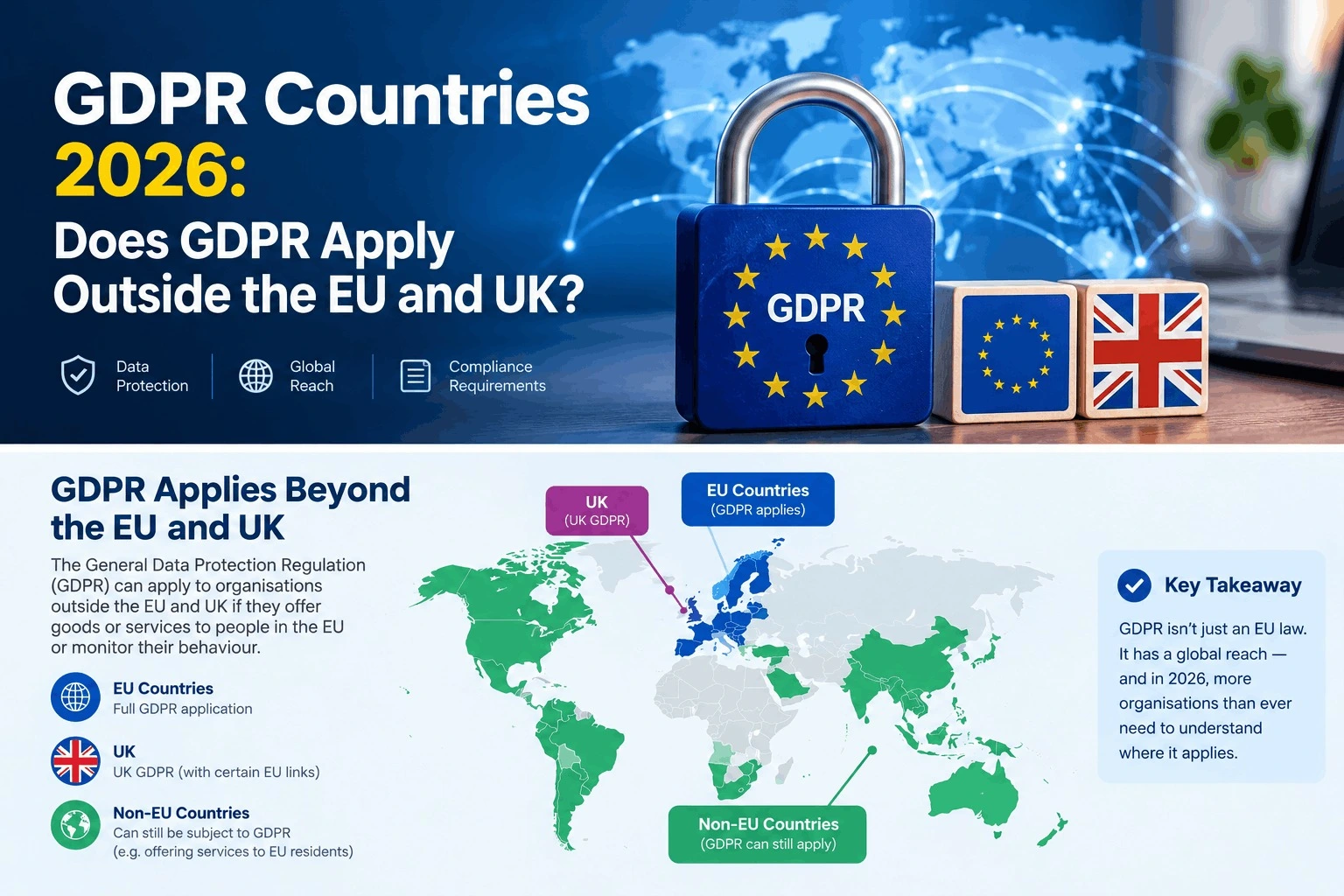
If you run a website, SaaS product, online store, or marketing platform, understanding GDPR Countries is important when you serve people across borders. The EU General Data Protection Regulation does not simply apply based on where a company is registered. Its territorial scope can also cover businesses outside the European Union. The UK has its own UK GDPR framework, which can also apply to organizations outside the UK. In 2026, businesses also need to consider changes introduced by the UK’s Data (Use and Access) Act 2025.
GDPR Countries: Where Does the GDPR Apply?
The EU GDPR does not create a fixed list of “GDPR countries.” Instead, Article 3 defines its territorial scope. The EU GDPR applies to qualifying personal-data processing carried out in the context of an establishment in the EU. It can also apply to organizations outside the EU when their processing relates to offering goods or services to people in the EU or monitoring their behavior there.
| Business situation | Can EU GDPR apply? |
| Business established in the EU | Yes, where the processing falls within its scope |
| Business outside the EU targeting people in the EU | Potentially |
| Business outside the EU monitoring people in the EU | Potentially |
| Business outside the EU with no relevant EU activity | Not necessarily |
| UK-based business | EU GDPR and UK GDPR may need to be considered separately |
The key point is that GDPR compliance depends on the processing activity and territorial connection, not simply the country where the company has an office.
Does GDPR Apply Outside the EU?
Yes. This is one of the most important parts of the GDPR’s territorial scope. For example, imagine a SaaS company based in Pakistan that deliberately markets its software to customers in France and Germany. If its processing falls within Article 3 because it is offering services to people in the EU, the company may have EU GDPR obligations even though it has no European office.
However, simply having a website that can technically be accessed from Europe does not automatically mean the GDPR applies to every activity. The circumstances of the processing, including whether goods or services are actually being offered to people in the EU or their behavior is being monitored, matter. The GDPR therefore has extraterritorial reach, but it is not a worldwide law that automatically applies to every company in every country.
What About the UK?
The UK is no longer part of the EU, so businesses should distinguish the UK GDPR from the EU GDPR. The UK GDPR applies to processing carried out by organizations operating in the UK. It can also apply to organizations outside the UK when they offer goods or services to individuals in the UK or monitor their behavior.
For example, a US e-commerce company selling directly to customers in the UK may need to assess its obligations under the UK GDPR. A company can therefore potentially have both EU GDPR and UK GDPR responsibilities when it serves customers in both markets.
UK Data Protection Changes in 2026
One of the most important 2026 updates is the Data (Use and Access) Act 2025 (DUAA). The Information Commissioner’s Office confirmed on 19 June 2026 that all data-protection provisions of the DUAA are now in force. The Act changes parts of the UK’s existing data-protection framework, including the UK GDPR and Data Protection Act 2018 framework.
This means businesses handling UK personal data should not rely only on older UK GDPR guidance. They should also review the current requirements introduced by the DUAA. For businesses operating internationally, this is particularly relevant when their privacy policies, data-processing procedures, complaint processes, or compliance documentation cover UK users.
EU, EEA and UK Are Different
The European Economic Area (EEA) consists of the 27 EU countries plus Iceland, Liechtenstein and Norway. The UK is not an EEA member. This distinction matters because people sometimes use “Europe,” “EU,” “EEA,” and “GDPR countries” as if they mean exactly the same thing.
They do not. The EU GDPR has relevance across the EU and also applies in certain circumstances to organizations outside the EU. The UK has its separate UK GDPR framework. The EU has also renewed its adequacy decision for the UK, with the current decision running until 27 December 2031, subject to its conditions.
How International Businesses Should Prepare
If your business serves customers internationally, start by mapping your data flows. Identify where customers are located, what personal information you collect, which legal frameworks may apply, and where that information is transferred or accessed.
You should also keep privacy notices, processor agreements, security measures, international-transfer arrangements, and data-retention practices under regular review. Because privacy laws can change, checking current guidance from the relevant regulator is important before making compliance decisions.
Conclusion
Understanding GDPR Countries is really about understanding territorial scope rather than memorizing a list of countries. The EU GDPR can apply to businesses outside the EU when specific Article 3 conditions are met, while the UK has a separate UK GDPR framework. For international businesses, GDPR compliance should therefore be based on actual customers, processing activities, monitoring, and data flows. In 2026, UK businesses and organizations serving UK users should also account for the Data (Use and Access) Act 2025, whose data-protection provisions are now in force.
Frequently Asked Questions
Does GDPR apply to companies outside Europe?
It can. The EU GDPR may apply to organizations outside the EU when their processing falls within Article 3, including certain activities involving offering goods or services to people in the EU or monitoring their behavior.
Is the UK still covered by the EU GDPR?
The UK has its own UK GDPR framework. Depending on the organization’s activities, the EU GDPR may also apply when it processes personal data within the EU GDPR’s territorial scope.
Does every country follow GDPR?
No. GDPR is an EU regulation with specific territorial reach. Other countries have their own privacy laws and frameworks.
What changed for UK data protection in 2026?
As of 19 June 2026, all data-protection provisions of the Data (Use and Access) Act 2025 are in force. Businesses handling UK personal data should consider these changes alongside the existing UK GDPR framework.
Leave a Reply