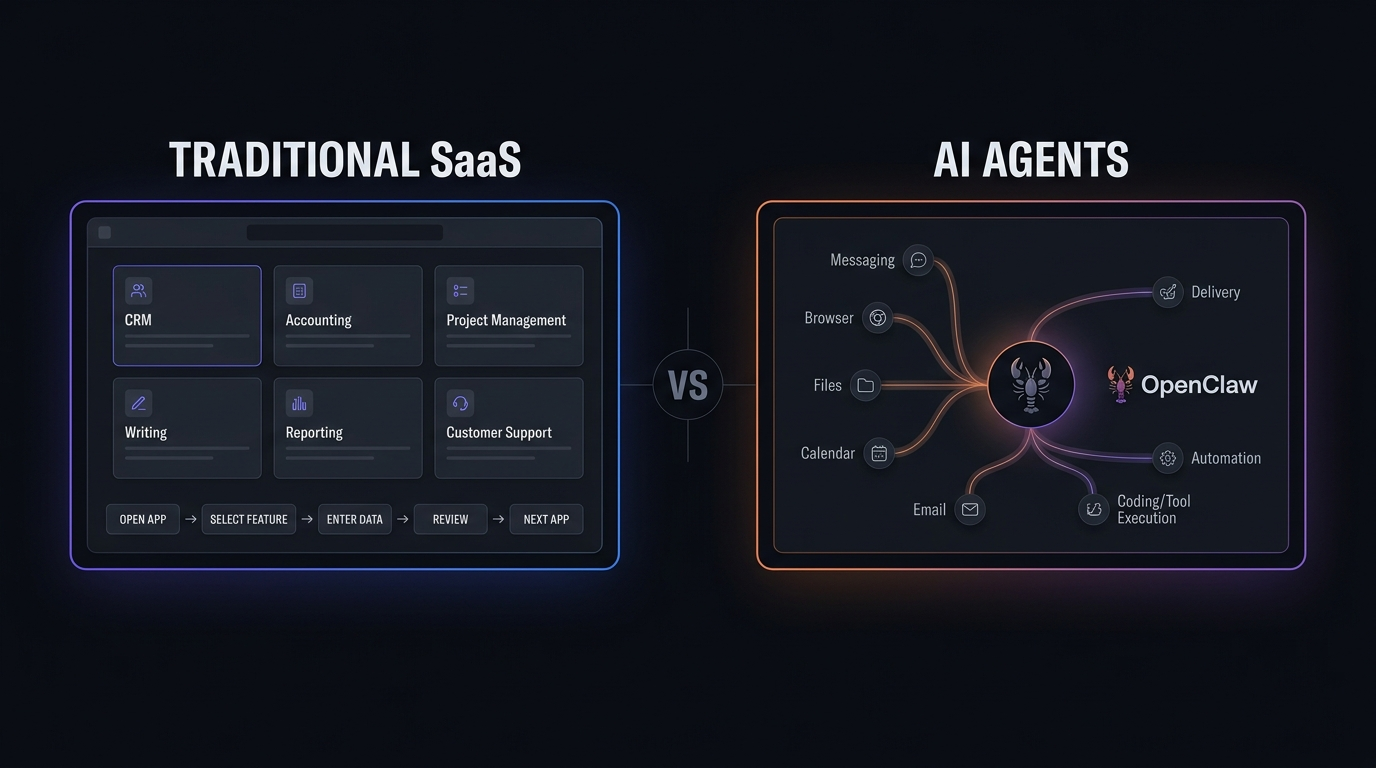
If you run a business, you already know the frustration: your team uses one tool for customer support, another for research, another for coding, and several more just to move information between them. AI Agents are changing that workflow by giving software more freedom to plan tasks, use tools, and complete multiple steps with less manual direction. Traditional SaaS still has a major advantage: predictable workflows, familiar interfaces, and clearly defined functions. But AI agent platforms are pushing software toward a different model where you describe the outcome instead of clicking through every step yourself. That raises an important question: are AI agents replacing traditional SaaS, or are they simply becoming another layer on top of it?
How We Evaluate AI Agents
For this comparison, we focus on two representative AI agent products and evaluate them around the tasks that matter when you are deciding whether an agent can replace or complement conventional software.
Our evaluation focuses on:
- Task autonomy: How much work can the system perform after receiving a goal?
- Tool usage: Can it interact with external tools, files, applications, or services?
- Workflow complexity: Is it useful for a single task or longer multi-step processes?
- Control: How easily can you review, interrupt, or redirect its work?
- Ease of use: Can a non-developer understand and operate the workflow?
- Value: Does the capability justify moving away from conventional SaaS workflows?
The goal is not to declare every AI agent better than SaaS. Instead, you should be able to see where each approach makes sense for developers, marketers, business owners, and everyday software users.
AI Agents vs Traditional SaaS at a Glance
| Tool / Approach | Best For | Starting Price |
| OpenClaw | Autonomous, customizable agent workflows | Free software; model/infrastructure costs vary |
| Hermes Agent | Developer-focused autonomous AI workflows | Free software; model/infrastructure costs vary |
Note: Traditional SaaS is an approach rather than a single product, so its pricing depends entirely on the software category and provider.
Best AI Agent Platform for Custom Autonomous Workflows: OpenClaw
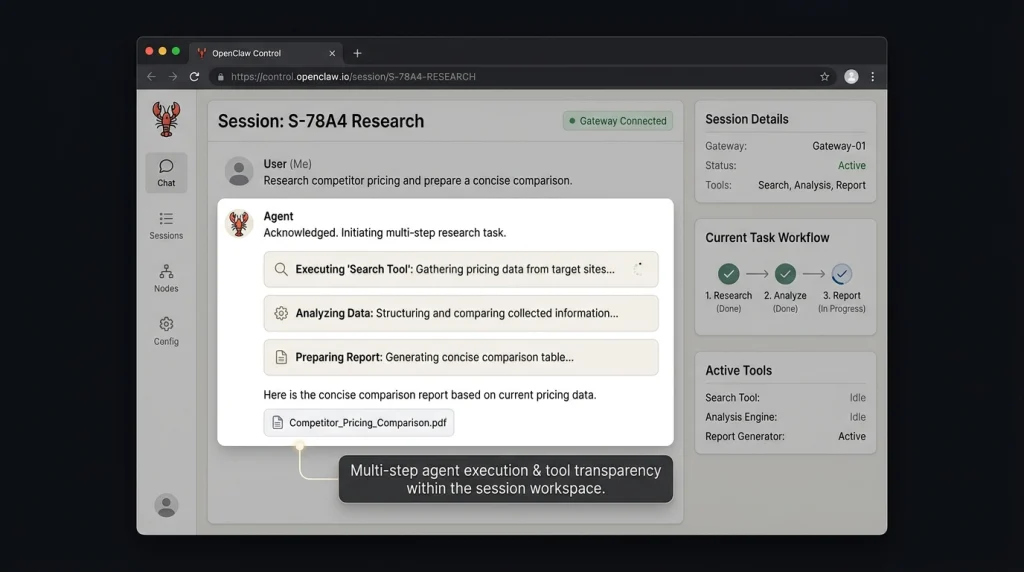
OpenClaw is aimed at users who want an AI agent to do more than answer questions. Its official site describes it as an open-source system that can run on your machine and perform actions such as organizing an inbox, sending emails, managing a calendar, and handling tasks through messaging apps.
That distinction becomes important when you compare AI agents with traditional SaaS. A conventional application generally waits for you to select the next function. An autonomous agent can potentially determine what needs to happen next based on the goal you provide.
OpenClaw is particularly interesting for technically confident users because its local-first approach gives you more control over the environment in which the agent operates. Instead of opening another SaaS dashboard for every task, you can use the agent as an automation layer around your existing workflow.
The difference becomes clearer when you give an agent a task containing several dependent steps rather than a simple question. Researching information, organizing it, and producing an output requires more than generating one response. It requires the system to manage a workflow.
OpenClaw is therefore more interesting when you care about AI automation tools that can participate in workflows rather than simply generate content.
Pros
- Open-source and designed to run on your own machine.
- Can connect agent-style tasks with everyday communication and productivity workflows.
Cons
- Setup can require more technical knowledge than conventional SaaS.
- Model, infrastructure, and usage costs can vary depending on how you deploy it.
Pricing: The OpenClaw software itself is open source; your actual cost depends on the AI models, infrastructure, and services you connect to it.
Best AI Agent for Developer-Oriented Automation: Hermes Agent
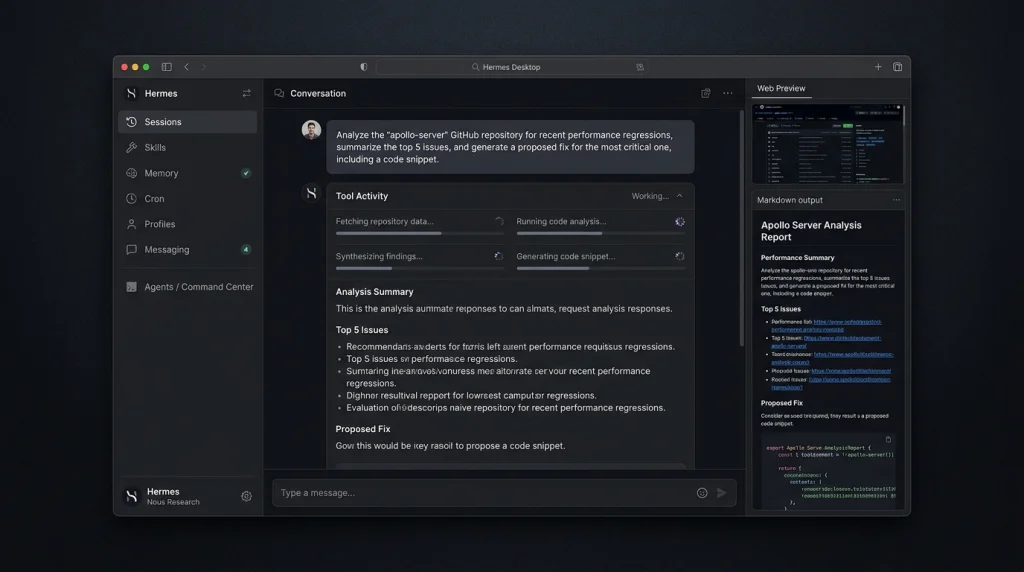
Hermes Agent takes a similarly agent-focused approach, but its appeal is especially relevant if you are comfortable working with developer tools and want an autonomous system rather than another conventional dashboard.
Hermes Agent is developed by Nous Research and is available as an open-source agent with native desktop applications for macOS, Windows, and Linux. Its official site also provides a terminal-based installation method, making it accessible to users who prefer command-line workflows.
This is where the AI Agents vs Traditional SaaS debate gets interesting. Traditional SaaS tends to package a fixed collection of features into an interface. An agent-based system can instead operate around a goal and determine which available capabilities are useful for reaching it.
Hermes is also designed around the idea of an agent that grows with continued use. Its project describes a built-in learning loop that can create skills from experience, improve them during use, persist knowledge, and search previous conversations.
The key test is not whether Hermes Agent can answer a technical question. Modern AI assistants can already do that. The more important question is whether the system can maintain context and perform multiple actions without requiring you to micromanage every step.
That makes Hermes Agent worth considering if you are exploring autonomous AI agents for development or technical workflows.
Pros
- Open-source with native desktop applications for major desktop operating systems.
- Built around persistent knowledge, skills, and a self-improving workflow model.
Cons
- It is better suited to technically confident users than people looking for a simple SaaS dashboard.
- Running it still requires consideration of model and infrastructure costs.
Pricing: Hermes Agent itself is open source. You can run it with your own infrastructure and model provider, while Nous Portal also offers a free tier and paid plans with monthly credits and access to more than 300 models.
AI Agents vs Traditional SaaS: What Actually Changes?
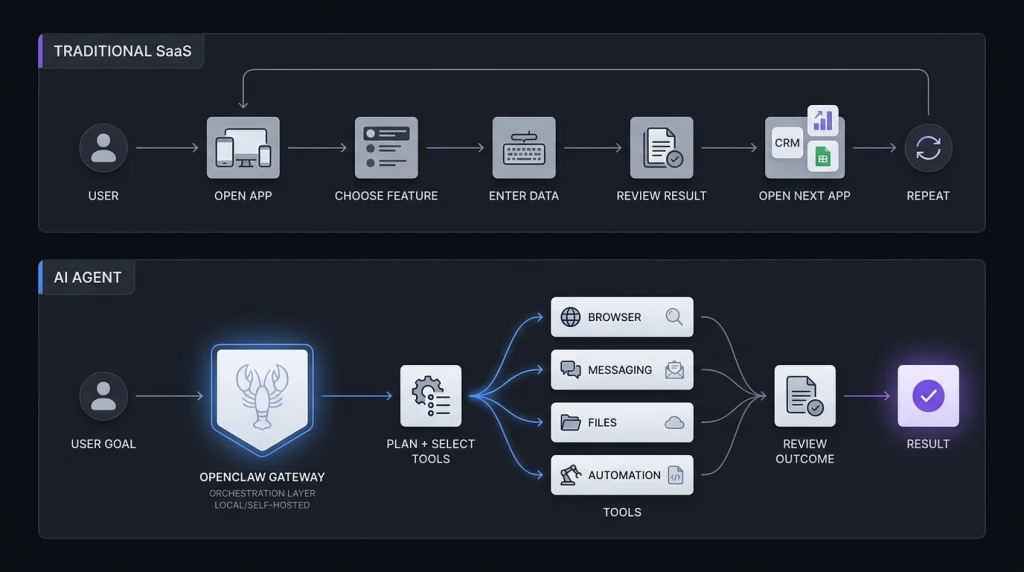
The biggest difference is not simply that one product uses AI and the other does not.
It is who controls the workflow.
With traditional SaaS, you normally control the sequence:
Open software → choose feature → enter information → review result → choose next feature.
With an AI agent, the workflow can become:
Give goal → agent plans actions → agent uses available tools → review outcome.
That sounds like a small change, but it can dramatically affect how software is designed. Traditional SaaS is excellent when you already know what you need to do. If you need accounting software to create an invoice, for example, a structured interface can be faster and more reliable than asking an autonomous agent to figure it out. Agents become more attractive when the workflow is messy.
Research, investigation, coding, information gathering, repetitive administration, and cross-application tasks can involve dozens of small decisions. That is where an agent has more room to provide value. The trade-off is control. A conventional SaaS workflow is usually predictable because you explicitly perform each action. An agent introduces another variable: whether the system interpreted your goal correctly.
Where Traditional SaaS Still Wins
It would be a mistake to assume that AI agents make ordinary software obsolete. Traditional SaaS remains powerful for repeatable tasks where consistency matters more than autonomy. Think about payroll, accounting, CRM records, project management, or inventory. You often want clear permissions, predictable screens, audit trails, and repeatable processes. In those situations, giving an autonomous system unrestricted control may create more problems than it solves.
SaaS also benefits from specialization. A dedicated writing application can provide focused editing controls. A CRM can organize customer records in a predictable structure. A project management platform can show tasks, deadlines, owners, and progress without requiring an agent to interpret the entire workflow. If you want to improve writing specifically, for example, dedicated writing assistants can still be a better fit than an autonomous agent for straightforward grammar and editing work.
Where AI Agents Have the Advantage
AI agents become compelling when your work does not fit neatly into one application. Imagine that you need to research competitors, collect information from several sources, organize the findings, compare them, and prepare a report. A traditional SaaS setup might require several applications and plenty of manual copying.
An agent can potentially act as the coordinator between those steps. This is why AI Agent Platforms are attracting attention. They are not simply competing with individual SaaS applications. In many cases, they are trying to sit above them and coordinate multiple tools.
OpenClaw is a good example of this broader approach because its official positioning focuses on performing tasks through communication channels and connected capabilities rather than simply returning text.
Hermes Agent approaches the problem from another direction, emphasizing an agent that can build skills and retain knowledge across sessions. The more fragmented your workflow becomes, the more interesting that model is. But autonomy should not be confused with accuracy. You still need checkpoints for important decisions, sensitive information, financial actions, and anything where an incorrect result could cause real damage.
Which Approach Should You Choose?
| Your Need | Better Fit |
| Fixed, repeatable business process | Traditional SaaS |
| Simple document or content editing | Traditional SaaS |
| Multi-step research | AI Agent |
| Cross-tool automation | AI Agent |
| Predictable reporting | Traditional SaaS |
| Developer experimentation | AI Agent |
| Sensitive financial workflows | SaaS + human oversight |
| Complex repetitive workflows | AI Agent + human review |
The best answer for many businesses is not AI agents or SaaS.
It is both.
You can keep specialized SaaS products as the systems of record while using agents as an orchestration layer around them. That approach gives you the predictability of conventional software without forcing employees to manually perform every repetitive step.
Final Verdict: Is Software Really Changing?
AI Agents are changing the relationship between people and software, but traditional SaaS is not disappearing overnight. The more realistic future is a combination of both: specialized applications handling structured jobs while agents coordinate complex work across them. If you are curious, start with a small workflow and compare the time, accuracy, and supervision required against your existing SaaS process. The bigger question is no longer whether software can perform a task it is how much of the workflow should you still have to operate yourself?
Frequently Asked Questions
Are AI Agents going to replace SaaS?
Probably not completely. AI agents are more likely to change how you interact with SaaS. Instead of manually opening several applications, you may increasingly use an agent to coordinate actions across them. Specialized SaaS products will still be valuable where structured data, compliance, permissions, and predictable workflows matter.
What are AI Agent Platforms used for?
AI Agent Platforms are designed to help agents perform tasks using models, tools, data, and workflows. Depending on the platform, you might use them for research, coding, customer support, automation, or business processes.
Should a small business use autonomous AI agents?
Start small. Pick one repetitive workflow where the potential benefit is obvious and the consequences of an error are manageable. Let the agent handle low-risk steps while keeping human approval for important decisions. Once you understand its strengths and failure points, you can expand its responsibilities.
Editorial disclosure: This comparison is based on product research and workflow-focused evaluation; pricing and features can change over time.
Leave a Reply