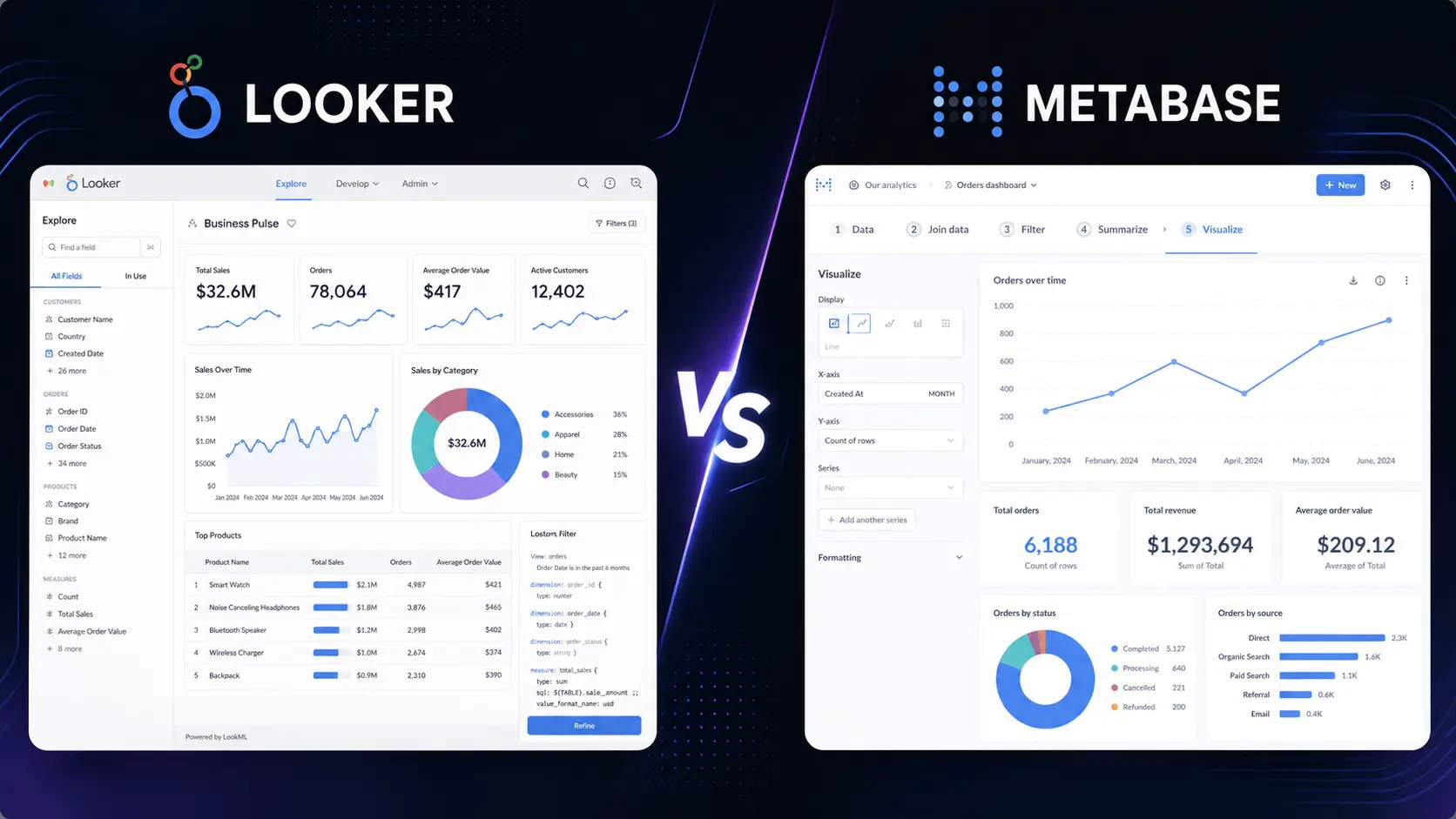
Choosing the right business intelligence platform can affect how easily a company can understand data, create reports, and keep business numbers consistent. Looker vs Metabase is an important comparison because both tools help teams explore data and build dashboards, but they follow very different approaches. Looker focuses on governed analytics and enterprise control, while Metabase focuses on simplicity, open-source access, and quick data exploration.
Looker vs Metabase: Key Features Compared
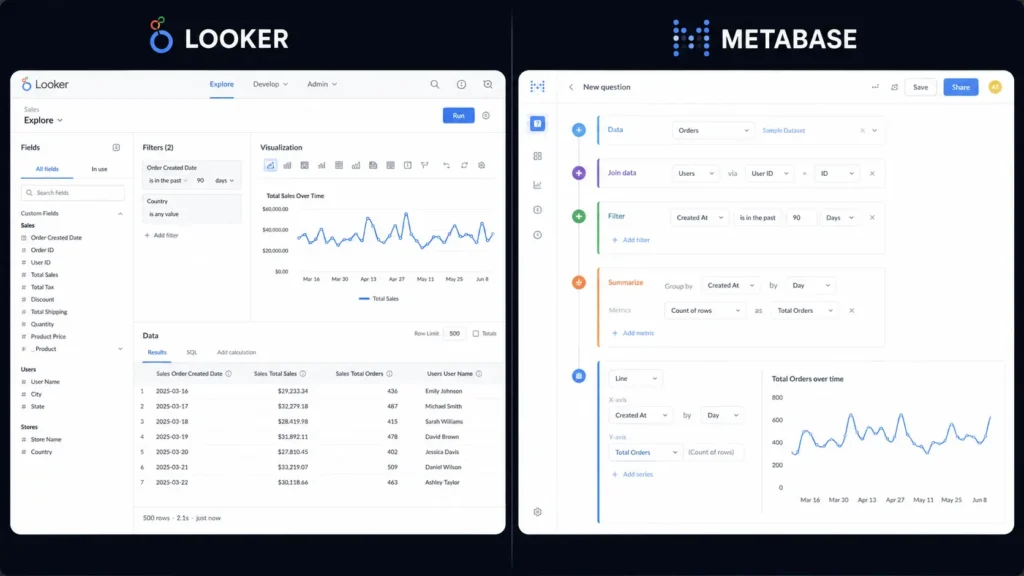
The biggest difference in Looker vs Metabase is the level of control each platform provides. Looker uses a central modeling system that helps teams define business metrics and relationships consistently. This is useful when many departments need to work with the same numbers. Metabase takes a more direct approach. Users can connect databases, explore information with a visual query builder, write SQL when needed, and create dashboards. Its Open Source Edition is available under the AGPL license.
| Feature | Looker | Metabase |
| Data exploration | Advanced | Easy and accessible |
| Data modeling | Excellent | Good |
| Visual query builder | Yes | Yes |
| SQL editor | Yes | Yes |
| Dashboards | Advanced | Advanced |
| Business metric governance | Excellent | Good |
| User permissions | Advanced | Advanced on paid plans |
| Data visualization | Excellent | Excellent |
| Scheduled reports | Yes | Yes |
| Alerts | Yes | Yes |
| Embedded analytics | Excellent | Yes |
| Open-source edition | No | Yes |
| Self-hosting | Available through supported options | Yes |
| AI features | Available | Available |
| Best for | Large and data-heavy organizations | Startups and growing teams |
| Ease of use | Moderate | Easy |
*Feature comparison reflects current product documentation and plan information from Google Cloud and Metabase. *
Looker vs Metabase: Pricing Comparison
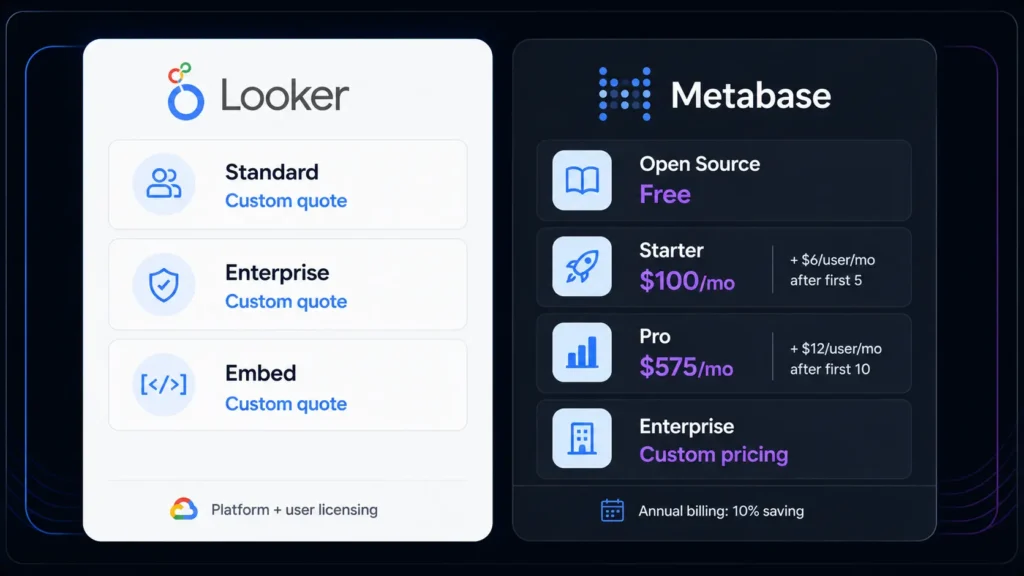
Pricing is one of the most important parts of Looker vs Metabase. Looker does not publish a simple fixed monthly price for its Google Cloud Core editions. Its pricing combines platform costs with user licensing, and Google directs customers to sales for a custom quote. The Standard, Enterprise, and Embed editions include different levels of features and usage. Metabase has a more transparent pricing structure. Its Open Source Edition is free to use, while its current Starter plan begins at $100 per month plus $6 per additional user, with the first five users included. The Pro plan starts at $575 per month plus $12 per additional user, with the first ten users included. Annual billing provides a 10% saving according to Metabase’s billing documentation.
| Pricing Option | Looker | Metabase |
| Free option | No standard free edition | Open Source Edition |
| Entry paid plan | Custom quote | Starter: $100/month + $6/user |
| Mid-level plan | Custom quote | Pro: $575/month + $12/user |
| Enterprise | Custom quote | Contact sales |
| Annual pricing | Custom quote | 10% annual billing discount |
| Self-hosting | Available depending on product setup | Open Source and paid options |
| User-based pricing | Yes | Yes on paid plans |
| Best pricing advantage | Enterprise customization | Lower entry cost and open-source option |
*Prices shown are based on official pricing pages available in August 2026 and may change. *
Looker vs Metabase: Which Has Better Data Analysis?
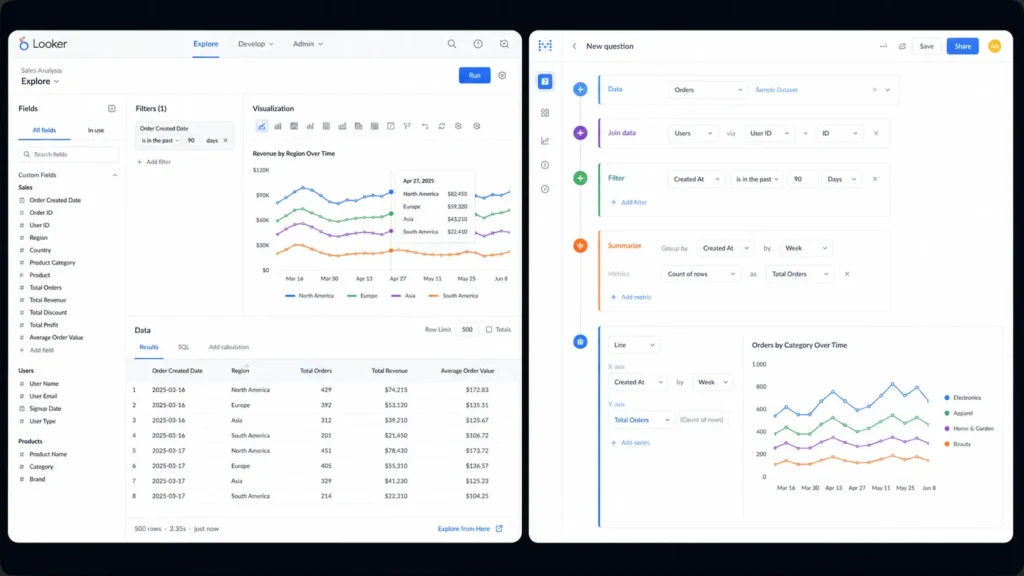
For advanced data analysis, Looker vs Metabase gives Looker an advantage. Its modeling approach helps organizations create shared definitions for important business metrics. This can reduce confusion when sales, finance, marketing, and management teams use the same data. Metabase is easier for everyday exploration. Users can ask questions through its query builder or use the SQL editor for more control. This makes it useful for teams that want quick answers without building a complex modeling layer.
Looker vs Metabase: Which Is Easier to Use?
When comparing ease of use in Looker vs Metabase, Metabase is the simpler option for most new users. Metabase is designed to let people explore data without requiring deep technical knowledge. Its visual tools can help business users create questions and dashboards without writing SQL for every task. Looker offers more control, but that control can require more training. Teams working with LookML and centralized data models may need technical users to manage the setup.
Looker vs Metabase: Enterprise Security and Governance
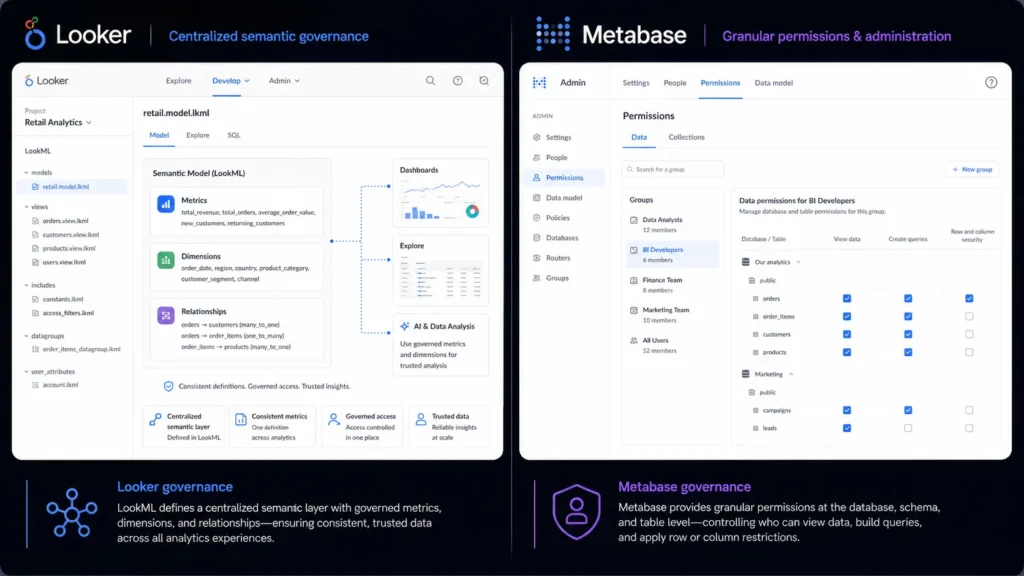
Enterprise governance is a major strength of Looker vs Metabase. Looker is designed for organizations that need centralized control over business definitions, permissions, reporting, and analytics. Metabase also provides advanced permissions on paid plans. Its Pro plan includes database-, row-, and column-level permissions along with single sign-on options. Enterprise customers can also receive stronger support and customized commercial terms. For companies with complex reporting structures, Looker may provide a more suitable foundation. For teams that need strong controls without the same level of complexity, Metabase can be a practical alternative.
Looker vs Metabase: Which Is Better for Small Businesses?
For small businesses, Looker vs Metabase often favors Metabase. The free Open Source Edition gives smaller teams a way to start without paying for a commercial BI platform. Metabase also offers a managed Starter plan for companies that do not want to maintain the software themselves. Looker can make more sense when a small company already has complex data requirements or expects to build a larger analytics operation.
Looker vs Metabase: Which Is Better for Enterprise Companies?
For large organizations, Looker vs Metabase becomes more balanced. Looker is a strong choice when centralized data definitions, advanced governance, detailed analytics, and embedded reporting are key requirements. Metabase can still work well for larger companies, particularly those that value self-hosting, open-source flexibility, and a simpler interface. Its Pro and Enterprise offerings add stronger permissions, support, and embedding options.
Looker vs Metabase: Final Verdict
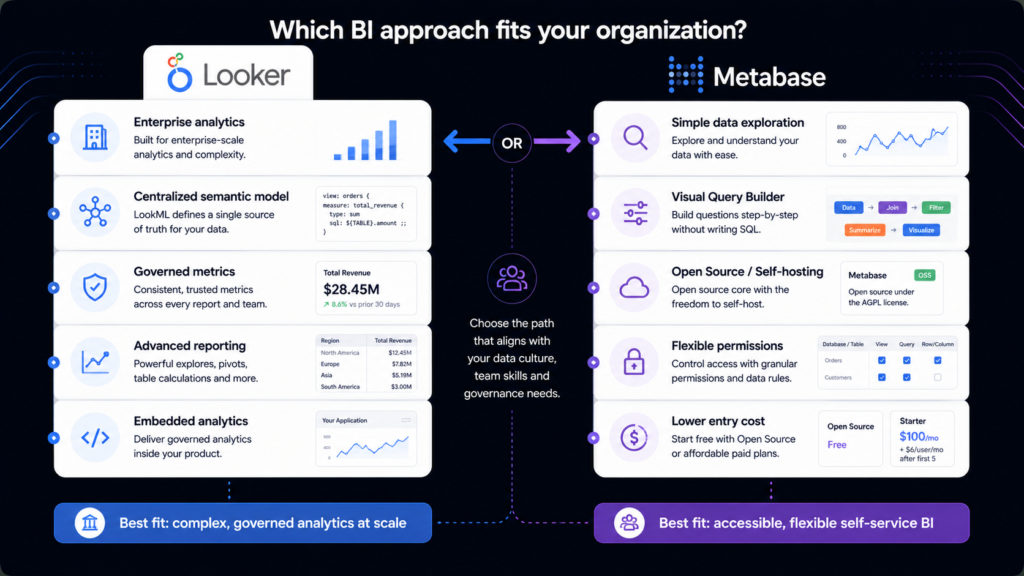
The best choice in Looker vs Metabase depends on the size and needs of your organization. Looker is better suited to businesses that need advanced governance, centralized data models, complex reporting, and enterprise analytics. Metabase is more attractive to teams that want simple data exploration, open-source flexibility, self-hosting, and clearer starting prices. If simplicity and cost control are your main priorities, Metabase is worth considering. If your organization needs deeper control over data and reporting at scale, Looker may be the stronger long-term choice.
FAQs About Looker vs Metabase
Is Metabase cheaper than Looker?
Metabase has a clear cost advantage for smaller teams because its Open Source Edition is free. Its paid Starter plan begins at $100 per month plus $6 per additional user. Looker uses custom pricing, so the final cost depends on the platform edition and user requirements.
Is Metabase easier to use than Looker?
Yes. Metabase generally has a simpler interface and is designed for quick data exploration. Looker offers deeper control but usually requires more technical knowledge.
Is Looker better for enterprise reporting?
Looker can be a better fit for enterprise reporting when an organization needs centralized business definitions, advanced governance, detailed permissions, and complex analytics.
Can Metabase be self-hosted?
Yes. Metabase offers an Open Source Edition for self-hosting, while paid plans also provide self-hosting options. Self-hosting gives teams more control but also means they are responsible for infrastructure, upgrades, backups, and monitoring.