Managing customer questions becomes difficult when messages arrive from live chat, email, WhatsApp, and social media at the same time. The right Customer Support Platforms can bring those conversations into one place, automate routine requests, and help your team respond without losing track of important issues. Two platforms worth comparing are Intercom and Chatwoot. Intercom focuses heavily on AI-powered customer service, while Chatwoot combines omnichannel support with an open-source approach. The big question is simple: should you pay more for Intercom’s broader customer experience ecosystem, or choose Chatwoot for its affordability and flexibility?
Editorial disclosure: This comparison is based on product documentation, current pricing information, and workflow-focused evaluation. It is not based on an undisclosed paid endorsement.
How We Evaluate Customer Support Platforms
We evaluated both platforms for common support workflows that startups, SaaS companies, and small customer service teams are likely to encounter. Rather than judging them only by the number of features listed on their websites, the focus was on practical day-to-day use.
The main evaluation criteria were:
- Shared inbox and conversation management
- AI and automation capabilities
- Live chat and communication channels
- Help center and knowledge-base features
- Team collaboration and reporting
- Pricing and scalability
We also considered how each platform fits into a broader business software stack. For example, if you’re comparing customer support with CRM functionality, our HubSpot vs Twenty comparison provides useful context around another important part of customer management.
At-a-Glance Comparison
| Tool Name | Best For | Starting Price |
| Intercom | AI-first customer support and SaaS teams | $29/seat/month annually |
| Chatwoot | Affordable omnichannel support and open-source flexibility | Free |
Intercom’s Essential plan starts at $29 per seat per month when billed annually. Chatwoot’s Hacker plan is free for up to two agents and 500 conversations per month.
Individual Tool Reviews
Best Customer Support Platform for AI-First Support: Intercom
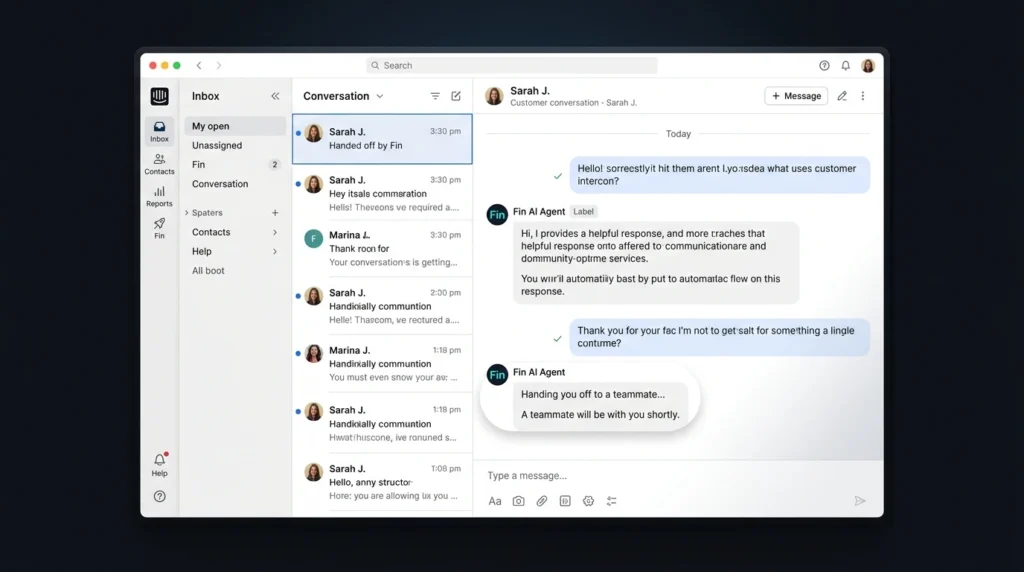
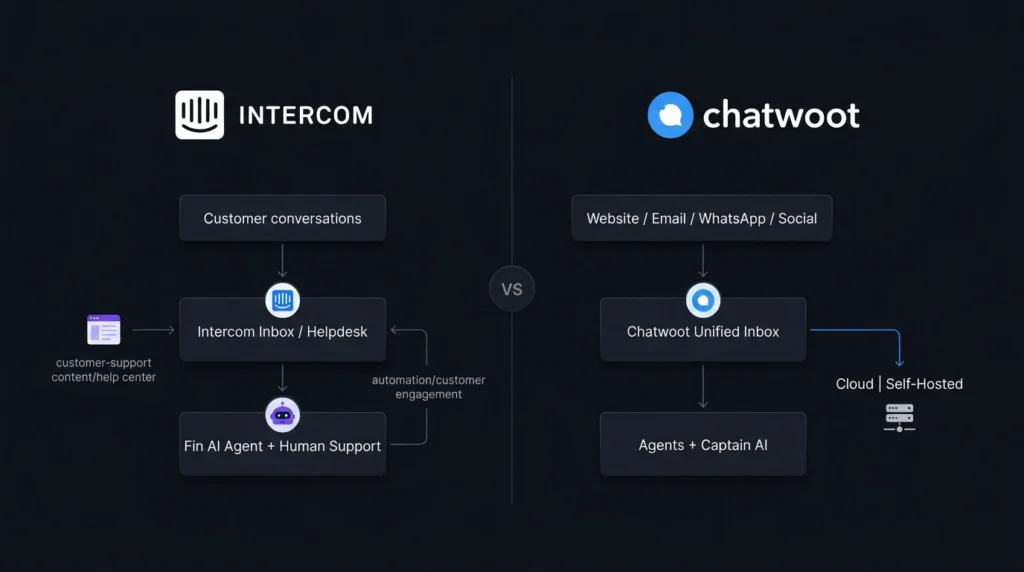
Intercom is the better fit when you want customer support, automation, AI, ticketing, and proactive customer communication in one platform. Its biggest differentiator is Fin, Intercom’s AI agent. Fin can answer customer questions using your support content and can hand conversations over to human agents when necessary. This makes Intercom particularly interesting if your team receives a large number of repetitive questions.
The platform also provides a shared Inbox where agents can manage customer conversations, assign conversations to teammates, and use automation to reduce manual work. Its help center can work alongside the support inbox, giving customers a self-service option before they contact an agent. One pricing detail you should watch is that Fin is charged according to outcomes rather than simply being included as unlimited AI usage. Intercom currently lists Fin from $0.99 per outcome. That means your actual monthly bill can depend on how much AI support your customers use.
For a growing SaaS company, this makes Intercom more than traditional customer support software. You can use the same ecosystem for support, customer engagement, and automated assistance.
Pros
- Strong AI agent and automation capabilities
- Extensive customer support and engagement ecosystem
Cons
- Costs can increase as your team and usage grow
- Advanced features are reserved for higher plans
Pricing: Essential starts at $29/seat/month when billed annually or $39/seat/month when billed monthly. Advanced starts at $85 annually or $99 monthly per seat, while Expert starts at $132 annually or $139 monthly. Fin starts at $0.99 per outcome. Intercom offers a 14-day free trial.
Best Customer Support Platform for Open-Source Flexibility: Chatwoot
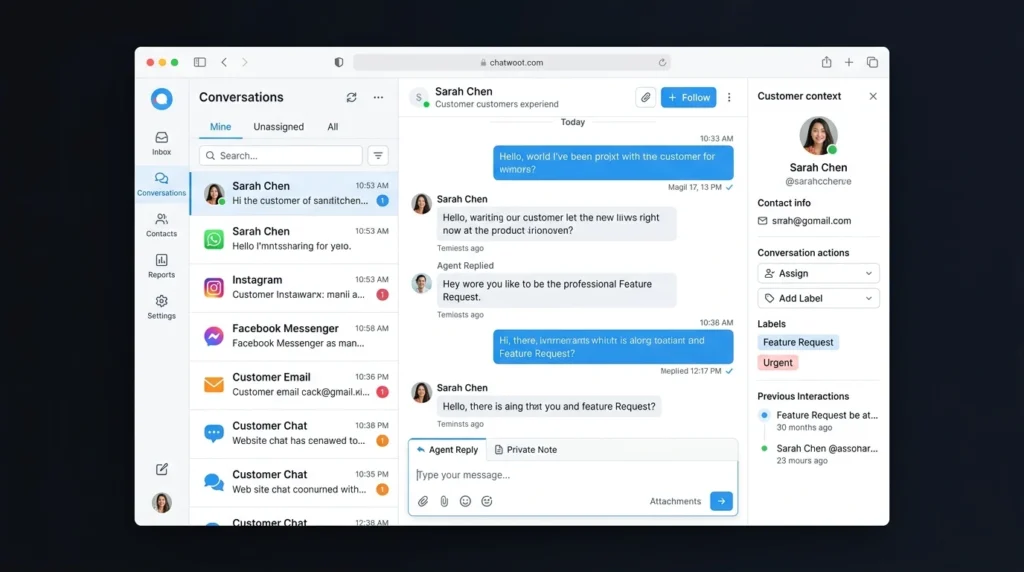
Chatwoot takes a more flexible approach to customer support. Its core idea is straightforward: give your team a shared workspace where conversations from different channels can be managed without forcing you into a proprietary support ecosystem. Depending on your plan and configuration, Chatwoot supports channels including website chat, email, Facebook, Instagram, WhatsApp, TikTok, Telegram, and others. This is useful when your customers don’t all communicate through the same channel.
The pricing is one of Chatwoot’s biggest advantages. Its Hacker plan is free for up to two agents and 500 conversations per month. The Startups plan begins at $19 per agent per month when billed annually, which makes it considerably more approachable for small teams. Chatwoot also offers a self-hosted Community Edition. That is a major distinction if you want to maintain more control over where your support infrastructure runs. Its Captain AI feature adds AI-assisted support capabilities, but the platform’s strongest argument remains its combination of omnichannel support, open-source flexibility, and lower entry cost.
Pros
- Free plan for small teams
- Open-source and self-hosting options
Cons
- Some advanced capabilities require paid plans
- AI usage is based on credits
Pricing: Hacker is free for up to two agents and 500 conversations/month. Startups costs $19/agent/month annually, Business costs $39/agent/month annually, and Enterprise costs $99/agent/month annually.
Intercom vs Chatwoot: Key Feature Comparison
| Feature | Intercom | Chatwoot |
| Shared inbox | Yes | Yes |
| Live chat | Yes | Yes |
| Email support | Yes | Yes |
| Available | Available | |
| AI agent | Fin AI Agent | Captain AI |
| AI pricing | From $0.99/outcome | Credit-based |
| Help center | Yes | Yes on eligible plans |
| Automation | Yes | Yes |
| Self-hosting | No | Yes |
| Free plan | No permanent free plan | Yes |
| Omnichannel support | Yes | Yes |
| Open-source | No | Yes |
The difference becomes clearer when you look beyond the feature checklist. Intercom is built around a broader customer engagement ecosystem. Its AI, support inbox, help center, ticketing, automation, and customer communication tools are designed to work together. Chatwoot puts more emphasis on flexibility and ownership. If self-hosting matters to you, Intercom simply cannot provide the same option because Chatwoot offers a self-hosted edition. That distinction can matter more than a long list of individual features.
Which Customer Support Software Should You Choose?
If you run a SaaS company and expect customer conversations to grow quickly, Intercom is probably the stronger choice. Its AI capabilities and broader customer engagement tools make it suitable for teams that want to automate repetitive support while maintaining human-agent workflows. You should lean toward Chatwoot if keeping software costs under control is important, particularly during the early stages of your business. The free plan gives very small teams somewhere to start, while the paid plans provide room to expand.
Chatwoot also deserves serious consideration if you want self-hosting. That option can be valuable for businesses that need greater control over their support infrastructure. Your wider workflow matters, too. Customer support teams often spend a surprising amount of time in meetings discussing customer issues, product feedback, and escalations.
Choose Intercom if:
- AI-powered support is a major priority
- You need customer engagement alongside support
- You’re running a growing SaaS or digital business
- You’re comfortable with usage-based AI costs
Choose Chatwoot if:
- You need an affordable support platform
- You want a free starting plan
- Omnichannel support is important
- You want open-source or self-hosted deployment
Final Verdict
Intercom and Chatwoot are both capable platforms, but they are aimed at slightly different priorities. Intercom is the stronger choice for businesses that want advanced AI support, customer engagement, and a mature commercial ecosystem. Chatwoot stands out for affordability, omnichannel support, and open-source flexibility. If you’re unsure, start with the available trial or free plan and put real customer conversations through the platform. The best Customer Support Platforms should reduce the work your team has to manage—not create another dashboard everyone learns to avoid. Which one fits the way your support team actually works?
Frequently Asked Questions
Is Intercom better than Chatwoot for AI customer support?
If AI is your main priority, Intercom has the more developed AI-centered support experience. Fin is closely connected to Intercom’s wider customer service environment, allowing AI assistance to work alongside human support workflows. However, that doesn’t automatically make it the right choice for everyone. If your support volume is relatively low and you’re more concerned about cost or self-hosting, Chatwoot can make more sense.
Is Chatwoot a good free customer support platform?
Yes. Chatwoot’s Hacker plan gives you a free starting point for up to two agents and 500 conversations per month. That can be enough for a small startup or early-stage business testing an omnichannel support workflow. Once your requirements grow, you’ll need to compare the paid plans carefully because additional channels, automation, AI credits, and other capabilities can affect the total cost.
Which one is better for a small business?
For a small business with a limited support budget, Chatwoot is generally the easier starting point. Its free plan removes the initial subscription cost, while its paid plans remain relatively affordable. Intercom can still be worthwhile if you expect to rely heavily on AI automation and proactive customer engagement. The better choice depends on whether you value lower entry cost or a broader customer experience platform.