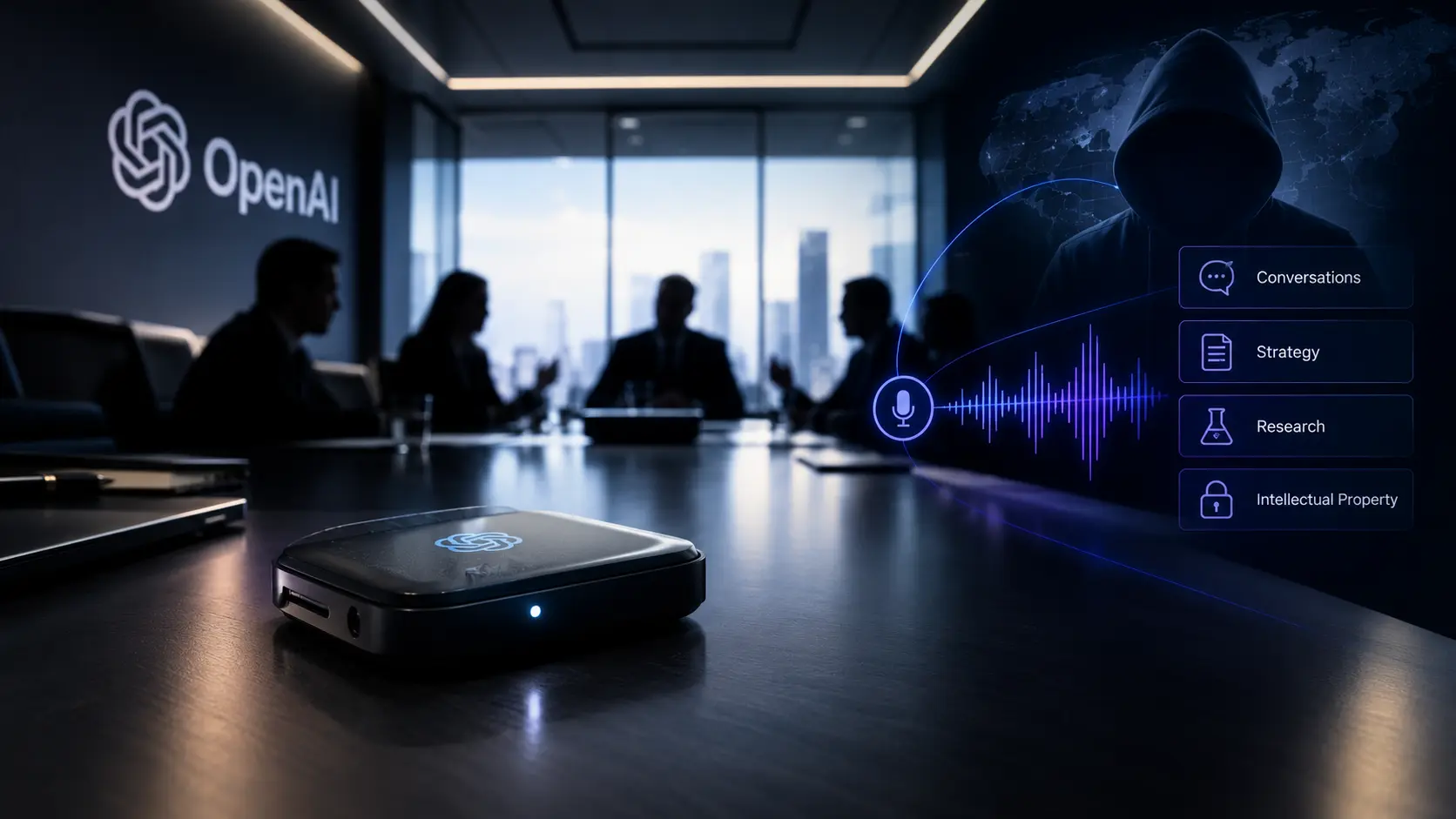
A tiny device hidden in a roll of toilet paper has become one of the strangest stories of the AI race. US federal agents have arrested an OpenAI engineer accused of planting a hidden recording device in an executive conference room. The case shows how valuable AI secrets have become, and why AI corporate espionage is now a serious concern for tech companies everywhere. Here is what we know, what remains unproven, and what other businesses can learn.
What Authorities Allege
According to a criminal complaint filed in federal court in San Francisco, the device was discovered on 30 September. It was plugged into a USB port on the back of a television in an executive meeting room and concealed in toilet paper. Reports describe it as thumb-sized, with a microphone and the ability to connect to a camera.
The Justice Department announced the charges on 13 October. The accused, a 35-year-old engineer named in the complaint as Abdulrahman Alfozan, was arrested the previous Friday, as CBS News reported. These are allegations. He has not been convicted, and it was not immediately clear whether he had a lawyer.
How the Device Was Traced
The complaint describes a careful investigation. After the discovery, the company added a camera to the room. Investigators say that camera later captured the engineer entering and checking behind the television where the device had been hidden. Office CCTV also allegedly showed him near the room about six times in the preceding month, despite having no authority to enter.
Investigators also say he left an unattended bag in another room that contained his wallet, identification and a second, similar recording device. OpenAI says it used its own AI models to help identify the person responsible and trace the device’s origins. The company says it fired the employee and referred the matter to the FBI, which is still investigating.
Why AI Secrets Are Such a Target
FBI Director Kash Patel said the alleged goal was to capture sensitive conversations about the company’s super intelligence technology, according to Reuters. Public reports so far have not said who, if anyone, the recordings were meant for, and the motive remains unproven.
What is clear is the value at stake. Leading AI labs spend billions training their models, and a single strategy meeting can reveal plans, research directions or partnerships worth a fortune to a rival. That makes executive rooms, not just computer systems, a prime target.
Lessons for Businesses of Any Size
Most companies will never face a planted bug, but the case highlights a wider risk: insider threats. People with legitimate access can cause more damage than outside hackers. Practical steps include:
- Control access to boardrooms and sensitive spaces, and keep logs of who enters.
- Check shared devices, such as meeting room TVs and their USB ports, as part of regular security sweeps.
- Use cameras and alerts lawfully and transparently in high-risk areas.
- Train staff to report unusual objects, unattended bags or people in places they should not be.
- Limit sensitive talk in rooms that are not secured, especially during major deals.
For smaller firms, our guide to cybersecurity tips for small businesses in Australia covers the basics.
A Wake-Up Call Beyond Silicon Valley
This case reads like a spy novel, yet the lesson is practical. As AI becomes more valuable, protecting conversations matters as much as protecting code. Every business with ideas worth stealing should treat its meeting rooms as part of its security plan.
Frequently Asked Questions
Was any data actually stolen?
Authorities have not said publicly whether useful recordings were captured or shared. That is likely to be examined as the case continues.
Did the complaint name OpenAI?
No. The complaint did not name the company, but OpenAI confirmed in its own statement that the device was found in one of its offices.
What happens next?
The case will move through the US federal courts, where prosecutors must prove the charges. Further details may emerge in court filings.
Could this happen in Australian companies?
Any organisation with valuable information faces insider risk. Clear access rules and regular checks of meeting spaces reduce the chance of a device going unnoticed.