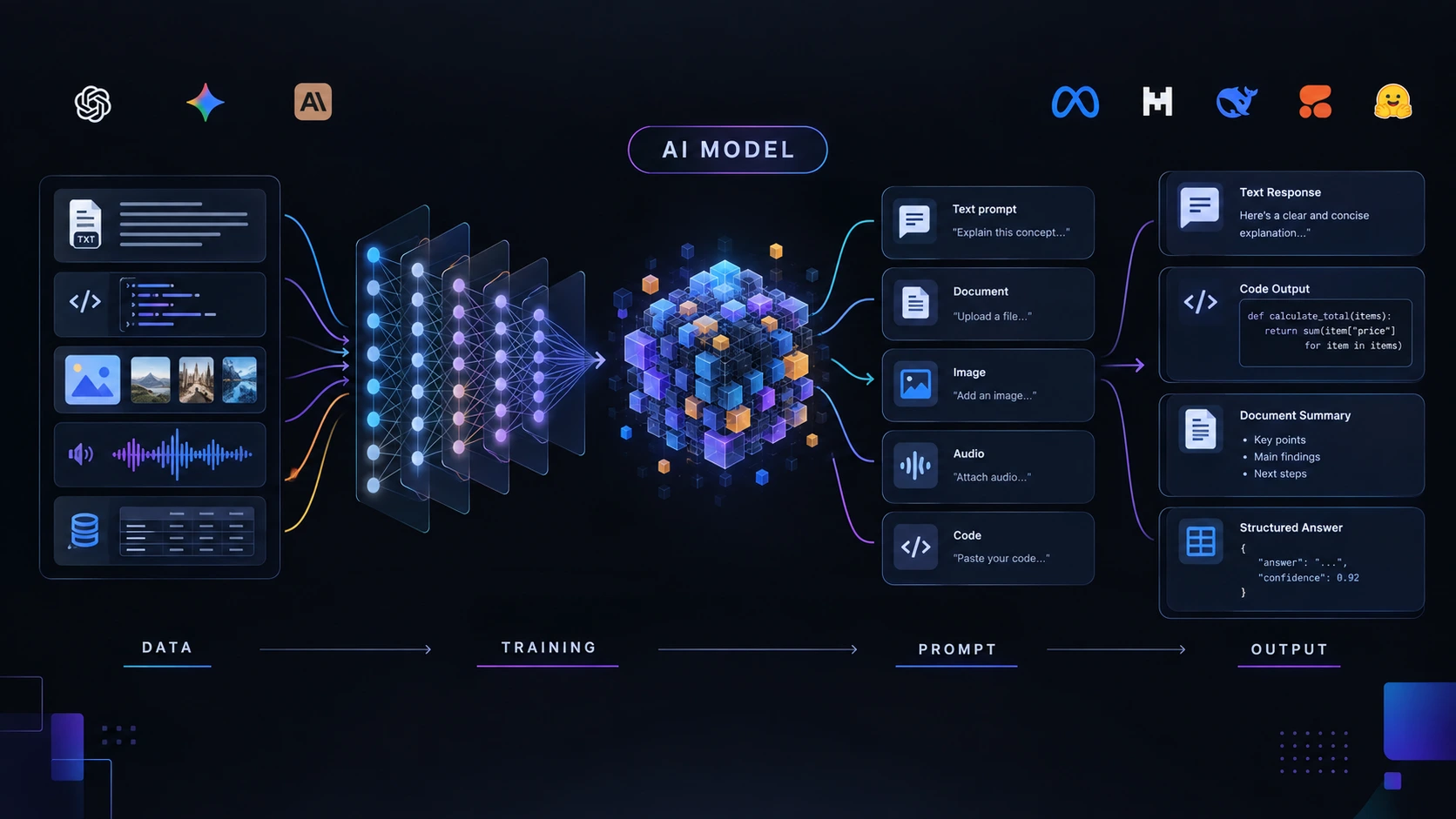
If you have ever wondered why ChatGPT can answer questions, generate code, summarize documents, analyze images, or create content, the answer starts with an AI Model. But what actually happens behind the screen? An AI model is a trained system that learns patterns from data and uses those patterns to make predictions or generate results. In 2026, powerful AI models are available through chat applications, application programming interfaces, open-weight downloads, and developer platforms.
Understanding these systems is useful even if you are not a developer. Marketers use AI models for content and research, students use them for learning, and developers use them to build applications. This article explains what an AI model is, how AI models are trained, and how they turn instructions into AI model output. It also looks at eight major AI model platforms and their current 2026 pricing.
Editorial disclosure: This article is independently written for educational purposes. Pricing and model availability were checked against official provider pages in September 2026 and may change later.
How We Evaluate AI Models
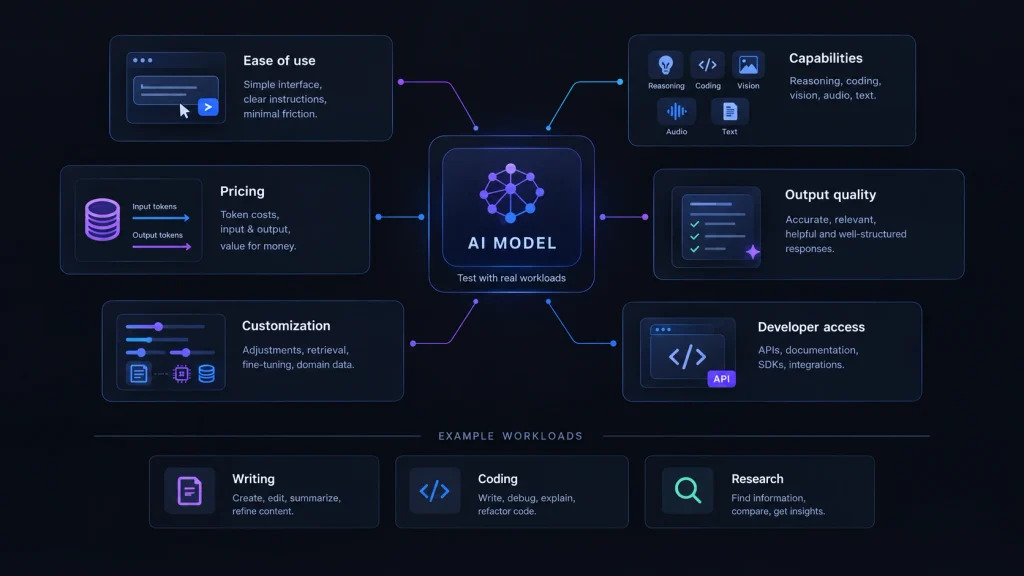
We evaluated these platforms based on practical usefulness rather than benchmark scores alone.
The evaluation considers:
- Ease of use: How quickly beginners can start.
- Model capabilities: Reasoning, coding, text, vision, audio, and other inputs.
- Output quality: Accuracy, consistency, and usefulness.
- Developer access: APIs, documentation, and integration options.
- Customization: Fine-tuning, retrieval, prompting, and deployment.
- Pricing: Free plans, subscriptions, API rates, and infrastructure costs.
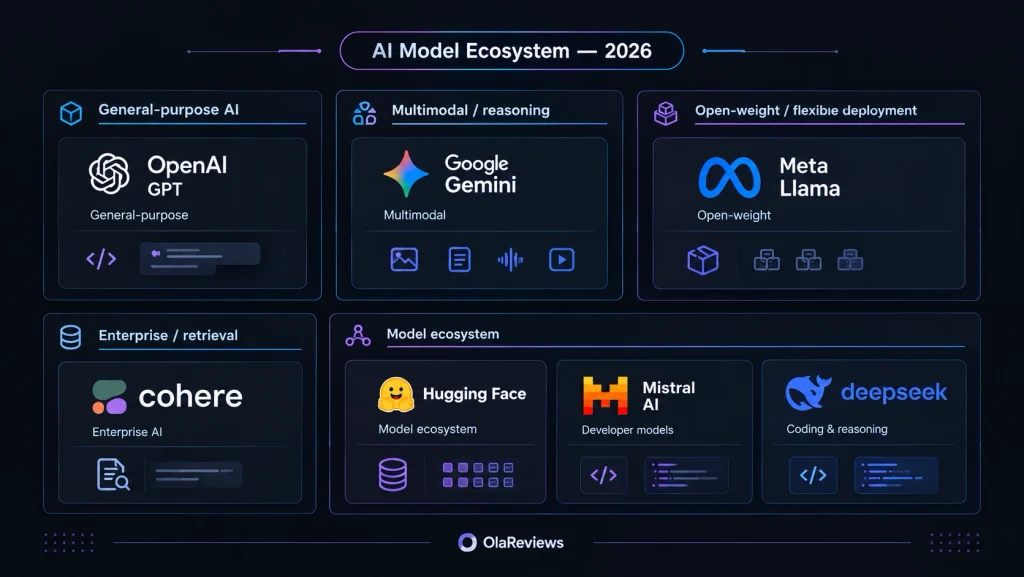
We also considered what makes each platform different. Some are designed for general-purpose AI, while others focus on open-weight models, enterprise search, coding, or AI development. The goal is to explain both the technology behind AI models and the practical cost of using them.
AI Models at a Glance
| AI Model / Platform | Best For | Starting Price |
| OpenAI GPT | General-purpose AI | Free |
| Google Gemini | Multimodal AI | Free tier |
| Claude | Writing and reasoning | Free |
| Meta Llama | Open-weight development | Free model access* |
| Mistral AI | Developers and coding | Free |
| DeepSeek | Coding and reasoning | Free |
| Cohere | Enterprise AI | Free on selected models |
| Hugging Face | Open-source AI | Free |
*Llama models are distributed under their applicable licenses. Hosting and inference can create additional costs.
1. Best AI Model for General-Purpose AI: OpenAI GPT
OpenAI GPT models are designed for a wide range of tasks, including writing, reasoning, coding, image understanding, multilingual work, and tool-based applications. For beginners, a chatbot is the easiest way to experiment. Developers can use the API to integrate models into websites, applications, automation systems, and other software. One simple way to understand an AI model is to give it the same question with different instructions. If you add context, examples, or constraints, the model can produce a different answer without being retrained. That is prompting, not AI model training.
This distinction matters. Training changes the model’s learned parameters, while prompting changes the information and instructions available during an individual request. OpenAI’s current API pricing is token-based. The official pricing page lists GPT-6 Astra at $5 per 1 million input tokens and $25 per 1 million output tokens for short-context standard usage. GPT-5.6 Luna is listed at $0.20 per 1 million input tokens and $1.20 per 1 million output tokens. Long-context pricing can be higher.
Developers interested in AI-assisted programming can also explore our guide to AI code editors in 2026.
Pros
- Broad range of AI capabilities
- Strong developer ecosystem and API access
Cons
- API costs increase with heavy usage
- AI output still needs verification
Pricing: ChatGPT has a free option. API pricing currently includes GPT-5.6 Luna at $0.20/M input and $1.20/M output, while GPT-6 Astra starts at $5/M input and $25/M output for short-context standard usage.
2. Best AI Model for Multimodal Work: Google Gemini
Google Gemini is built for multimodal AI tasks. Depending on the model, it can work with combinations of text, images, audio, and video. This makes Gemini useful when an application needs more than text generation. For example, a developer can create a workflow where a user uploads an image and asks the model to identify information inside it.
Google offers different Gemini models at different performance and cost levels. Its official pricing page lists both free-tier and paid-tier usage, with prices depending on the specific model. For example, the current pricing page lists certain Gemini models at $0.75 per 1 million input tokens and $3.75 per 1 million output tokens through December 31, 2026, while lower-cost variants are available at substantially lower rates. Google also applies different rates for caching and some specialized models.
Gemini is also relevant to the wider development of AI search engines, where language models increasingly work with retrieved information rather than relying only on their internal training.
Pros
- Strong multimodal capabilities
- Several model options for different workloads
Cons
- Model availability can change
- Advanced models can become expensive at scale
Pricing: Gemini API provides free-tier access for supported models. Paid API pricing varies by model, with current official rates ranging from low-cost Flash variants to higher-priced advanced models.
3. Best AI Model for Writing and Reasoning: Claude
Claude is designed for writing, analysis, reasoning, coding, and document-based workflows. It is particularly useful when you need to provide detailed instructions or work with large amounts of context. Common applications include editing reports, analyzing documents, drafting content, planning projects, and solving complicated problems.
Claude also fits naturally into writing workflows. If you are researching different writing assistants, it is useful to understand that a writing application and the underlying AI model are not necessarily the same thing. Anthropic currently offers a Free plan. Claude Pro costs $20 per month, or $200 per year. Anthropic also offers Max 5x at $100 per month and Max 20x at $200 per month.
For API users, the official Claude pricing page lists Claude Sonnet 5 at $2 per million input tokens and $10 per million output tokens. Anthropic confirmed in August 2026 that this introductory pricing became the permanent standard price.
Pros
- Strong writing and reasoning capabilities
- Useful for long-form analysis and coding
Cons
- Free usage is limited
- Higher API usage can become expensive
Pricing: Free plan available. Claude Pro costs $20/month or $200/year. Max 5x costs $100/month, while Max 20x costs $200/month. Sonnet 5 API pricing is $2/M input and $10/M output.
4. Best AI Model for Open-Weight Development: Meta Llama
Meta Llama takes a different approach from consumer AI chatbots. Meta provides Llama models under their applicable community license terms, giving developers more flexibility to download, experiment with, and deploy model weights than they typically get with a purely hosted proprietary model.
The Llama ecosystem includes models such as Llama 4 Scout and Llama 4 Maverick. Meta describes Llama 4 Scout as supporting a very large context window, while Maverick provides a much larger mixture-of-experts architecture. Llama is particularly interesting if you want to understand how to train an AI model, fine-tune an existing model, or experiment with local deployment.
However, free model access does not mean that running a large model is free. GPU servers, storage, bandwidth, and inference can all create costs. There is also an important distinction between open-weight and completely unrestricted open-source software. Developers should always review the specific license attached to the model they plan to use.
Pros
- Flexible deployment options
- Useful for developers and researchers
Cons
- Large models require significant computing resources
- License terms need to be checked before commercial deployment
Pricing: There is no standard Llama monthly subscription. Model weights are provided under their applicable licenses. Your actual cost depends on whether you self-host the model or use a third-party inference provider.
5. Best AI Model for Developers: Mistral AI
Mistral AI combines commercial models, open-weight models, developer APIs, and AI infrastructure. Its model catalog covers different workloads, allowing developers to choose models based on performance, latency, context, and cost. Mistral describes its lineup as including both open-weight and commercial large language models.
For API users, one clear example is Mistral Large, which currently costs $0.50 per 1 million input tokens and $1.50 per 1 million output tokens. This pricing makes Mistral attractive when you need a capable model but want to keep token costs under control. Mistral also provides tools for more advanced AI development, including model customization, training, and deployment. That makes it useful beyond simple chatbot use.
Pros
- Competitive API pricing
- Mix of open-weight and commercial models
Cons
- Large model catalog can be confusing for beginners
- Advanced deployment requires technical knowledge
Pricing: Mistral Large costs $0.50/M input and $1.50/M output tokens. Other Mistral models have different rates, so developers should check the current pricing page before choosing a model.
6. Best AI Model for Coding and Reasoning: DeepSeek
DeepSeek has become an important option for developers interested in coding, reasoning, and cost-efficient API usage. One useful feature for developers is its API compatibility with common AI development patterns. This can make it easier to test DeepSeek without completely redesigning an existing application.
The official DeepSeek pricing documentation currently lists model prices per 1 million tokens. For the current V4 family, pricing includes different peak and off-peak rates depending on the model. The official pricing page lists V4 Flash at $0.14/M input and $0.28/M output during peak pricing, with lower off-peak rates of $0.07/M input and $0.14/M output. V4 Pro is listed at $0.435/M input and $0.87/M output during peak pricing, with lower off-peak pricing also available. This makes DeepSeek particularly interesting for high-volume applications where token costs matter.
The important point is that price should not be the only factor. Developers should test coding accuracy, latency, context handling, reliability, and output quality using real workloads.
Pros
- Competitive token pricing
- Strong focus on coding and reasoning
Cons
- Pricing and model availability can change
- Generated code still requires testing
Pricing: DeepSeek V4 Flash is currently pricing at $0.14/M input and $0.28/M output during peak periods, while V4 Pro is $0.435/M input and $0.87/M output. Off-peak rates are lower.
7. Best AI Model Platform for Enterprise AI: Cohere
Cohere focuses heavily on enterprise AI, retrieval, agents, search, and multilingual applications. Unlike consumer chatbot subscriptions, Cohere’s model pricing is mainly based on API usage or enterprise deployment. Its current Command family includes models such as Command A, Command A+, Command R7B, Command A Reasoning, and other specialized models.
For example, Command A costs $2.50 per 1 million input tokens and $10 per 1 million output tokens. It has a 256,000-token context window and is designed for enterprise agents, tool use, and retrieval-augmented generation. Cohere also has lower-cost models. Command R7B costs $0.0375/M input and $0.15/M output, making it useful when throughput and cost are more important than maximum model capability.
Cohere is especially relevant when companies need AI to work with their own information. Retrieval can bring current company data into a model’s context without retraining the underlying model every time a document changes.
Pros
- Strong enterprise and retrieval focus
- Multiple models for different cost and performance requirements
Cons
- More technical than consumer AI platforms
- Enterprise deployments can require additional infrastructure
Pricing: Command A costs $2.50/M input and $10/M output. Command R7B is much cheaper at $0.0375/M input and $0.15/M output. Some newer Cohere models have separate pricing or free access subject to rate limits.
8. Best AI Model Platform for Open-Source Experimentation: Hugging Face
Hugging Face is different from most platforms in this list because it is an AI ecosystem rather than one model family. Its Model Hub provides access to a huge range of models and datasets. Developers can inspect model cards, experiment with Spaces, use inference providers, and deploy models with different hardware configurations. Hugging Face currently offers a free account, while PRO costs $9 per month, Team starts at $20 per user per month, and Enterprise starts at $50 with custom enterprise features.
Its compute and inference services are priced separately. Hugging Face says its GPU compute starts at $0.60 per hour, while inference providers use pay-as-you-go billing. Free users currently receive $0.10 in monthly inference-provider credits, while PRO users receive $2 in monthly credits. For someone learning how to train an AI model, Hugging Face is particularly useful because it lets you explore different model families instead of being locked into one provider.
Pros
- Huge AI model and dataset ecosystem
- Excellent for experimentation and learning
Cons
- Large number of choices can overwhelm beginners
- Compute costs are separate from the basic Hub account
Pricing: Free account available. PRO costs $9/month, Team starts at $20/user/month, and Enterprise starts at $50. GPU compute starts at $0.60/hour on the current pricing page.
AI Model Pricing and Technical Comparison
| Platform | Starting Price | Example Current Pricing | Model Type |
| OpenAI GPT | Free | GPT-5.6 Luna: $0.20/M input, $1.20/M output | Proprietary |
| Google Gemini | Free tier | Paid rates vary by model | Proprietary |
| Claude | Free | Sonnet 5: $2/M input, $10/M output | Proprietary |
| Meta Llama | Free model access* | Hosting/inference dependent | Open-weight |
| Mistral | Free | Mistral Large: $0.50/M input, $1.50/M output | Mixed |
| DeepSeek | Free | V4 Flash: $0.14/M input, $0.28/M output peak | Open/hosted |
| Cohere | Free on selected models | Command A: $2.50/M input, $10/M output | Enterprise-focused |
| Hugging Face | Free | PRO: $9/month | Open ecosystem |
*Llama infrastructure and hosted inference costs depend on the deployment method.
What Does “Per Million Tokens” Mean?
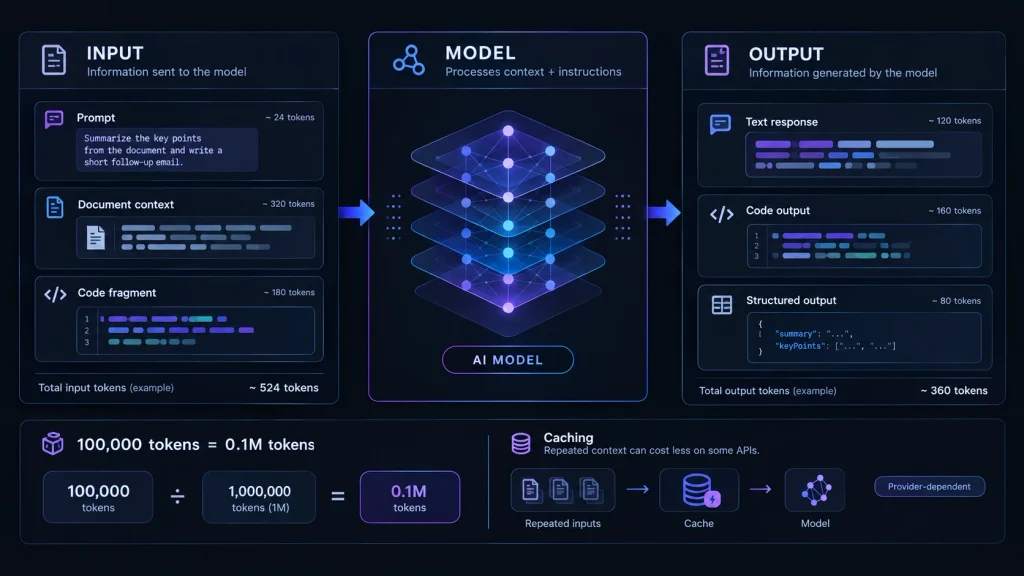
Many AI APIs charge based on tokens instead of individual requests. A token is a small unit of information processed by an AI model. Depending on the language and text, it may represent part of a word, a complete short word, punctuation, or another piece of text.
There are normally two main costs:
- Input tokens: Information sent to the model.
- Output tokens: Information generated by the model.
For example, if an API costs $1 per million input tokens, sending 100,000 input tokens would cost roughly $0.10 before other applicable charges.
This is why comparing only the headline price can be misleading. A model with a higher cost per million tokens might still be cheaper for a particular workload if it requires fewer tokens, produces better results, or reduces the number of requests needed. Caching can also reduce costs on some platforms when the same information is repeatedly processed.
Final Thoughts
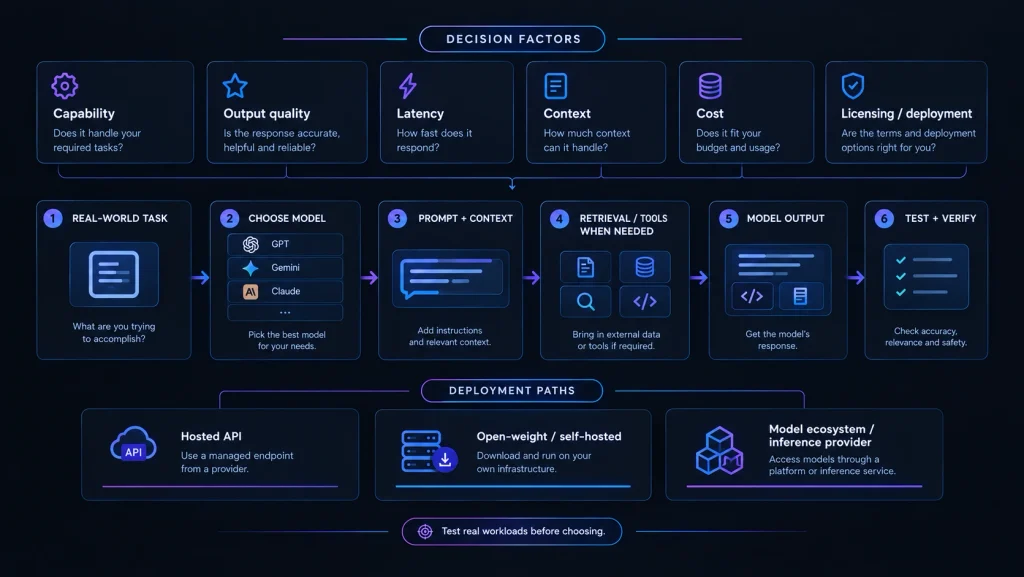
Understanding an AI Model becomes much easier when you separate training, prompting, and output. Training teaches a model patterns from data. Prompting provides instructions and context. The model then uses its learned parameters and available context to generate an AI model output. In 2026, you do not need to build an AI model from scratch to start experimenting. Free plans, API access, open-weight models, and platforms such as Hugging Face have made AI development much more accessible.
The best platform depends on what you want to accomplish. OpenAI and Gemini are strong choices for general-purpose applications. Claude is useful for writing and reasoning. Llama and Mistral are attractive for developers who want more control over models. DeepSeek can be compelling for coding and lower-cost API workloads. Cohere is designed around enterprise use cases, while Hugging Face gives developers access to a much broader AI ecosystem.
Pricing matters, but it should not be the only factor. Context limits, output quality, latency, reliability, model capabilities, licensing, and deployment requirements can have a much larger impact on the final cost of an AI project. The best way to choose an AI model is therefore simple: test several models using the same real-world prompts and measure the results against your actual requirements.
FAQ
What is an AI model?
An AI Model is a trained computational system that learns patterns from data and uses those patterns to make predictions, classifications, or generate content. Large language models are a type of AI model designed to process and generate language.
How do you train an AI model?
Learning how to train an AI model starts with data, a model architecture, computing resources, and an optimization process. During training, the model processes examples and adjusts internal parameters to reduce errors. Developers evaluate the results and may repeat the process with better data, settings, or training techniques. Training a frontier-scale model from scratch is extremely different from fine-tuning a smaller existing model.
Is prompting the same as AI model training?
No. Prompting gives an already-trained model instructions or additional context. Training changes the model’s internal parameters through an optimization process. Fine-tuning is a form of additional training where an existing model is adapted using another dataset.
Can I train an AI model for free?
You can learn the fundamentals for free using smaller models, open-weight models, cloud notebooks, and platforms such as Hugging Face. However, training a large foundation model from scratch requires substantial computing resources, datasets, storage, and engineering work.
Which AI model is best?
There is no single best AI model for every task. OpenAI and Gemini are strong general-purpose choices. Claude is useful for writing and reasoning. Llama and Mistral provide more flexibility around model deployment. DeepSeek is attractive for coding and cost-conscious API workloads. Cohere focuses on enterprise AI, while Hugging Face provides access to a broad ecosystem of models and tools.
Leave a Reply