WhatsApp Will Stop Working Without Your SIM From 1 January: What Indian Users Must Do
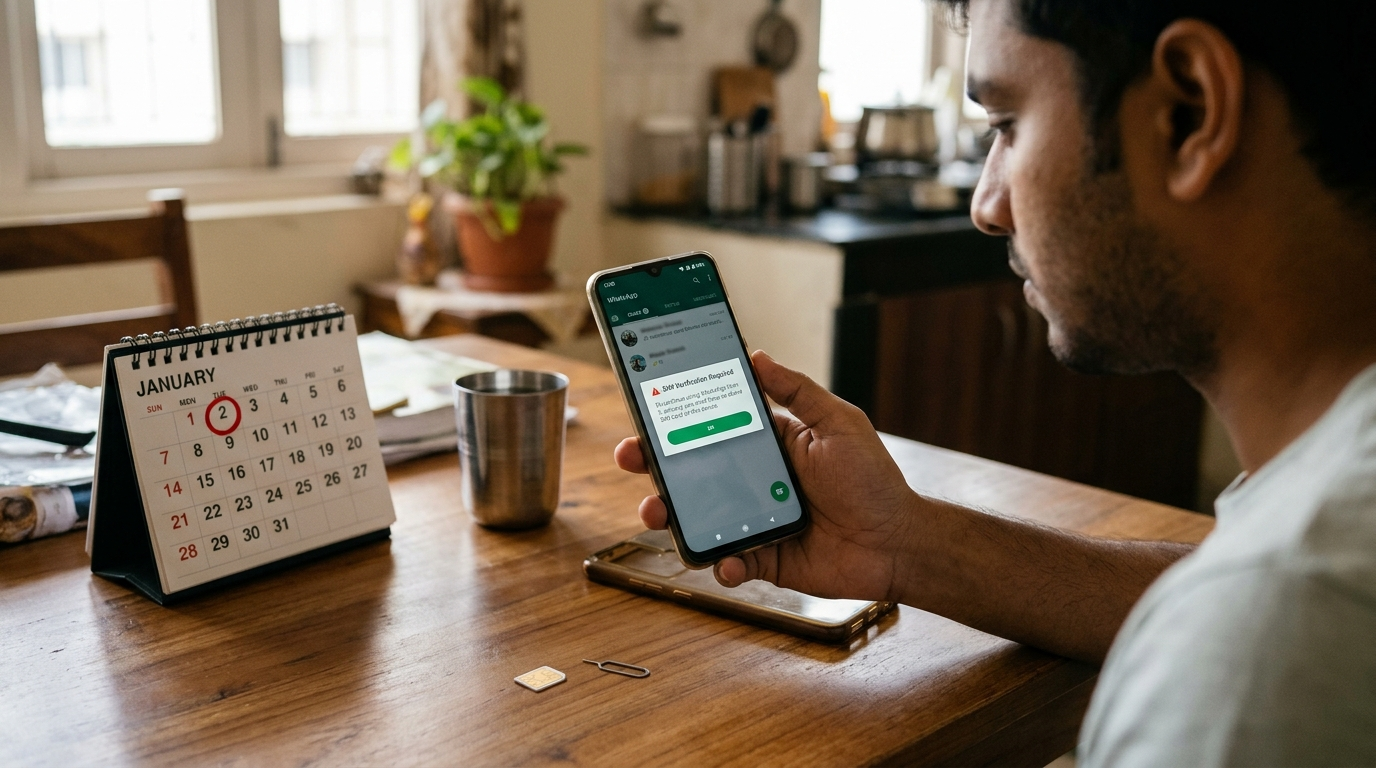
Imagine reaching for your spare tablet one morning in early 2027, tapping the familiar green icon and finding your conversations locked away. That is a realistic prospect for a surprising number of Indian households. A fresh telecom regulation will soon oblige the biggest chat apps to confirm that the card behind your account is physically present in the handset you are holding. Curiosity has exploded online, with Google lookups for the messaging giant climbing sharply across the country. Below, we unpack the WhatsApp SIM binding requirement, identify the people most exposed to the SIM binding rule in India, and set out a calm plan for the weeks ahead.
The Short Version
India’s telecom department, known as the DoT, has told major messaging and calling apps to keep every account tied to the working SIM that matches its Indian mobile number. Companies must comply by 31 December 2026, which makes 1 January 2027 the date when the change is expected to take effect.
In practice, that means an app may stop working on a device that does not contain your registered SIM. WhatsApp and Telegram are not being banned or switched off in India.
Which Apps Are Covered
Eight platforms appeared on the list published alongside the original order in late 2025:
- Arattai
- JioChat
- Josh
- ShareChat
- Signal
- Snapchat
- Telegram
It covers messaging services that rely on an Indian phone number as the way to recognise each user.
Why the Government Wants This
The official reasoning is fraud prevention. Today, an account can keep working long after its SIM has been removed, switched off or taken overseas. According to a government statement carried by All India Radio, that gap lets criminals run anonymous scams, fake “digital arrest” calls and government impersonation schemes using Indian numbers. The statement estimated that cyber fraud cost Indians above ₹22,800 crore during 2024.
Linking each account to a physical, verified SIM is meant to make that kind of misuse far harder and easier to trace.
Who Will Notice the Change Most
Most people who use WhatsApp on the same phone that holds their SIM should see little difference. The groups most likely to run into trouble are:
- People who use a second phone or tablet for messaging without the registered SIM inside it.
- Anyone who removed their SIM after setting up an account, for example to keep an old number alive on Wi-Fi.
- Frequent travellers who swap in a local SIM abroad.
- Desk-based staff who keep the browser or computer version of the app open from nine to five.
- Owners of eSIM-only handsets, whose position has yet to be spelled out, according to Inc42.
What Happens to WhatsApp Web?
This is where reports differ, so it is worth being careful. The original directions required web and desktop sessions to log out periodically, at intervals of no more than six hours, with users relinking through a QR code. More recent coverage, including Digit’s explainer, says the forced six-hour logout is not being applied across the board, although linked devices may still need to reconnect.
We recommend holding off on assumptions about your laptop until the app’s makers publish their own instructions, while bracing for a little more code-scanning once January arrives.
Your Pre-Deadline Checklist
There is still time to prepare. We suggest working through these steps before December ends:
- Check which SIM your account uses. Make sure the number registered to WhatsApp is the SIM you actually keep in your main phone.
- Keep that SIM active. An expired or disconnected SIM could leave you locked out.
- Create a fresh backup of your conversation history in the cloud, so any forced re-login leaves nothing behind.
- Open the linked devices screen and prune any laptop or tablet you have stopped using.
- Plan for travel. If you go abroad often, think about how you will keep your Indian SIM available.
- Watch for in-app notices. WhatsApp and Telegram are expected to explain their own approach closer to the deadline.
Scammers often exploit confusing changes like this one. Treat any text warning that your profile faces deletion unless you tap a link or read out a code as a red flag. Our guide to iOS 27’s scam protection explains one useful safeguard for iPhone users, and our report on CERT-In’s AI agent warning covers another recent security alert in India.
What Is Still Unclear
Several details remain open. Officials have hinted at a staggered start. Reports also suggest Android handsets could be handled before Apple’s because of engineering hurdles, while the fate of eSIMs and secondary gadgets remains vague. Olareviews will refresh this explainer as fresh official detail emerges.
A Small Change With a Big Reach
India’s SIM binding rule aims to make life harder for scammers, but it will also change how millions of people use messaging apps every day. Most users will barely notice, while second-device and web users will need to adapt. Check your registered SIM, back up your chats and watch for official guidance from WhatsApp before 31 December.
Frequently Asked Questions
No. Nothing is being shut down. The likely change is that your number’s card has to stay in the handset running the app.
That may become difficult under the new rule. Platforms have not yet confirmed exactly how secondary devices will work.
It applies to accounts that use an Indian mobile number.
Consider moving your account to the number you actively use, or reinserting and keeping the original SIM active, before the deadline.