Could AI Really Replace Real Estate Agents? An Australian Reality Check
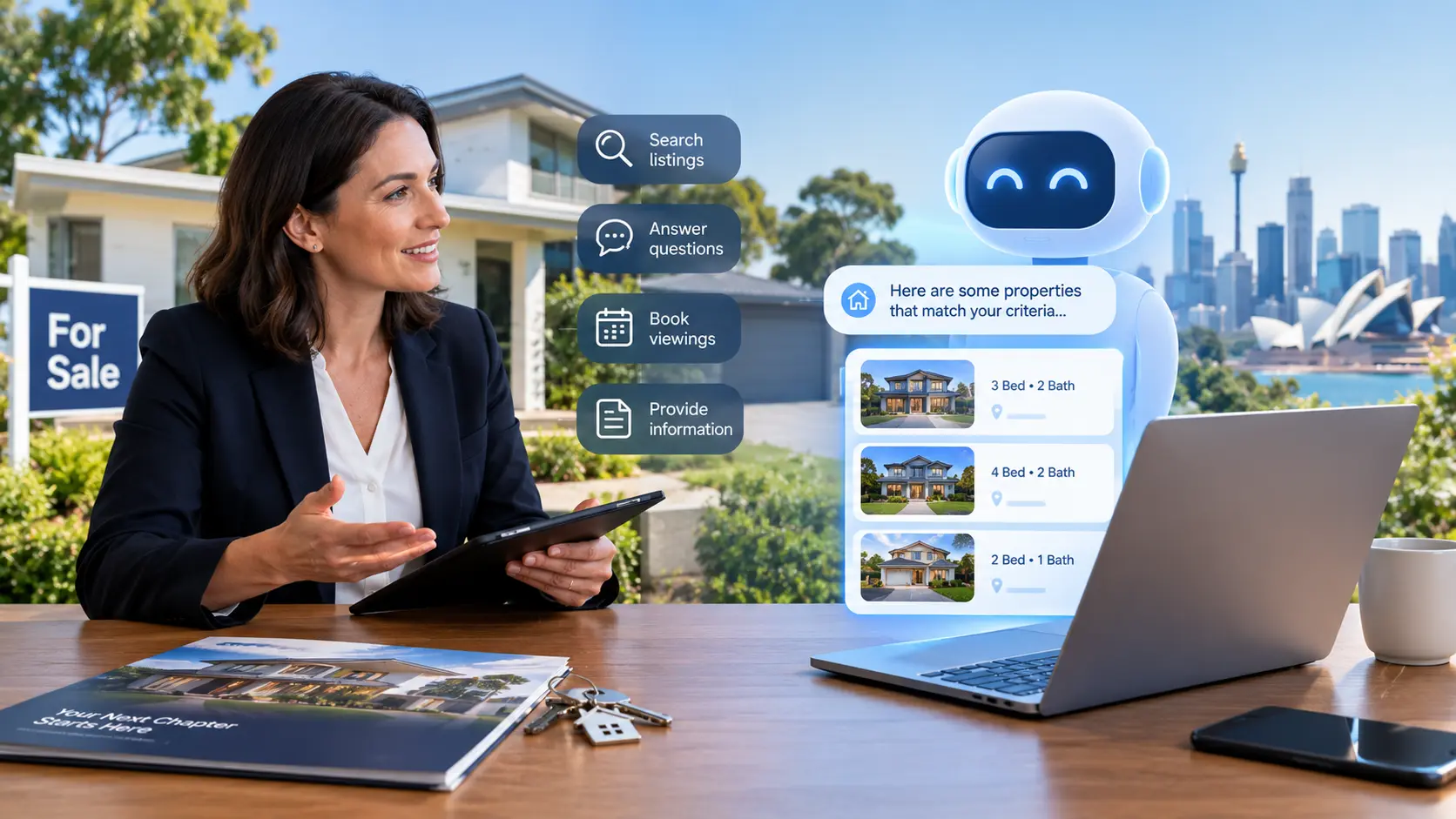
A single question on X recently set off a fierce debate. A user asked why real estate agents are still needed when AI and property websites seem to do so much of the work. The post has drawn more than a million views and over 1,500 replies since it went up on 12 October. It is a fair question in Australia too, where the agent’s commission is often the biggest cost of selling a home. So could AI replace real estate agents? We looked at what the technology already does well, and where Australian law and everyday reality still draw a firm line.
What AI Already Does Well in Property
AI in Australian real estate is no longer an experiment. Many agencies now use it for jobs that take time but need little judgement, such as:
- Writing first drafts of listing descriptions and social media posts
- Replying to portal enquiries within seconds, at any hour
- Booking inspections and following up after open homes
- Turning campaign data into reports for sellers
- Producing quick price estimates from recent sales
For buyers and sellers, this mostly shows up as faster replies and more polished marketing. We cover tools like these in our guide to best AI tools for small business, and we compared voice assistants in Best AI Call Agents for Business.
Why the Law Still Needs a Human
Selling property in Australia is a regulated activity. Each state and territory licenses the people who can act for a seller, and those licences carry duties that software cannot hold. A licensed agent must act in the client’s interest, keep proper records and answer to a regulator when things go wrong.
Price advertising shows why this matters. In New South Wales, an agent who advertises a price below their reasonable estimate of the likely selling price is underquoting, which is an offence under the Property and Stock Agents Act 2002. NSW Fair Trading’s underquoting guidance explains the record-keeping rules agents must follow. The NSW Government has also proposed lifting the penalty from $22,000 to $110,000 or three times the agent’s commission, whichever is greater. An algorithm can suggest a price, but a person has to stand behind it.
Privacy rules cover AI too
Agents handle sensitive details, from buyer finances to tenant histories. The national privacy regulator recommends that organisations avoid entering personal information, especially sensitive information, into publicly available AI tools, according to the OAIC’s guidance on commercially available AI products. It also says privacy obligations apply to both the information fed into an AI system and the output it produces. Our explainer on AI privacy rules in Australia covers what this means for consumers.
The Parts of a Sale That Resist Automation
Beyond legal duties, much of the value in a property sale is human by nature.
Negotiation is the clearest case. A skilled agent hears hesitation in a buyer’s voice, knows when to push and when to wait, and calms a nervous seller late on auction day. Auctions add pressure, with state rules shaping how bids are handled. Then there is local knowledge, like which street floods in heavy rain or why one side of a suburb sells faster. Data captures some of this, but not all of it.
Trust matters as well. Most Australians sell a home only a few times in their lives, and it is often their largest asset. Many sellers want someone accountable on the other end of the phone, not a chatbot.
What This Means for Buyers and Sellers Now
The realistic future is not agents versus AI. It is agents using AI, and that shift raises useful questions.
Sellers can ask an agency how it uses AI and whether that saves money. If software now writes the listing and answers enquiries, there may be room to negotiate commission or marketing costs. Buyers should treat automated price estimates as a starting point and compare them with recent nearby sales. Everyone should ask how an agency stores and protects personal information.
Smarter Tools, Same Accountability
AI is changing the daily work of Australian property agents faster than many people realise. It drafts, replies, schedules and crunches numbers around the clock. Yet the parts of a sale that carry legal weight and real emotional stakes still rest with licensed people who can be held to account. The smart move for buyers and sellers is to expect agents to use AI well, and to keep asking what that means for service and price.
Frequently Asked Questions
Can I sell my home in Australia without an agent?
Yes. Private sales are legal, and some online services list homes on major portals for a flat fee. You will still need a conveyancer or solicitor for the contract and settlement, and you take on marketing, inspections and negotiation yourself.
Are AI price estimates accurate?
They can be a helpful guide in suburbs with many recent sales. They struggle with unusual homes, recent renovations and fast-moving markets, where an inspection by an agent or valuer adds detail that data misses.
Do agents have to tell me when they use AI?
There is no single blanket rule. However, the OAIC’s guidance says businesses should clearly label public-facing AI tools, such as chatbots, so customers know what they are dealing with. Asking an agency directly is always reasonable.
Will AI make commissions cheaper?
It may put pressure on fees over time, since routine tasks take less effort. For now, commission is still negotiated agency by agency, so comparing quotes pays off.